The Funnel as a Hero's Journey: Mapping Content to Every Stage of the Buying Decision
The traditional funnel is built around what the business needs from the customer. The Hero's Journey funnel is built around what the customer experiences. That single reorientation changes every content decision you will ever make.

Most marketing teams can draw the funnel in their sleep. Awareness at the top, Consideration in the middle, Decision at the bottom, with Retention tacked on as an afterthought when the quarterly report asks about churn. They know which metrics belong to each stage. They know which budgets get allocated where.
What most of them cannot explain is why the content they publish at each stage so often fails to move anyone anywhere.
The answer is structural. The traditional funnel is a business model, a map of what the company wants to extract from the customer at each stage. It describes the commercial outcome of the relationship, not the human experience of it. Content built to serve a commercial outcome, rather than a human experience, is content that gets ignored - technically delivered, strategically inert.
The structural error: The traditional funnel asks "what stage is the customer at in our process?". The Hero's Journey funnel asks "what is the customer experiencing right now, and what do they need from us to take the next step on their own terms?". These are not the same question. They produce entirely different content.
The Hero's Journey framework established earlier in this series resolves this by shifting the map. Instead of building the funnel around the business's commercial stages, we can build it around the Hero's experiential stages: what they are thinking, feeling, and needing at each moment of the journey. The four stages remain the same. The content logic at each stage changes completely.

The Four-Stage Map: What the Hero Experiences and What Content Does
Each stage of the funnel corresponds to a specific moment in the Hero's Journey. Understanding that correspondence is the foundation of every content decision – from the format you choose to the hook you write to the CTA you place and the metric you use to judge whether it worked.
Stage 1 – Awareness
The Ordinary World & The Inciting Incident
The Hero does not yet know you
The Hero is living inside their problem. They have not named it yet, or if they have, they have not decided it is worth solving. They are not searching for your brand – they are scrolling, reading, existing inside a daily frustration that has not yet crossed from "annoying" to "urgent". Your content does not find them at the search bar. It finds them in the feed, in the middle of doing something else.
You have two seconds. Your content must do one thing: make The Hero feel seen. Not informed. Not persuaded. Seen. The Hook is the Inciting Incident – the moment the Ordinary World is interrupted by the recognition that things could be different.
What the Hero needs in the awareness stage:
- Recognition of their specific struggle
- Validation that it is a real problem, not a personal failure
- Curiosity, not a sales message
Content that works in the awareness stage:
- Short-form social – pain-point hooks
- Reels and Shorts – first 3 seconds do all the work
- Organic search targeting problem-aware queries
- Thought leadership placements
Stage 2 – Consideration
Evaluating the Guide
The Hero is deciding whether to trust you
The Hero has recognised their struggle. They are now evaluating whether you are a trustworthy Guide or just another brand with a polished pitch. This is the most delicate stage in the entire journey. Trust, once lost here, is rarely recovered. The Hero is not ready to buy. They are ready to learn – and learning requires that the Guide demonstrate both empathy and authority simultaneously.
The Inverted Narrative Pyramid governs every piece at this stage: value must arrive early, and the structure must reward the reader who stays. A well-built long-form article, a case study written from the Hero's perspective, a framework they can use immediately – these are the mechanisms that move someone from curious to convinced.
What the Hero needs in the consideration stage:
- Evidence you understand the problem deeply
- Proof that the transformation is real, not just claimed
- A framework – something they can hold and use
- Room to evaluate at their own pace
Content that works in the consideration stage:
- Long-form articles and deep-dive guides
- Email newsletters - trust built over repeated contact
- Case studies told from The Hero's perspective
- Webinars and educational video
Stage 3 – Conversion
Crossing the Threshold
The Hero is ready to commit
The Hero has evaluated. They have decided the transformation is worth the risk of the crossing. They are standing at the threshold, and this is where most brands lose them. Not because the offer is wrong, but because the path to commitment is unclear. The CTA is buried. The landing page is cluttered. The form asks for fourteen fields before The Hero has agreed to anything. Hesitation kills conversions - and hesitation is always caused by friction, not lack of desire.
At this stage, the content's job is not to persuade. The persuasion happened in consideration. The content's job is to remove every obstacle between The Hero's decision and the action that follows it. One clear path. One unmistakable next step. As we established in the Visual Literacy article, the CTA must be the undeniable focal point, surrounded by white space so the eye has nowhere else to go.
What the Hero needs in the conversion stage:
- Narrative satisfaction – the choice feels logical
- Risk reduction – proof others have crossed safely
- One clear, frictionless next step
- No competing CTAs
Content that works in the conversion stage:
- Landing pages – one message, one CTA
- Testimonials positioned at the threshold
- Product demos and free trials
- Retargeting for Heroes who paused
Stage 4 – Retention & Advocacy
The Return with the Elixir
The Hero has transformed – now they share it
The funnel ends at conversion. The narrative does not. In the Hero's Journey, the Hero returns to their Ordinary World - but transformed. They carry the Elixir: the new capability, the new confidence that makes the previous struggle feel like a different life. The brand's role now is not to celebrate the sale. It is to equip The Hero to succeed with the transformation - because a Hero who succeeds becomes an Advocate, and an Advocate is the most credible voice in any marketing system.
Most organisations radically underinvest here. Post-purchase emails are automated sequences written by no one in particular, in a tone that bears no resemblance to the brand voice that earned the sale. The Hero who committed to a transformation receives a transaction confirmation and a support FAQ. That is not the return with the Elixir. That is abandonment dressed as customer service.
What the Hero needs in the retention & advocacy stage:
- Confirmation the transformation was the right choice
- Practical tools to realise the full value
- Content that serves their new reality
- Others who have made the same crossing
Content that works in the retention & advocacy stage:
- Onboarding sequences in the brand's exact voice
- Tutorial content – the Elixir in practical form
- Loyalty communications built around The Hero's progress
- Referral prompts with language to share their story
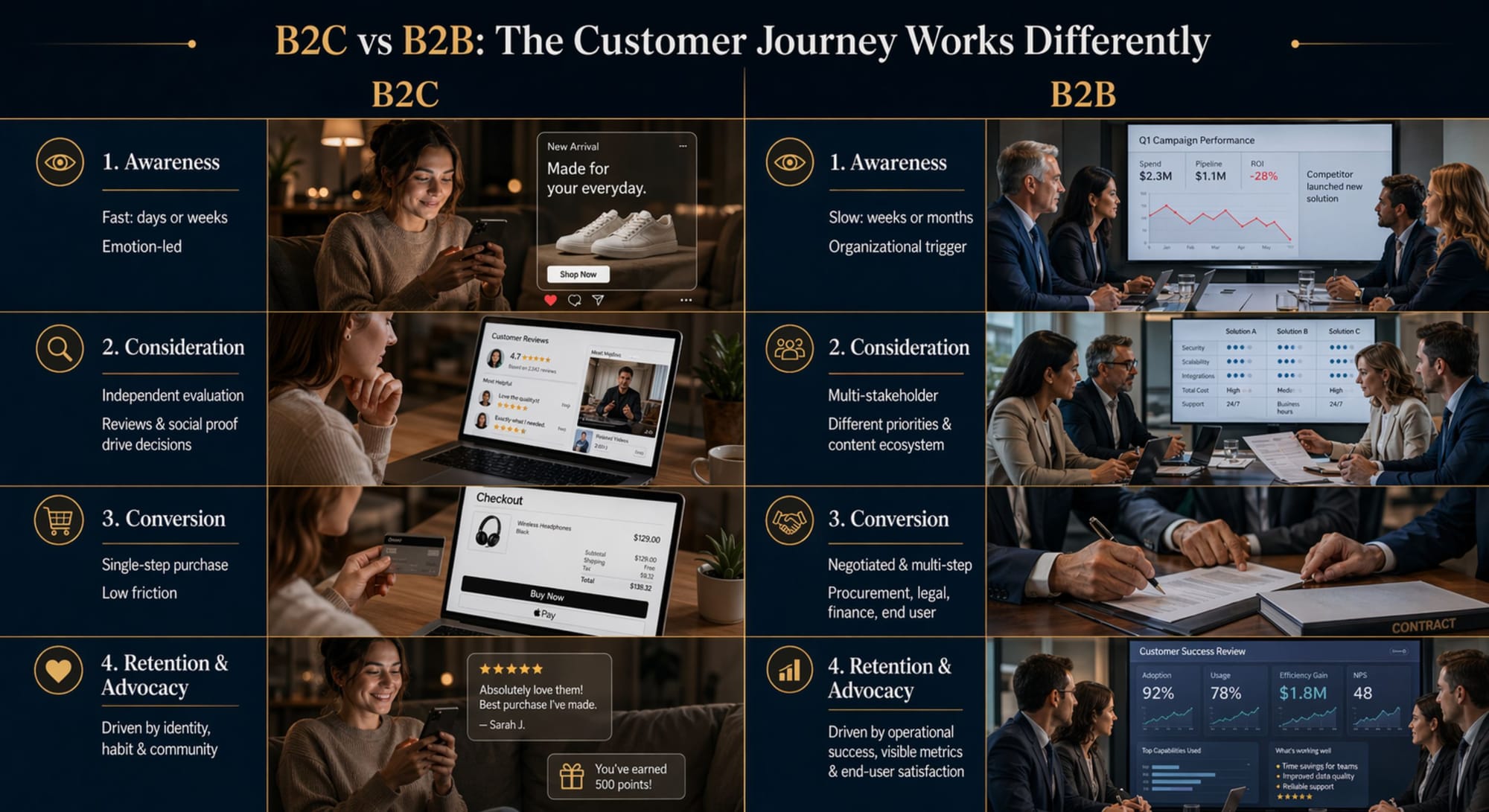
B2B and B2C: The Same Journey, Different Terrain
The four-stage map holds for both contexts. The Hero's experience is structurally identical. What differs is the duration of each stage, the number of people involved in the crossing, and the emotional register that makes content effective at each moment.
At the Awareness stage, the B2C journey moves in days or weeks. There is one Hero, one decision, and emotion is the primary trigger – a great hook can move someone from scroll to action in a single encounter. In B2B, the same stage stretches to weeks or months. Multiple stakeholders become aware at different times, and the Inciting Incident is rarely a personal emotional moment. It is an organisational one – a board meeting, a failed campaign, a competitor making a move that forces the question.
Consideration behaves differently too. In B2C, The Hero evaluates independently, guided by reviews, social proof, and the quality of your content. Trust is built fast or not at all. In B2B, the Consideration stage can last months, with multiple stakeholders evaluating simultaneously, often with conflicting priorities. The Guide must speak to the CMO's strategic concerns and the team lead's operational worries inside the same content ecosystem, which means a single piece of content rarely serves both. The editorial calendar must hold room for both.
Conversion in B2C is a single, often impulsive, crossing. Friction is the primary enemy - every additional form field, every unclear CTA, every moment of hesitation increases abandonment. In B2B, the crossing is negotiated and multi-step, involving procurement, legal, finance, and the end user. Content at this stage must reduce risk for each stakeholder type separately, not just for the primary buyer who was convinced in Consideration.
Retention follows the same structural divergence. In B2C, what sustains the relationship is emotional loyalty and habitual re-purchase: The Hero's identity becomes associated with the brand, and community belonging keeps them close. In B2B, the relationship is renewed through demonstrable operational success. The metrics must be visible, and they must be reported in language the organisation uses internally, not in the brand's marketing language. One important truth that applies to both: an unhappy end-user in B2B will cancel a contract that a satisfied procurement team already agreed to renew. The Retention stage is never just about the person who signed.
The content strategy for a B2C brand can be highly centralised: one persona, one narrative arc. The content strategy for a B2B brand must account for multiple Heroes simultaneously, each at a different stage, each with a different set of concerns. The creative brief must name which Hero, at which stage, it is serving - or it will serve none of them adequately.
Two Mistakes That Break the Funnel Narrative
Mistake #1: Writing Consideration content about the product instead of for the problem
The most common Consideration-stage failure: content positioned as educational but actually promotional. A "guide" that features the product in every third paragraph. A "how-to" that only works if you use this specific tool. A "comparison" written to confirm the brand's superiority rather than to help The Hero make a genuinely informed decision. Heroes who encounter this content recognise it immediately. They leave. And they are right to.
Mistake #2: Abandoning the narrative voice at the Retention stage
The Hero who crossed the threshold expects the brand voice they fell in trust with to continue on the other side. When the onboarding sequence is written in generic corporate language, when the support emails sound nothing like the blog, when the loyalty communications carry no trace of the narrative that earned the sale – The Hero experiences a discontinuity that quietly erodes trust. They do not always churn immediately. But they stop feeling like the protagonist of a story. They start feeling like an account number. That is the moment Retention becomes a problem.
How to Use GenAI as Your Funnel Content Architect
The most common GenAI failure in content production is using a generic prompt: "write a blog post about X for our audience". That produces content that belongs to no stage, serves no Hero's specific need, and sounds like every other brand in the category. The fix is a stage-specific prompt that tells GenAI exactly where in the journey this piece lives and what job it must do there.
Try this prompt:
You are the Senior Content Strategist and Brand Storyteller for [Brand Name].
You are producing a piece of content for a specific stage of the Hero's Journey funnel.
The Hero: [Persona name + their primary struggle in one sentence]
The stage: [Awareness / Consideration / Conversion / Retention]
The narrative job of this piece: [One sentence - what this piece must make The Hero feel, understand, or believe]
The format: [Blog article / LinkedIn post / Email / Landing page / Onboarding sequence / etc.]
The channel: [Specify]
Stage-specific instructions:
If Awareness:
- Open with The Hero's specific struggle - not the brand, not the category.
- Use one of the five hook types: Pain Point, Counterintuitive, Curiosity Gap, Stakes, or Recognition.
- The brand must not appear until The Hero has been fully recognised.
- End with a forward-pointing sentence that creates narrative tension without resolving it.
- Do NOT include a product CTA.
If Consideration:
- Lead with empathy, transition to authority.
- Deliver a named framework, a step-by-step guide, or a case study from The Hero's perspective.
- Include one practical GenAI prompt the reader can use immediately.
- End with a single soft CTA that advances the relationship.
If Conversion:
- The persuasion is already done. This piece removes friction, not objections.
- One headline. One CTA. No competing actions.
- Social proof must appear within the first scroll.
- The Special World painted in 15 words or fewer.
If Retention:
- Write as if continuing a conversation, not starting a new one.
- Reference the transformation The Hero has already committed to.
- Deliver practical value that helps The Hero succeed with what they have adopted.
- The tone must be identical to the content that earned the sale.
Brand voice: [3 adjectives]
Words we always use: [List 3-5]
Words we never use: [List 3-5]
Output: [Specify – full draft / outline / hook variations / subject line options]
Rules:
- The brand is never the protagonist. The Hero's experience opens and closes every piece.
- Every piece must belong to one stage only – no drifting.
- Flag any sentence where the brand risks becoming the protagonist instead of the Guide.
Save this as the master funnel prompt in your team's GenAI toolkit. Adapt the stage-specific section for each brief. Run three variations per piece before choosing: the first output is the average, the third is where the specificity starts to compound.
Validate the result. GenAI applies the structure. It does not know your market, your Hero's exact language, or the cultural context that makes a particular hook land. Use your marketing expert lens, GenAI provides the architectural scaffolding, you provide the strategic intelligence that makes it true.
Final Thought
The funnel has not changed. Awareness, Consideration, Conversion, Retention - those four stages will be on every marketing slide deck for the next decade. What changes when you rebuild the funnel as a Hero's Journey is not the structure. It is the orientation. Every content decision stops being about what the brand wants the customer to know, and starts being about what The Hero needs to feel, believe, and experience before they will take the next step.
That reorientation is what this entire series has been building toward – from the buyer persona that gave The Hero a name, through the brand governance that gave The Guide a voice, to the content calendar that gave the story a rhythm. The funnel is the map. The Hero's Journey is the compass. Together, they tell you not just where the customer is, but what they are living through, and how to build the content that makes the crossing feel possible.
Is your funnel a commercial pipeline designed for your business or a narrative arc designed for your customer?
Recommended Use Cases:
 Diana Socaciu