The Anatomy of Action: Turning Vague Business Goals into High-Performance Creative Briefs
Turn vague business goals into high-performance creative briefs. Learn a practical framework and GenAI prompts to sharpen briefs and cut revisions.

We've all been there: a project kicks off with a goal like "generate more leads" or "increase brand awareness". While these are essential business objectives, they are nearly impossible for creative teams to act upon - because they describe what the business wants, not what the customer needs to feel.
A vague brief often leads to expensive revisions, misaligned content, and frustrated teams. To get high-performing creative work – especially as we use GenAI to scale content production – we need to master the art of translation. We must turn a "what" (the business result) into a "how" (the creative spark that moves people to act). In this article, I'll walk you through the framework I use to write briefs that give creative teams a destination rather than a list of ingredients, and how GenAI can pressure-test your thinking before a single designer or writer touches the project.
Why Most Briefs Fail Before the Work Begins
The most common point of failure in the creative process isn't a lack of talent. It isn't budget. It isn't even time. It's a lack of clarity at the very start, in the document that's supposed to prevent all the problems downstream: the creative brief.
When a brief is weak, it creates a cascade of issues:
- Designers interpret the objective visually in completely different directions
- Copywriters default to generic product descriptions because they don't know what emotional outcome they're driving toward
- Feedback rounds multiply, not because the work is bad, but because nobody agreed on what "good" looked like
- GenAI tools, fed a vague brief, produce technically correct but emotionally inert content
A sharp brief doesn't constrain creativity. It focuses it - the same way a camera lens doesn't limit what you can photograph, it determines what you choose to make sharp.
The Creative Brief as a Translation Layer
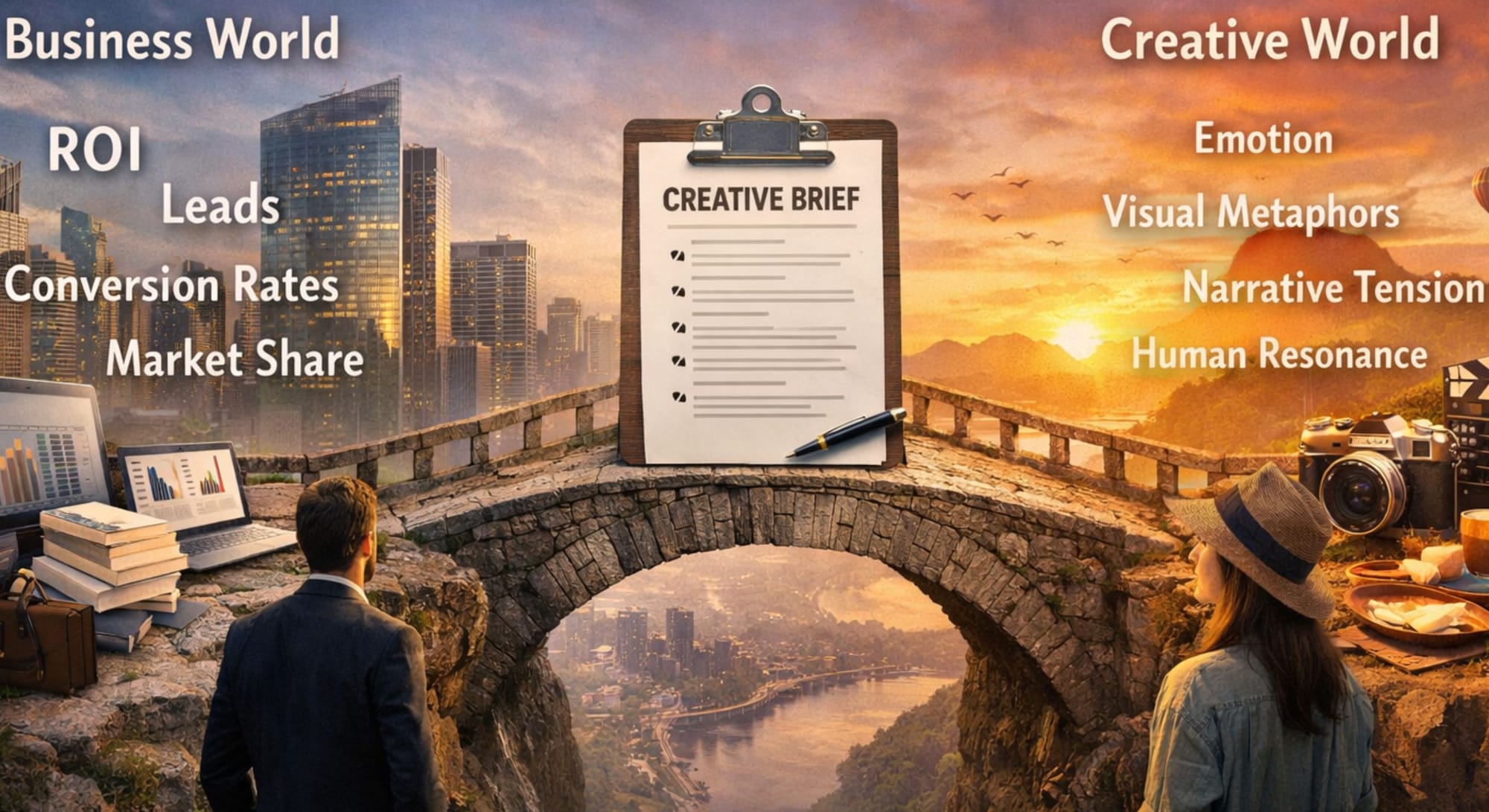
Think of the creative brief as a bridge. On one side sits the Business World - ROI, leads, conversion rates, market share. On the other side sits the Creative World: emotion, visual metaphors, narrative tension, and human resonance. The brief is the only document that speaks both languages simultaneously.
To be effective, every brief must answer three fundamental questions:
1. The Context: Why are we doing this right now? What is the market moment, the business pressure, or the opportunity that makes this campaign necessary today and not six months ago?
2. The Obstacle: What is standing in the way of the customer taking action? Not "why don't they know about us yet", but what specific belief, fear, habit, or competing priority is preventing them from choosing us?
3. The Transformation: How do we want the customer to feel after seeing this? What emotional state are we trying to create, and how is it different from how they felt before?
If your brief cannot answer all three questions with specificity, it is not ready to go to a creative team, and it is certainly not ready to be fed into GenAI.
Business Wishlist vs. Strategic Blueprint
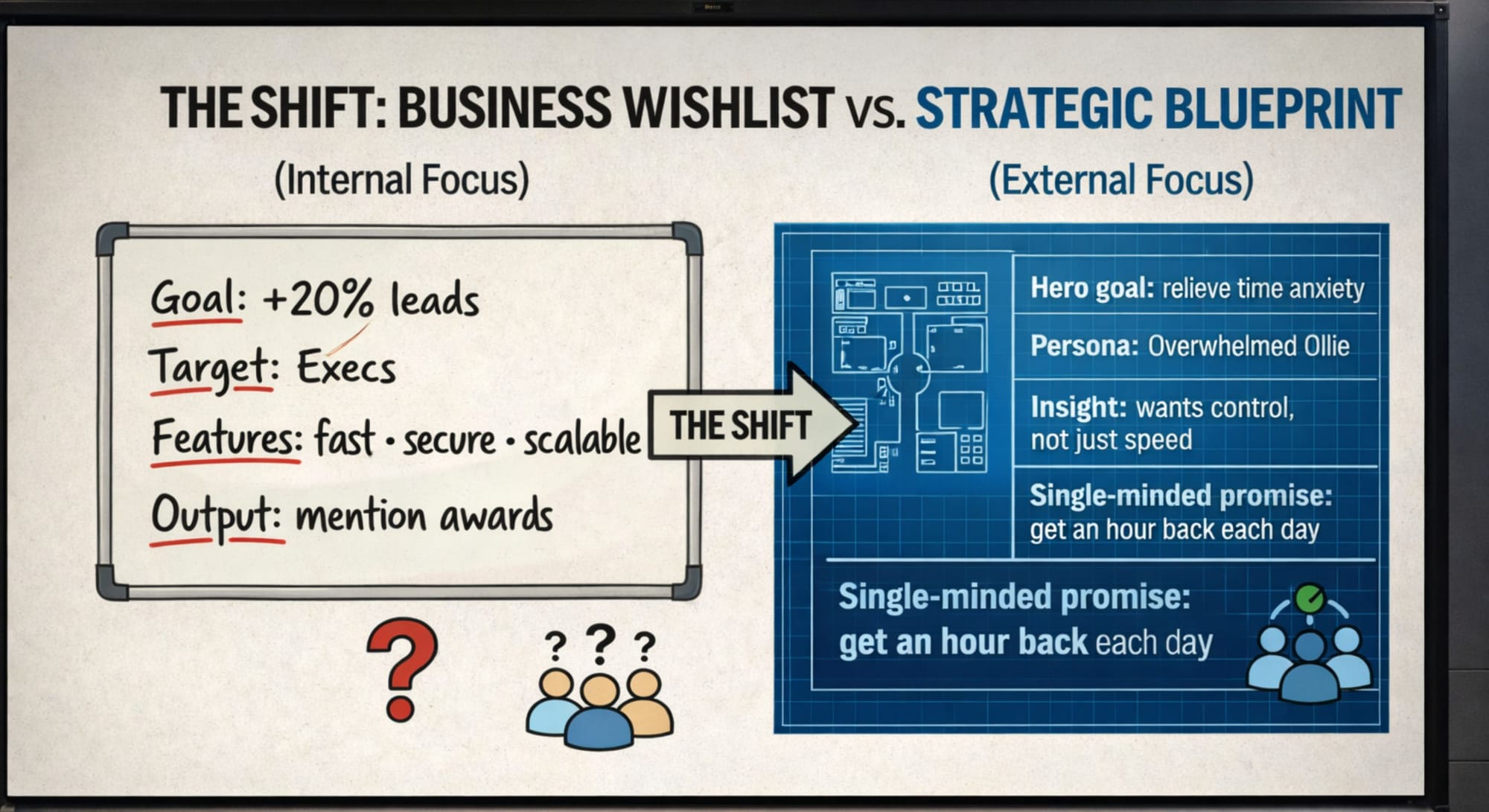
There are two fundamentally different ways to write a creative brief. One of them produces generic content. The other produces work that converts.
The Business Wishlist  | The Strategic Blueprint  |
|---|---|
| Perspective: Internal KPIs and company needs | Perspective: The Hero's (Customer's) emotional reality |
| Content: Features, technical specs, broad demographics | Content: Specific emotional obstacle + Single-Minded Proposition |
| Problem it creates: Generic, brand-centric content that tells the team what to say but not why the customer should care | Result: Gives the creative team a "problem to solve" rather than a "list to mention", creating space for storytelling that actually converts |
| Example: Objective: "Get more leads." Target: "Men aged 25-45." Message: "Our software is fast and reliable." Output: A list of features to mention. | Example: Objective: "Solve the Hero's anxiety about X." Persona: "Commuter Chris, who feels out of control." Insight: "Chris isn't looking for speed; he's looking for 5 minutes of peace." Single-Minded Proposition: One clear reason to act. |
The Strategy: Don't tell a creative what to say. Tell them what you want the audience to do, and why they currently aren't doing it.

The Creative Compass: Three Tools for Brief Precision
Once the brief exists, a second problem emerges: how do you keep the creative work on track once it's in motion? Good ideas are seductive. Teams get excited. Concepts multiply. And before long, the work is "cool" but completely disconnected from the original business objective.
The Creative Compass gives you three anchors that prevent this drift:
The Insight (True North)
The hidden truth about the customer's reality. You don't invent it - you find it in data, conversations, reviews, and behavior. If your work isn't aligned with True North, you're off course from the start.
The Single Minded Proposition (The Heading)
The SMP (Single-Minded Proposition), the one specific direction you've chosen to travel. You cannot go North and East simultaneously. The SMP ensures everyone moves toward the exact same point.
The Proof (Map Credibility)
Why should the Hero trust you? This is the data, evidence, or social proof that confirms your path will actually lead to their victory. Without proof, your SMP is just a claim.
The Creative Compass works alongside the brief, not instead of it. The brief defines the destination; the Compass keeps the team oriented throughout the journey.
What a Weak Brief Costs You (In Real Terms)
Let's make the stakes concrete. A single misaligned campaign doesn't just waste the creative team's time, it compounds across the entire production pipeline:
- Revision rounds: Each round of feedback on misaligned work costs 2-5 hours of senior time. Multiply by 3 rounds, 4 stakeholders, and 6 assets.
- Opportunity cost: The time spent correcting misaligned work is time not spent on the next campaign.
- GenAI waste: If you feed a vague brief into AI tools, you get fast, polished, wrong content, and then spend more time correcting AI output than it would have taken to write it manually.
- Team morale: Talented creatives who consistently receive unclear direction stop investing their best thinking, because they've learned it will be redirected anyway.
The hidden cost: A vague brief doesn't just produce bad work, it produces work that looks finished but doesn't perform. That's the most expensive outcome: spending the budget, launching the campaign, and getting nothing back.
Common Brief Mistakes (and How to Fix Them)
Mistake #1: Listing objectives instead of insights
An objective tells the team what the business wants. An insight tells the team what the customer is experiencing. "Increase trial sign-ups by 20%" is an objective. "First-time users abandon the product because they feel stupid in the first 10 minutes" is an insight. One of these produces a coupon. The other produces an onboarding experience that changes behavior.
Mistake #2: Writing for everyone
If the brief says "Target: All decision-makers in mid-size companies", the creative team has no human to write for. The brief must name a persona – a specific human with a specific problem – even if the campaign will eventually reach thousands of people. Writing for one person's emotional truth reaches many. Writing for a demographic segment reaches no one.
Mistake #3: Multiple single-minded propositions
The word "single" in Single-Minded Proposition is not decorative. Every time a brief lists three key messages, the creative team faces an impossible choice, or tries to include all three and produces diluted work. If you can't choose one message, your brief is actually three briefs. Split them, or go back to strategy.
How to Use GenAI to Pressure-Test Your Brief
GenAI is the ultimate "Brief Architect". You can use it to find the holes in your logic before the brief ever reaches a designer or writer, and before any budget is committed to a direction that won't work.
The Strategy: Use GenAI to play Devil's Advocate. Ask it to find weaknesses in your reasoning or to suggest a more emotionally resonant Insight based on your persona data.
Use this prompt to stress-test any brief:
You are a Senior Creative Strategist with 20 years of experience writing high-performance creative briefs.
I will share a creative brief with you.
Brief: [Paste your brief here]
Your task is to:
1. Identify the 3 weakest points in this brief – where is the thinking vague, generic, or unclear?
2. Challenge the Insight: Is this a real human truth or a business assumption dressed up as one?
3. Challenge the SMP: Is this truly single-minded, or is it trying to say two things at once?
4. Suggest one stronger, more emotionally specific version of the Insight.
5. Confirm what is working well and should be kept.
Run this before every brief goes to a team. The 15 minutes it takes will save days of revision.
The "Vague-to-Vivid" Transformer: A Practical Exercise
Once your brief is sharp, you can use GenAI to translate it into creative hooks – the opening lines that stop the scroll, open the email, or make someone pause on an ad.
Step 1: The Setup
Take a business goal you currently have (e.g., "Promote our new webinar").
Step 2: The Prompt
We are writing a series of hooks for [Project Name].
The Hero: [Insert Persona Name and their primary emotional state].
The Problem: [Insert specific pain point – internal, not functional].
The Guide's Tool: [Insert your product/service – one sentence].
Task: Generate 5 hooks (for LinkedIn, Email Subject Line, and Ad Copy) that:
1. Start with the Hero's internal frustration (not the product feature).
2. Create a Curiosity Gap about the solution - hint at transformation without giving it away.
3. Avoid clickbait by using an Empathetic and Authoritative tone.
4. Stay under 15 words each.
Output format: Present each hook with the channel label and a one-sentence explanation of the emotional mechanic it uses.
Step 3: Validate the result
Use your own expertise and judgment to evaluate the output. Does it sound like your brand? Does it match the persona's emotional reality? Would it stop you if you saw it in your feed? When in doubt, edit using your marketing expert lens – GenAI provides the volume, you provide the judgment.
The Brief as a Force Multiplier
A brief is often the most important document a marketing team produces – yet it's consistently the least invested in. We spend weeks on campaign execution and hours on strategy decks, but the brief that connects the two gets written in 20 minutes on a Friday afternoon.
When a brief is weak, it's a drag on every person and tool downstream: designers, writers, AI tools, media buyers, and stakeholders. When it's sharp, it becomes a force multiplier - aligning everyone around the same human truth, the same emotional destination, the same creative north.
Final Thought
The brief doesn't limit creativity. It gives creativity a problem worth solving. Every piece of content in this series – from buyer personas to brand voice to narrative structure – leads to this moment: the brief where strategy becomes execution.
Are we giving our teams a destination - or just a list of ingredients?
Recommended Use Cases:
 Diana Socaciu