From Strategy to Calendar: How Narrative Governance Works in Practice
You have the strategy, the personas, the narrative spine, and the funnel map. Here is the translation system that turns all of it into a content calendar that actually runs - week after week, without losing the thinking that built it.

We have all been in that room. The strategy offsite went well. The whiteboards were full. The personas were named, the narrative spine was written, the funnel stages were mapped to content types, and everyone left aligned. There was a photograph of the whiteboards. Someone said they would build a deck from it by the end of the week.
Two weeks later, someone sends a Slack message asking what to post on LinkedIn tomorrow 😄. And just like that, every hour of strategic thinking disappears into the same reactive publishing queue that was the problem before the offsite happened.
This is not a discipline problem. It is a translation problem. The strategy was built in one language (frameworks, principles, narrative arcs) and the calendar is being built in another language entirely – formats, deadlines, and whoever is available. Nobody built the bridge between them. This article builds that bridge.
The Governance Gap
Most content calendars are publishing schedules dressed up as strategy. They contain dates, formats, titles, and assignees. What they do not contain, and what separates a calendar from a governance system, is the strategic logic behind every entry. Why this topic, at this stage of the funnel, for this persona, in this format, on this channel, this week.
Without that logic embedded in the calendar, every new piece of content is a fresh creative decision. The team looks at next Tuesday's blank entry and asks: what should we write about? That question is the moment the strategy stops existing. Because the answer is never found in the strategy document. It is found in the Slack thread, in the competitor's latest post, in whatever the CEO mentioned in the all-hands last Thursday.
The governance gap: A content calendar without embedded strategic logic is a to-do list. A content calendar with embedded strategic logic is a narrative governance system. The difference is not the tool - it is whether calendar entries answer "why this?" before anyone asks "what next?".
In an earlier article, I described how a narrative governance calendar looks like. That article explained the destination. This one maps the route.

The Three Translation Layers
Moving from strategy to calendar is a three-layer process. Skip any layer and the calendar reverts to a publishing schedule.
Layer 1 – Strategic Inputs
Everything the calendar needs to govern itself already exists in the work you have done across this series. The buyer persona governs who every piece is written for. The Narrative Spine governs whether a content idea earns its place – if it cannot be traced to the Spine, it does not enter the calendar. The funnel stage map governs the hook, the CTA, and the success metric for every single entry. The brand manual governs the voice. These inputs do not live in a strategy document nobody reads after the offsite. They live inside the calendar, as named fields that must be completed before any entry moves to production.
Layer 2 – Governance Rules
Five explicit criteria every calendar entry must pass before it moves from idea to brief to production. The Persona Rule: every piece serves one named persona, never "everyone". The Spine Rule: every piece is traceable to a specific fragment of the Narrative Spine - Ordinary World, transformation, or Special World. The Stage Rule: every piece serves exactly one funnel stage, and that stage governs the entire brief. The Distinction Rule: every piece reinforces the brand's positioning distinction - generic content that passes the other four rules still fails this one. The Brief Rule: no brief, no production. This is the rule most often abandoned under deadline pressure. It is also the one whose violation is most expensive to fix after the content is published.
Layer 3 – The Operational Calendar
Once the inputs are mapped and the rules applied, the calendar stops being a scheduling tool and starts being an operating system. Every entry contains not just what is being produced and when - but why it belongs in the narrative, who it serves, which stage it occupies, and which metric will determine whether it did its job. Most teams run Layer 3 without Layers 1 and 2. The calendar is technically full. The strategy is not present in a single entry.
What a Governed Entry Actually Looks Like
The difference between a publishing schedule and a governed calendar is not complexity. It is specificity. Here is the same article entry, written both ways.
| ❌ Publishing Schedule Entry | ✅ Governed Calendar Entry |
|---|---|
| Title: "How AI Is Changing Retail Marketing" Date: 29 Apr Format: Blog article Owner: Content team | Title: "How AI Is Changing Retail Marketing" Date: 29 Apr · Format: Long-form article Persona: Emma, Head of Marketing, omnichannel retailer, 80–200 stores Stage: Awareness - Ordinary World Spine fragment: Naming the AI adoption struggle before the framework arrives SMP: AI in retail is not a technology problem. It is a brand coherence problem hiding behind a technology budget. Success metric: Time on page >4 min · LinkedIn saves · Newsletter sign-ups Brief status: Approved · Owner: DS |
Both entries produce an article. Only one of them produces a governed piece of narrative content.
The SMP - Single-Minded Proposition - is the key distinction. A topic tells you what to write about. An SMP tells you what the content must make the reader believe by the time they finish reading it.
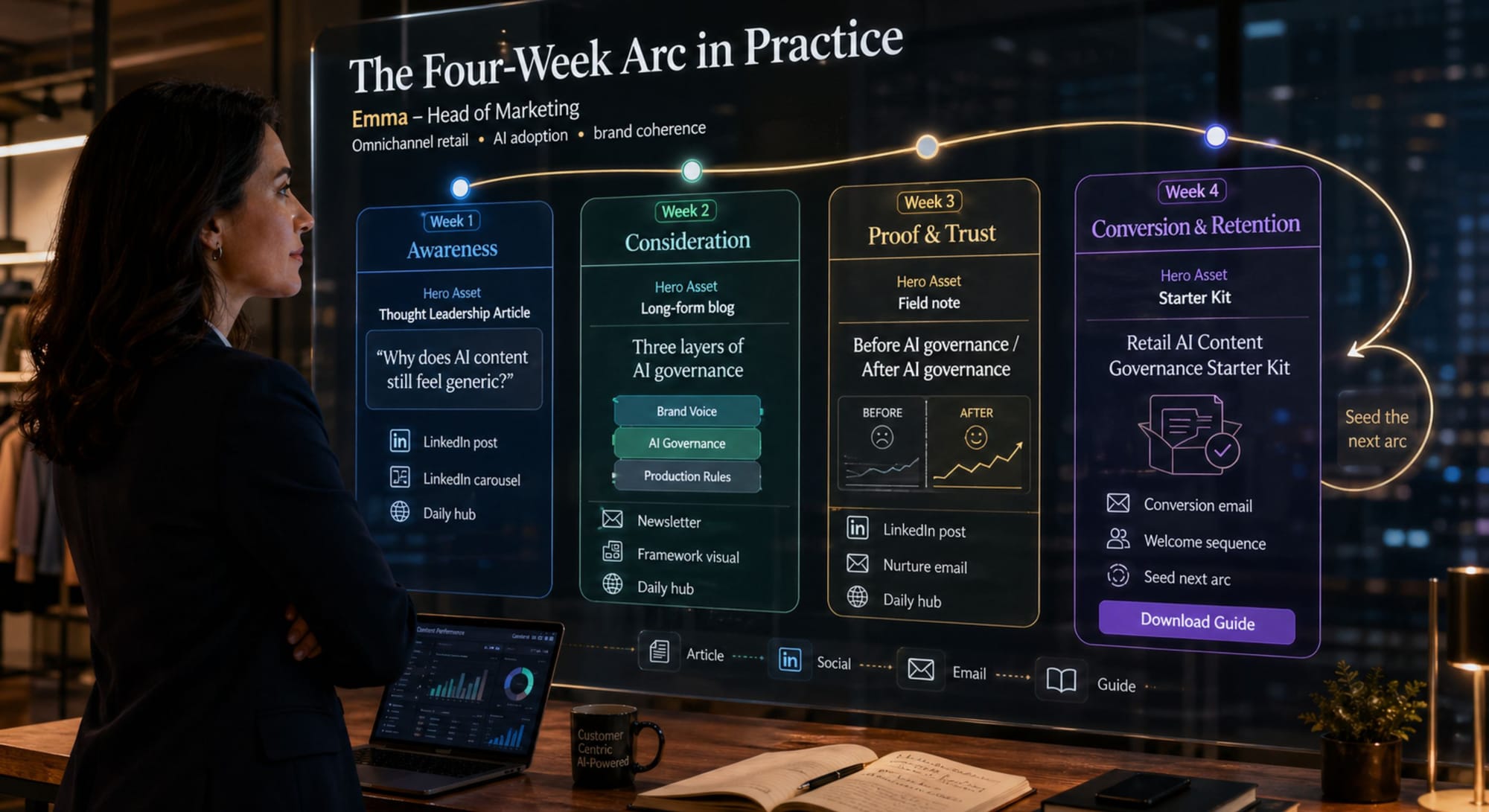
The Four-Week Arc in Practice
Four weeks is one complete narrative arc - long enough to move a Hero from first encounter to conversion decision, short enough to plan with genuine specificity. Place the Hero Asset first in each week. Every other piece that week is a derivative or a pointer. Here is what a governed arc looks like for a retail brand publishing thought leadership on AI - whose Hero is Emma, Head of Marketing at a mid-size omnichannel retailer navigating AI adoption without losing brand coherence.
Week 1 – Awareness
- Naming the Ordinary World Hero Asset
Thought Leadership Article · Long-form article
"Your retail brand has adopted five AI tools this year. Why does your content still feel generic?" Opens the struggle. The solution does not appear yet. - Supporting
Social · LinkedIn post
Pain-point hook extracted from the article: the specific moment Emma realises AI output is indistinguishable from a competitor's. One struggle, named precisely. - Supporting
Social · LinkedIn carousel
"5 signs your AI content strategy is producing volume without brand coherence" – derived from the Hero Asset. Each slide names one symptom Emma recognises immediately. - Daily Hub
Social · Short-form post
"The problem with AI in retail marketing is not the output. It is that nobody told the AI what the brand believes". No CTA. Seeds the curiosity gap for Week 2.
Week 2 – Consideration
- Introducing the Framework Hero Asset
Blog · Long-form article
"The three layers of AI governance every retail brand needs before scaling content production" - with a GenAI prompt Emma can use with her team this week. - Supporting
Email · Newsletter
Framework summary for subscribers. One immediate action. Links to the full article for the reader who wants the full thinking. - Supporting
Social · LinkedIn post
The framework as a visual: Brand Voice Layer → AI Governance Layer → Production Rules Layer. The hierarchy in one image. - Daily Hub
Social · Short-form post
"The retail brands getting the most from AI are not the ones with the biggest tech stack. They are the ones with the clearest brand rules". Opens the gap. Does not close it.
Week 3 – Consideration
- Proof and Trust Hero
Asset · Field note
"What happened when a 120-store fashion retailer ran AI-generated campaign copy without a brand governance layer" - written from Emma's perspective, not the technology vendor's. - Supporting
Social · LinkedIn post
"Before AI governance / After AI governance" contrast. Same campaign brief, different results. The transformation made concrete in two columns. - Supporting
Email · Nurture email
Sent to readers who engaged with Week 2. Names Emma's specific fear - AI making the brand sound like every other retailer. Points to the field note. - Daily Hub
Social · Short-form post
"A brand voice document reduces AI content revision cycles by 60%. Not because AI gets better. Because the brief gets clearer". Specific outcome. No hedge.
Week 4 – Conversion & Retention
- Closing the Arc
Hero Asset · Downloadable Guide / Gated framework guide
"The Retail AI Content Governance Starter Kit" - a one-page framework Emma's team can implement in a day. One CTA. Gated by email. The Special World made tangible. - Supporting
Email · Conversion email
Sent to readers who engaged with Weeks 2 and 3. Names the Inciting Incident: the board meeting where someone asked why the AI content sounds off-brand. One link. One ask. - Retention Welcome
Email · Post-download email sequence
For Emma - the Hero who downloaded the kit. Email 1: how to use it. Email 2: the most common governance mistake in week one. Written in the brand's exact voice throughout. - Seed Awareness
Social · LinkedIn post
"Most retail brands using AI for personalisation are personalising the wrong thing". Seeds the next arc. Names a new Ordinary World. Restarts the journey for the next segment.
Three Mistakes That Break the Calendar
Mistake #1: Building the calendar before completing the strategic inputs
The most common failure sequence: the team decides to "get organised" and builds a calendar structure – tabs, columns, colour coding – before the persona is documented, the Narrative Spine is written, or the funnel stages are mapped. The result is an immaculate calendar architecture that governs nothing. The calendar should always be the last tool built, not the first.
Mistake #2: Allowing the calendar to become the strategy
This is the most insidious failure mode because it looks like success. The calendar is full, the team is producing consistently, the metrics are growing, and nobody has looked at the Narrative Spine in three months. Topics are chosen because they performed well last month, not because they serve the Hero's next step in the journey. The calendar is running. The strategy is not.
Mistake #3: Skipping the seed entry that starts the next arc
Every four-week arc should end with an entry that seeds the beginning of the next one, a piece of Awareness content that introduces the next Ordinary World struggle. Without this seed, the calendar runs four strong weeks and then goes silent while the team decides what to do next. The silence is not a production problem. It is a governance problem. The narrative stopped. The audience noticed, even if they could not name why.
How to Use GenAI as Your Calendar Translation Engine
The translation from strategy to calendar is exactly the kind of structured, repetitive reasoning task where GenAI adds genuine operational value, not by generating content ideas, but by applying the governance logic you have already built to evaluate, assign, and brief every entry before it enters production.
Use this prompt:
You are the Content Governance Lead for [Brand Name].
Your role is to evaluate content ideas against the brand's strategic inputs and translate approved ideas into fully governed calendar entries.
The Strategic Inputs:
Narrative Spine: [Paste the one-sentence Spine]
Primary Persona: [Name + one-sentence description]
Funnel Stage Distribution Target: [e.g., 30% Awareness / 40% Consideration / 20% Conversion / 10% Retention]
Positioning Distinction: [The one thing this brand owns that competitors cannot credibly claim]
Brand Voice: [3 adjectives]
The 5 Governance Rules:
1. Persona Rule: Every entry must serve one named persona.
2. Spine Rule: Every entry must be traceable to a specific fragment of the Narrative Spine.
3. Stage Rule: Every entry must serve exactly one funnel stage.
4. Distinction Rule: Every entry must reinforce the positioning distinction - not just be "relevant".
5. Brief Rule: Every entry must have an SMP before moving to production.
TASK: Evaluate each content idea below.
For each one:
Step 1 – Governance Check: Apply all five rules. Fail early – if a rule breaks, explain why and stop.
Step 2 – Stage Assignment: Assign to the correct funnel stage. One sentence of reasoning.
Step 3 – Brief: Named persona + struggle · Stage + narrative job · SMP · One action · Success metric.
Step 4 – Calendar Entry: Title | Date | Format | Persona | Stage | SMP | Owner | Metric | Brief Status
Content ideas to evaluate: [List ideas here]
Rules:
- Reject ideas that cannot pass all five rules. Fewer governed entries beat a full calendar of ungoverned noise.
- The SMP must be a claim, not a topic. "Why AI content fails in retail" is a topic. "AI content fails in retail because the brief precedes the brand rules" is an SMP.
- Flag any entry where the Distinction Rule produces a generic SMP - the most common governance failure.
Feed this prompt the ideas from your team brainstorm. What comes back is not a calendar - it is a governed shortlist.
The ideas that survive all five rules become calendar entries with briefs already drafted. The ideas that fail show you exactly where the team's instinct is pulling away from the strategy.
Validate the result. Use your own expertise and judgment before acting on any output. GenAI applies the governance rules you give it, but t does not know whether those rules still reflect your latest positioning or the competitive shifts that happened last month. You provide the strategic currency. GenAI provides the governance structure.
Final Thought
Strategy that lives only in documents is not strategy. It is intention. The gap between intention and execution is not closed by discipline or better project management tools. It is closed by a translation system – the five governance rules that connect every calendar entry back to the thinking that built it, applied week after week without exception.
The fifteen articles before this one built the strategic foundation. This article builds the bridge. The next articles in this series build the system on the other side – the Hero Asset Model, the Content OS, the production workflows that make great strategy sustainable at real-world scale. The bridge only works in one direction. Strategy to calendar. Never the other way around.
Is your content calendar governing your narrative or is your publishing schedule governing your strategy?
Recommended Use Cases:
 Diana Socaciu