Brand Narrative Architecture: How to Build a Story That Scales
The Hero's Journey is the philosophy. Brand Most brands have a story. Very few have a story that stays coherent when the team grows, the channels multiply, and the message gets handed to twelve different people with twelve different interpretations.

In an earlier article I wrote about why brands need the Hero's Journey framework - how making your customer the hero and your brand the guide is the structural shift that turns generic content into something people actually care about. That framework tells you the shape of a brand story.
But knowing the shape is not the same as having an architecture. A story is a single instance. A narrative architecture is the system that produces consistent, coherent stories across every channel, team member, campaign, and piece of content your brand puts into the world. One you can write in an afternoon. The other takes deliberate design - and without it, even the best-intentioned teams produce messaging that drifts, fragments, and gradually loses the thread. This article is about building the architecture, not just telling the story.
The Difference Between a Brand Story and Brand Narrative Architecture
A brand story is a single, well-told narrative. It has a beginning, a middle, and an end. It is the story of why the company exists, what problem it solves, and what the world looks like when the customer succeeds with its help. Every brand needs one.
Brand Narrative Architecture is the system that makes the brand story scalable. It is the set of structural decisions that allow ten different people or ten different GenAI prompts - to produce content that all sounds like the same brand telling the same story, even when the format, the channel, the audience segment, and the content type are completely different.
The architectural rule: A brand story without narrative architecture is a painting without a frame. Beautiful in isolation. Impossible to reproduce at scale without losing what made it meaningful.
The distinction matters most at the exact moment most brands are experiencing it: when they begin scaling content production, when they adopt GenAI tools, when they expand their team, or when they bring on external agencies. These are the moments when narrative coherence either holds - because the architecture exists – or fragments – because the architecture was never built.
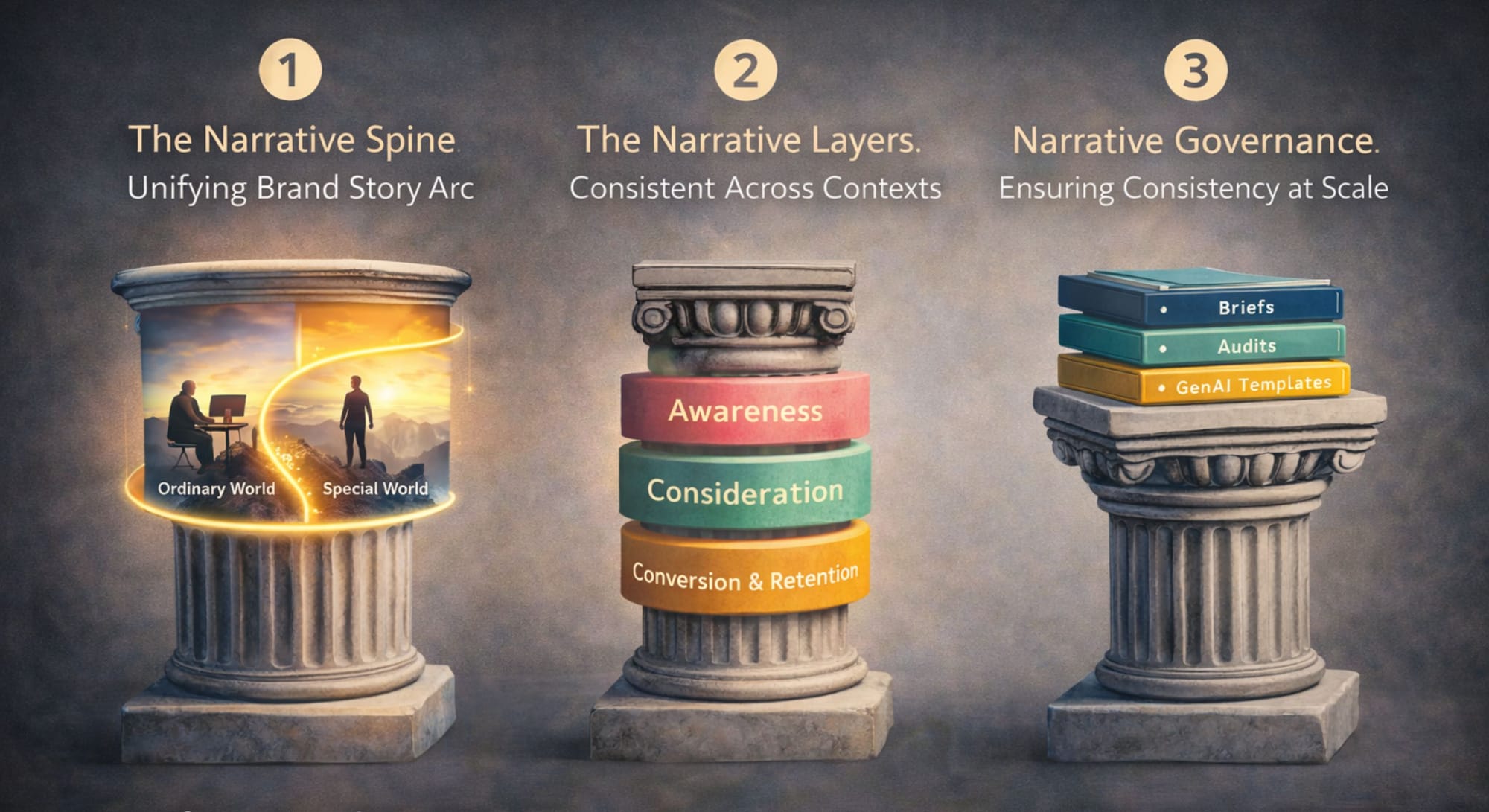
The Three Pillars of Brand Narrative Architecture
Pillar 1 – The Narrative Spine
The Story Everything Connects To
The Narrative Spine is the single story arc that sits at the centre of every piece of content your brand produces. It is not a tagline. It is not a mission statement. It is the complete narrative expressed in one sentence that contains four elements: who The Hero is, what Ordinary World they are currently living in, what transformation your brand enables, and what their Special World looks like when they succeed.
Every piece of content - a LinkedIn post, a whitepaper, a product page, a sales email, a 60-second Reel - is a fragment of this Spine. Some pieces express The Ordinary World. Others express the transformation. Others paint The Special World. But they all connect to the same central story, which means a reader who encounters your content across multiple channels over multiple weeks receives a coherent narrative, not a collection of unrelated messages.
The Narrative Spine Formula
"[The Hero] is currently living in [The Ordinary World, their specific struggle]. With [The Guide's approach], they cross the threshold into [The Special World, the specific transformation]. Every piece of content this brand produces is a step on that crossing.
Example for a marketing strategy blog: "Marketing leaders in scaling organisations are drowning in tactical execution while their strategy fragments. With documented frameworks and a GenAI stack that enforces them, they move from reactive operators to architects of a system that compounds. Every article is a step on that crossing."
The test of a well-built Narrative Spine is simple: read any piece of content your brand has produced in the last 90 days and ask whether it clearly belongs to this story. If the answer is yes for most pieces and no for some, the Spine exists but is not being enforced. If the answer is unclear for most, the Spine has not been built.
Pillar 2– The Narrative Layers
How the Story Adapts Without Fragmenting
A single story must express itself differently across different channels, audiences, and content types - without losing its essential character. This is the function of the Narrative Layers: they define the rules for how the Spine adapts to different contexts while remaining recognisably the same story.
There are three Narrative Layers every brand needs to define:
- The Awareness Layer – how the Spine is expressed in content designed to interrupt and capture attention. At this layer, the story focuses almost entirely on The Ordinary World: the Hook that names the struggle so precisely that The Hero recognises themselves. The brand is barely present. The problem is everything.
- The Consideration Layer – how the Spine is expressed in content designed to build trust and authority. At this layer, the story moves into the transformation: the framework, the methodology, the evidence that the crossing is possible. The brand emerges as The Guide. The tone shifts from empathetic to authoritative.
- The Conversion and Retention Layer – how the Spine is expressed in content designed to close the loop and sustain the relationship. At this layer, the story completes: The Hero has crossed the threshold, The Special World is real and accessible, and the brand's role is to equip The Hero to maintain the transformation. Tone: practical, warm, direct.
The Narrative Layers are not three separate stories. They are three expressions of the same Spine, calibrated for where The Hero is in their journey. A brand that treats Awareness content and Retention content as separate strategic exercises (with separate briefs, separate voices, and no narrative continuity between them) is not telling a story. It is running a sequence of disconnected campaigns.
Pillar 3 – Narrative Governance
The System That Keeps the Story Consistent at Scale
The Narrative Spine defines what the story is. The Narrative Layers define how it adapts. Narrative Governance is the operational infrastructure that ensures both are actually applied: consistently, across every team member, agency, freelancer, and GenAI tool that produces content on behalf of the brand.
Narrative Governance is built from three components:
- The Narrative Brief – a one-page document that every piece of content must be traceable to. It names the Spine, identifies which Narrative Layer the piece belongs to, specifies The Hero and their current stage in the journey, and defines the single narrative job of this specific piece. If the brief cannot answer these four questions, the content should not be written yet.
- The Narrative Audit – a quarterly review of all published content against the Spine. Which pieces clearly belong to the story? Which fragment it? Which are narratively orphaned - technically on-brand but not connected to the central arc? The Audit is not a punishment. It is a calibration mechanism that keeps the story honest over time.
- The Narrative Prompt Library – a set of GenAI prompt templates, pre-loaded with the Spine, the Layers, and the brand's specific vocabulary, that any team member can use to produce content that is architecturally sound before a single editorial decision is made. This is the component that makes Brand Narrative Architecture genuinely scalable in the GenAI era.
Narrative Governance is the bridge between the Brand Manual and the Content Calendar. The Brand Manual defines the laws. The Content Calendar enforces the rhythm. Narrative Governance ensures that everything published between those two structures actually belongs to the same story.
Brand Narrative Architecture Mistakes That Fragment Stories at Scale
Mistake #1: Building the story but not the system
The most common failure: a compelling brand story is developed, documented, and then left to be interpreted differently by every person who touches it. Without the Narrative Spine written as a single sentence, the Layers defined for each stage of The Hero's journey, and the Governance infrastructure to enforce both – the story exists only in the brand book. It does not exist in the content.
Mistake #2: Confusing channel adaptation with narrative fragmentation
Adapting the tone and format of content for different channels is not narrative fragmentation – it is smart execution. Narrative fragmentation is when the adaptation changes not just the format but the fundamental story: The Hero changes, the transformation changes, the brand's role changes. The test: if you removed the logo from your content across all channels, would a reader recognise it as the same brand telling the same story? If the answer is no, the architecture needs rebuilding.
Mistake #3: Building the Narrative Prompt Library after GenAI adoption rather than before
Most organisations adopt GenAI tools first and then try to retrofit narrative consistency onto the output afterwards. This approach guarantees inconsistency – because GenAI without architectural context produces content that is average across all brands in the training data, not specific to yours. The Narrative Prompt Library should be built before GenAI is deployed for content production, not after the team has already noticed that the output sounds generic.
Mistake #4: Auditing content for brand compliance rather than narrative coherence
Brand compliance audits check whether the logo is the right colour, the font is correct, and the approved vocabulary has been used. Narrative coherence audits check whether the content belongs to the same story. Both matter. But most brands do the former and skip the latter – which is why it is possible to have a visually consistent brand that tells a completely incoherent story across its content.
How to Use GenAI as Your Narrative Architect
Once the Narrative Spine is written and the three Layers are defined, GenAI becomes genuinely powerful, not as a content generator, but as a Narrative Architect that can produce any piece of content in any format while remaining architecturally connected to the central story.
Use this as the master prompt template for your Narrative Prompt Library:
You are the Senior Brand Storyteller and Narrative Architect for [Brand Name].
Your role is to ensure that every piece of content produced for this brand belongs to the same central story, regardless of format, channel, or audience segment.
The Narrative Spine:
[Hero] is currently living in [Ordinary World – their specific struggle].
With [Brand's approach or tool], they cross into [Special World – specific transformation]. The brand's role in every piece of content is to make that crossing feel possible, inevitable, and earned.
The Narrative Layers:
Awareness: Focus on The Ordinary World. Name the struggle so precisely that The Hero recognises themselves. The brand is barely present. The Hook is everything.
Consideration: Move toward the transformation. Introduce the framework. The brand emerges as The Guide. Tone: empathetic and authoritative.
Conversion & Retention: Complete the arc. The Special World is accessible. Equip The Hero to maintain the transformation. Tone: practical, warm, direct.
Brand Vocabulary:
Always use: [List 5-8 approved terms]
Never use: [List 5-8 banned terms]
The customer is always: The Hero
The brand is always: The Guide
Task: Produce [content type] for the [Awareness / Consideration / Conversion] Layer.
Target Hero: [Persona name and primary struggle]
Narrative job of this piece: [One sentence - what this piece does in the story arc]
Format and length: [Specify]
Channel: [Specify]
Rules:
- The brand is never the protagonist. The Hero's struggle opens every piece.
- Every piece must belong clearly to one Narrative Layer, not drift between them.
- Flag any output that risks becoming brand-centric rather than Hero-centric.
- End every Awareness and Consideration piece with one forward-pointing sentence that advances the story without resolving it.
Validate the result. The prompt provides architectural soundness, it does not provide market knowledge, cultural nuance, or the editorial judgment that separates technically correct content from content that actually moves people. Apply your strategic and creative lens before any output is published. GenAI builds to the architecture. You decide whether the architecture served the story.
Final Thought
The Hero's Journey tells us what every brand story is ultimately about: a person in struggle, a guide who understands that struggle, a transformation that changes what is possible. Brand Narrative Architecture tells us how to make that story hold across a hundred pieces of content, a dozen contributors, and a GenAI stack that can produce volume faster than any editorial team can review it.
A brand without a Spine tells a different story every week. A brand with a Spine tells the same story a hundred different ways. Only one of those builds the kind of recognition that compounds into trust, and trust is the only marketing asset that cannot be copied, bought, or generated by a prompt.
Does every piece of content your brand produced last month belong to the same story or are you publishing a collection of messages that happen to share a logo?
Recommended Use Cases:
 Diana Socaciu