From Vibe to Law: How Serious Brands Scale Consistency with GenAI
Turn brand identity into governance. Build a scalable Brand Manual, clarify voice vs. tone, and use GenAI to keep every channel consistently on-brand.

Most brands that break at scale don't break because of bad design or weak products. They break because they never made the transition from feeling like a brand to operating like one. In this article, I'll show you the exact framework I use to turn brand identity into a governance system, and how GenAI becomes the engine that enforces it across every channel, every team member, and every piece of content you produce.Whether you're a solo consultant building a personal brand or a marketing leader managing a team of five agencies, this blueprint applies. Because at some point, every growing brand faces the same fork in the road: stay a vibe, or become a law.
Why "Vibes" Work Early and Destroy You Later
There is a dangerous misconception in marketing that branding is mostly about creativity. It isn't. At scale, branding is about governance.In the early days of a startup, you can survive on a "vibe". A small team creates content based on gut feeling, and because the team is small, the voice remains consistent. The founder writes the posts. The founder approves the copy. The founder IS the brand. There is no gap between intent and output.
But what happens when you scale? What happens when you have 50 employees, five external agencies, three freelance writers, and a stack of AI tools all generating content at once? If you rely on "vibes" at that level, you don't have a brand. You have chaos. A LinkedIn post that sounds confident. A newsletter that sounds apologetic. A website that sounds corporate. An Instagram that sounds like an intern. All of them technically "on brand" in someone's mind, and none of them actually aligned.
The difference between a messy brand and a scalable one isn't better ideas, it's better documentation and smarter systems. To build a brand that endures, we need to move from abstract feelings to strict laws. That transition starts with one document: the Brand Manual.
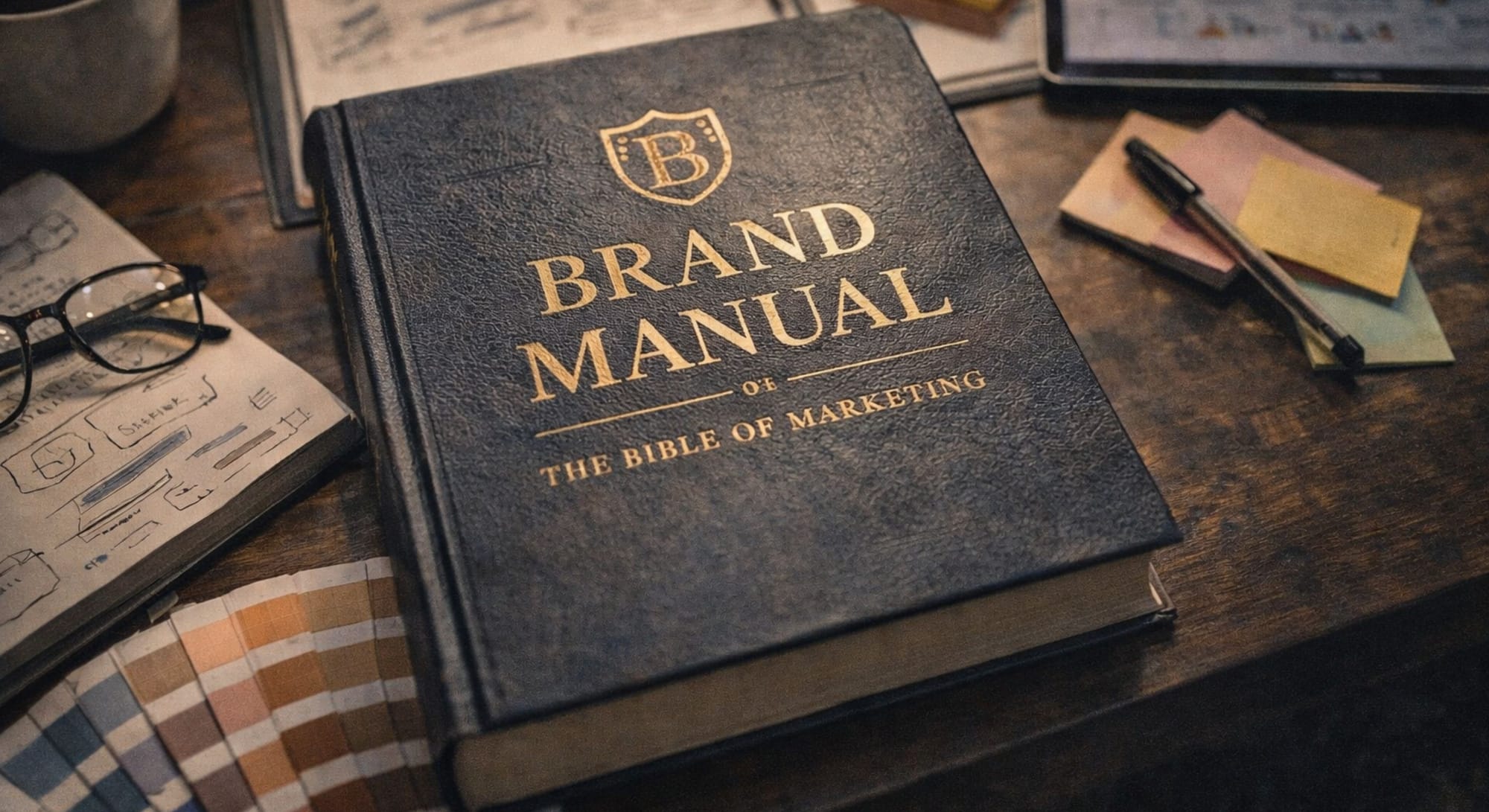
What a Brand Manual Actually Contains (And What Most Get Wrong)
Most Brand Manuals I've seen in 20+ years of marketing are glorified mood boards: logo usage rules, color palettes, font specifications. Those matter for visual identity. But they do nothing for verbal consistency, content strategy, or AI governance.
A complete Brand Manual – one built to scale – has three layers:
Layer 1: Identity Foundation
- Brand Mission: Why does this brand exist beyond making money?
- Brand Values: The non-negotiable beliefs that guide every decision (3-5 maximum).
- Brand Personality: If the brand were a person, how would you describe them? (3-5 adjectives, e.g., Bold, Empathetic, Direct.)
- Brand Promise: The single statement that encapsulates what you deliver, every time.
Layer 2: Verbal Identity (The Part Most Brands Skip)
- Brand Voice: Your constant. The climate, not the weather.
- Tone Guidelines: How voice shifts based on context, channel, and audience emotion.
- Language Rules: Words you always use. Words you never use. Sentence structure preferences.
- Messaging Pillars: The 3-5 core themes your content always orbits.
Layer 3: Operational Rules
- Channel-Specific Guidelines: How the brand sounds on LinkedIn vs. Instagram vs. email vs. website.
- Content Formats: What types of content the brand produces and the rules for each.
- Approval Framework: Who can publish what, and when does content need review?
- AI Usage Policy: What GenAI tools can and cannot do in content creation for this brand.
The most common mistake: Brands invest in Layer 1 (Identity) and ignore Layers 2 and 3 entirely. Then they wonder why their content feels inconsistent even though "everyone knows the values."
The Golden Rule: Voice vs. Tone - Why Most Marketers Confuse Them
The most critical part of the brand manual – and the part most people get wrong – is verbal identity. To operationalize your writing at scale, you must understand the distinction between Voice and Tone.
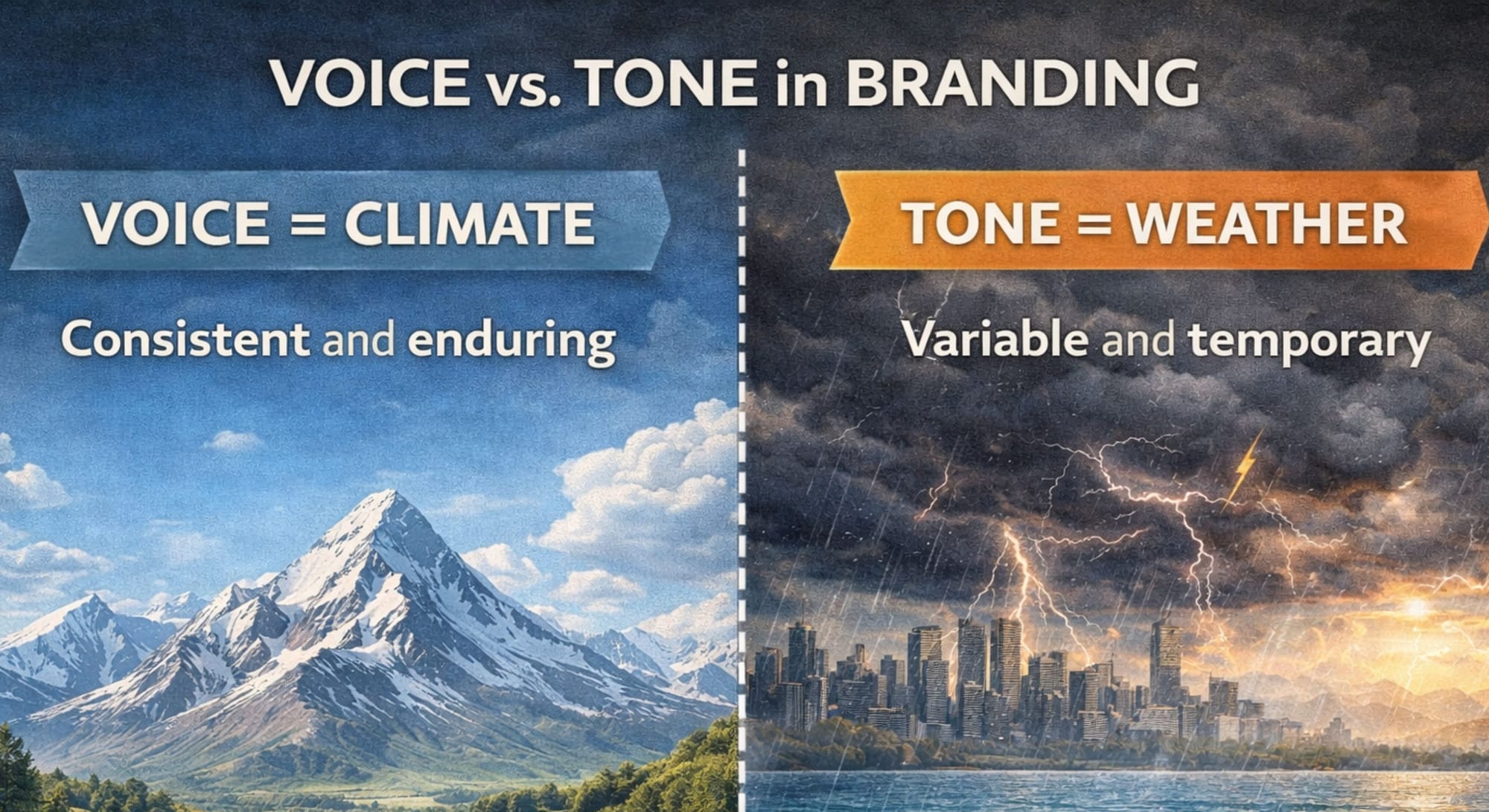
Think of it as The Climate vs. The Weather.
- VOICE is the Climate. It is constant. Never changes. Who the brand IS.
"We are always empathetic."
Defined by 3-5 adjectives.
Example: Bold, Direct, Human. - TONE is the Weather. It is flexibile. It shifts by context. It changes based on the situation. How the brand FEELS in the moment.
"On Instagram we're warm. On LinkedIn we're authoritative."
Defined by channel + audience emotion + content type.
Example: Celebratory in launch posts, Serious in crisis comms
The rule is simple: you can change the weather, but not the climate.
A brand that is fundamentally "empathetic" can be playful on Instagram and formal in a white paper, but it should never sound cold, dismissive, or arrogant in either context.
Real example - Apple:
- Voice (Climate): Innovative, Simple, Human
- Tone on product pages: Minimalist, aspirational "The ultimate iPhone."
- Tone in support comms: Warm, patient, clear "We're here to help."
- Tone in environmental reports: Serious, responsible, data-driven
Same brand. Same voice. Three completely different tones. That's not inconsistency, that's mastery.
Mistakes Brands Make With Voice and Tone
Mistake #1: Defining voice with vague adjectives and no examples
"We are authentic and innovative." Every brand says this. It means nothing without examples. For every voice adjective, your manual needs: a DO example, a DON'T example, and a sentence explaining WHY.
Mistake #2: Using the same tone across all channels
A LinkedIn article and an Instagram story are not the same format, do not reach the same mindset, and do not deserve the same tone. Brands that write LinkedIn posts like press releases and Instagram captions like legal disclaimers are misreading both channels, and losing both audiences.
Mistake #3: Not updating the manual when the brand evolves
Brand voice is not static. It matures. A startup that was "disruptive and rebellious" at launch may evolve into "confident and authoritative" as it becomes a market leader. Review your Brand Manual annually or after any significant repositioning.
How to Use GenAI to Analyze Your Competitive Landscape
Before you finalize your own brand voice, it's worth understanding the verbal territory your competitors already occupy.
Use this prompt:
You are a senior brand strategist.
I will give you the names of my top 5 competitors in [industry/niche].
For each brand:
1. Analyze their tone: How do they sound? (e.g., authoritative, friendly, technical, emotional)
2. Identify their core promise: What single value proposition do they repeat most?
3. Find the Gap: What psychological need or emotional angle are ALL of them ignoring?
Competitors: [List them here]
Output: A comparison table, followed by a "White Space" summary – the messaging territory that is currently unoccupied and available for a new brand to own.
The output gives you a map of the verbal landscape and shows you where the white space is. Where is the brand that is warmer in a cold industry? More direct in a jargon-heavy space? More human in a category full of corporate-speak? That white space is where you position your voice.
How to Use GenAI as Your Brand Guardian
Once your Brand Manual exists, GenAI stops being a content generator and becomes a Brand Guardian - a system that enforces consistency at scale.
Here is the prompt:
Role: You are the Senior Editor and Brand Guardian for [Brand Name].
Brand Voice: [Insert 3 adjectives e.g., Bold, Concise, Empathetic]
Brand Tone for this channel: [e.g., Warm and conversational for Instagram / Authoritative for LinkedIn]
Target Audience: [Insert your primary persona – name, role, pain point]
Messaging Pillars: [Insert your 3-5 content themes]
Words we ALWAYS use: [List 5-10 approved terms]
Words we NEVER use: [List 5-10 banned terms]
Sentence structure: [e.g., Short sentences. Active voice. No jargon.]
Task: Review the following content draft and:
1. Flag any sentence that violates the brand voice or tone guidelines.
2. Suggest specific rewrites for flagged sections.
3. Confirm which elements are on-brand and why.
Content draft: [Paste your content here]
This prompt transforms GenAI from a generic writing assistant into a trained editor who knows your brand as well as your best senior copywriter, and never forgets the guidelines.
What Brand Governance Looks Like in Practice
Before (off-brand - vague, corporate):
"Our cutting-edge platform leverages innovative synergies to empower your team with next-generation solutions that drive transformational outcomes."
After (on-brand - direct, honest, pragmatic):
"Our platform cuts your reporting time by 40%. No setup fees. No learning curve. Just the data you need, when you need it."
Same product. Same intent. Completely different impact - because the second version obeys the brand's verbal laws. When you give GenAI the right Brand Guardian prompt, it catches the first version every time.
Building Your Brand Manual: A Starting Checklist
If you're starting from scratch, here is the minimum viable Brand Manual you can build in a focused afternoon:
- 3-5 Brand Personality Adjectives - with one DO and one DON'T example each
- Brand Voice Statement - one paragraph describing how the brand sounds and why
- Tone Map by Channel - LinkedIn, Instagram, Email, Website (minimum)
- 3-5 Messaging Pillars - the content themes you own
- Approved Vocabulary List - 10 words/phrases you always use
- Banned Vocabulary List - 10 words/phrases you never use
- Brand Guardian Prompt - saved and shared with everyone who creates content
It's not perfect. It's not complete. But it is infinitely more useful than a vibe - and it gives GenAI exactly what it needs to start working for your brand, not against it.
A junior marketer relies on creativity. A marketing leader relies on manuals and systems. GenAI doesn't replace either - it amplifies the leader who has done the thinking first. Build the laws, then let the machine enforce them.
Final Thought
Brand governance is one of the highest-leverage investments a growing brand can make. If you want to build your Brand Manual or audit your current brand voice, I work with teams and founders to do exactly that. I also write about GenAI, marketing strategy, and the frameworks that actually work in practice.
Does your team have a "Bible", or are you just winging it?
Recommended Use Cases:
 Diana Socaciu