Clockwork and Clarity: Why the Content Calendar Is Actually a Narrative Governance System
Stop reactive content. Use a content calendar as narrative governance - strategy, assets, logistics, performance - then repurpose hero assets with GenAI.

We have all received that late-Friday email from a product team: "We have a major integration launching in 48 hours. We need a detailed blog post and three social media messages by Monday". It is reactive, vague, and practically guaranteed to produce noise rather than impact.
In product development, no one would dream of shipping code without a deployment plan. Engineering teams have sprints, staging environments, and release calendars. Yet, when it comes to content strategy, many sophisticated marketing teams abandon this structured mindset in favor of an ad-hoc scramble to simply publish something – anything – before the deadline.
A Content Calendar is too often misunderstood as merely a spreadsheet: a flat list of dates and titles with no strategic weight. In reality, a truly sophisticated calendar is a Narrative Governance System. It is the operational bridge between your high-level marketing strategy and your daily execution. It visualizes exactly what you are saying, to whom, and when.
To break free from the cycle of reactive content creation, I will explain in this article how the same engineering logic we apply to design: Hierarchy, Contrast, and White Space - but this time, applied to the dimension of Time.
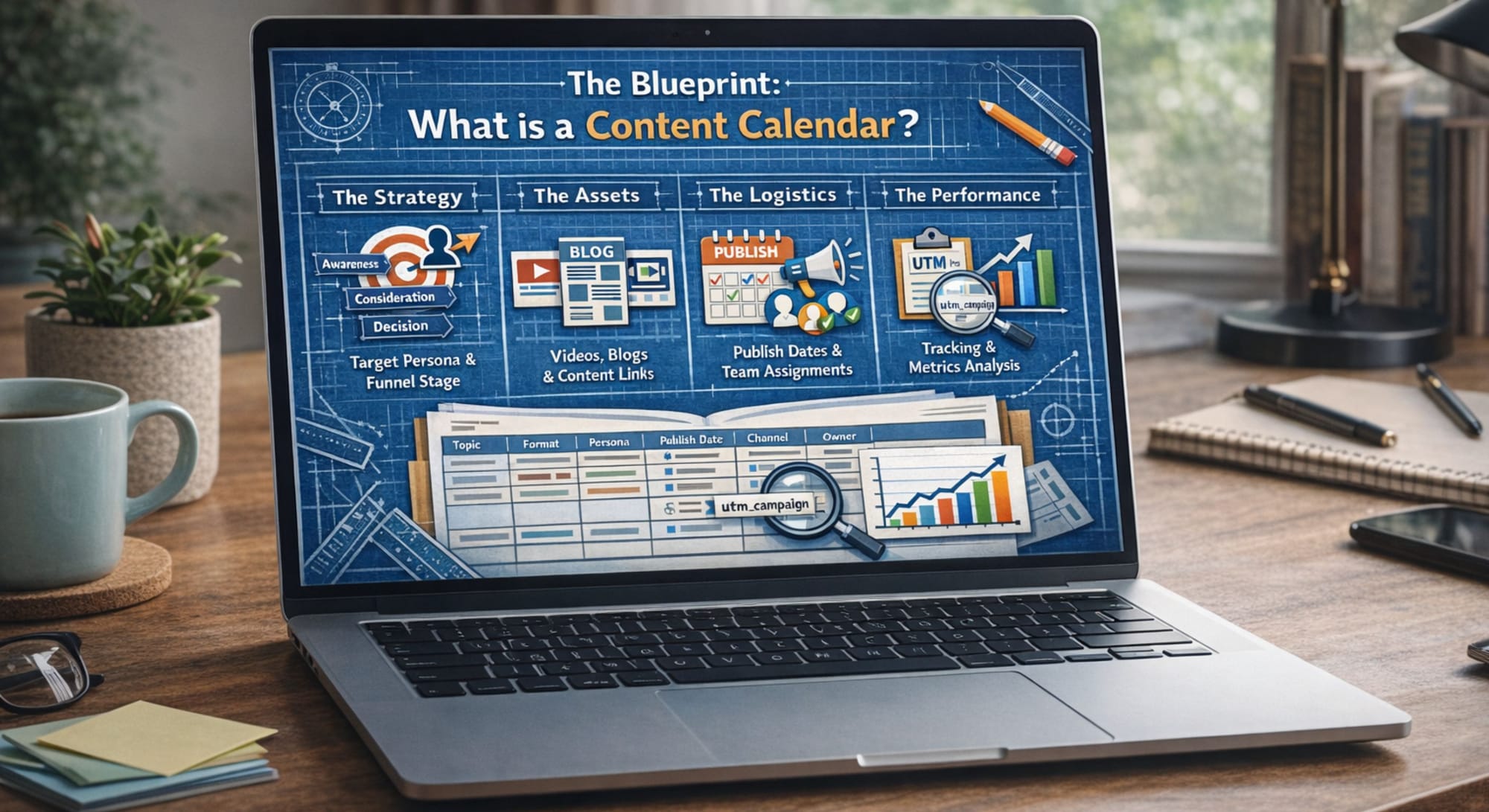
The Blueprint: What Is a Content Calendar?
A serious content calendar is not a list of blog post titles with dates attached. It is a strategic command center. To be effective, your calendar must contain four foundational pillars:
1. The Strategy Layer
This is where you document who you are speaking to and why. Every piece of content should be mapped to a specific buyer persona and a specific stage of the funnel - Awareness, Consideration, or Decision. If you cannot immediately answer "Who is the Hero of this piece?" then the content should not be on the calendar.
2. The Assets Layer
This defines the what and the how. What is the format? (Video, blog post, LinkedIn carousel, email newsletter.) What is the core message? What is the link to the draft, the final version, and the performance tracking? The Assets Layer ensures that no piece of content is a mystery file buried in someone's Google Drive.
3. The Logistics Layer
This is the when and the who owns it. Publish dates, distribution channels, assigned owners for copywriting, design, and approval. The Logistics Layer is where most reactive teams fail, because without clear ownership, nothing gets done until the last minute.
4. The Performance Layer
This is the "did it work?" stage. A tracking mechanism for UTM parameters, engagement metrics, and post-campaign KPIs. The Performance Layer closes the loop; it ensures that your calendar is a learning system, not just a publishing machine.
Without these four pillars, your calendar is not a governance system. It is just a to-do list with dates.

The Framework: Temporal Hierarchy
In design, Visual Hierarchy dictates what commands the eye first. In a calendar, Temporal Hierarchy dictates which moment commands the audience's mind first.
Not every date has equal strategic weight. A random Tuesday LinkedIn post is not equivalent to a quarterly product launch. Yet many content calendars treat them as if they are. We will establish a clear structure:
Hero Assets (The Epics)
These are your quarterly anchors – massive technical whitepapers, major product launches, or annual events. They are the "Inciting Incidents" of your narrative quarter. Everything else in the calendar should either build anticipation for the Hero Asset or extend its reach afterward.
Example: A Q2 whitepaper on AI in fashion retail becomes the Hero Asset. All surrounding content in April and May should tease its key insights, build curiosity, and drive registrations.
Supporting Themes (The Chapters)
These are monthly or bi-weekly campaigns that break down the Hero Asset's key ideas into manageable, consumable segments. They create narrative momentum. Each Supporting Theme answers one specific question the Hero Asset raises, building a coherent story arc across weeks.
Example: If the Hero Asset is "The Future of AI in Fashion Retail," the Supporting Themes might be: Week 1 "Why Traditional Personalization Fails," Week 2 "The Role of Agentic AI," Week 3 "Case Study: How Brand X Increased Conversion by 40%."
Daily Hub Content (The Noise)
This is the necessary, consistent, low-friction social content that keeps your brand visible between the big moments. But here is the critical insight: without the first two pillars, daily content devolves into monotone background noise. It becomes the very thing we are trying to escape – content for content's sake.
Daily Hub Content should always ladder up to a Supporting Theme, which ladders up to a Hero Asset. That is how you build narrative coherence across time.

The Cadence: Best Practices for Execution
Having a calendar is useless if it is treated as a rigid spreadsheet rather than a living strategic tool. The best teams use their calendars to enforce consistency while leaving room for agility. Here is how to avoid the reactive trap and maintain a strategic rhythm.
The Reactive Trap (What NOT to Do)
The Short View: Planning only one week in advance and constantly scrambling for ideas. This forces your team into a perpetual state of panic, where every content decision is made under time pressure with no room for strategic thinking.
The Echo Chamber: Treating every channel identically – copy-pasting the exact same text to LinkedIn, Email, and X. This ignores the fact that each platform has different audience expectations, content formats, and engagement patterns.
The Volume Metric: Focusing only on quantity – "we need to post every day" – rather than narrative progression. Posting daily without a coherent story is just adding to the noise.
The Strategic Rhythm (What TO Do)
The 80/20 Rule: 80% of content is planned and batched weeks in advance -Evergreen content, Campaign launches, Product releases. The remaining 20% is left open for real-time industry news, trend-jacking, or timely responses. This allows you to be both strategic and agile.
Content Repurposing: Plan around "Hero Content" – one high-value asset (e.g., a webinar, a research report) that is systematically sliced into 10+ smaller micro-assets over the course of a month. This maximizes ROI on every piece of content you create.
Example: One 60-minute webinar becomes: 1 blog post summarizing key takeaways, 4 LinkedIn posts (each highlighting one framework), 2 email newsletters (teaser + recording), 3 Twitter threads, and 5 short-form video clips for Reels.
Cross-Functional Alignment: Use the calendar as a single source of truth so Sales, Customer Success, and Product teams know exactly what message is currently in the market. This prevents the embarrassing scenario where a sales rep is pitching Feature A while marketing is promoting Feature B.
Content Calendar Mistakes to Avoid
Mistake #1: Treating the calendar as a publishing schedule instead of a strategic roadmap
Many teams use their calendar to track when things go live, but not why they go live in that order. A true governance system maps every piece of content to a business objective, a persona, and a stage in the customer journey. If we cannot immediately explain how a piece of content moves the needle, it should not be on the calendar.
Mistake #2: Ignoring the narrative arc across weeks and months
Posting five unrelated blog posts in a month is not a content strategy - it is a content collection. The most effective calendars tell a coherent story over time, with each piece building on the last and creating anticipation for what comes next. Every piece should answer: "How does this connect to the larger narrative we are building?".
Mistake #3: Failing to close the performance loop
If we are not tracking what worked and what did not, the content calendar is a one-way publishing machine, not a learning system. Build performance reviews directly into the calendar cadence - monthly retrospectives where you analyze engagement, conversion, and sentiment data to inform the next month's strategy.
How to Use GenAI as Your Content Repurposing Engine
The hardest part of managing a content calendar is filling it with high-quality ideas without burning out your team. We can use GenAI not only to write the final posts, but to map out a month of strategic micro-content from a single core asset.
Here is how to turn one Hero Asset into two weeks of content using AI.
You are a Senior Content Strategist specializing in content repurposing and narrative sequencing.
I am providing you with our latest [Whitepaper/Webinar Transcript/Blog Post].
Task: Break this single asset down into a 2-week Content Calendar for
LinkedIn and our Email Newsletter.
Constraints:
1. Create 4 distinct LinkedIn posts. Each post must focus on a different angle:
(1) The contrarian hot take
(2) The step-by-step framework
(3) The core data/statistic with commentary
(4) The emotional customer pain point
2. Create 1 Email Newsletter outline that summarizes the main value of
the asset and includes a clear CTA.
3. Provide this in a table format with the following columns:
- Publish Date (Day 1-14)
- Channel (LinkedIn, Email, etc.)
- Format (Carousel, Text Post, Newsletter)
- Core Angle (one sentence describing the narrative focus)
- Draft Hook (the first 2 sentences only)
Tone: Empathetic and authoritative. No fluff. Ensure each piece builds narrative momentum toward the Hero Asset.
Step 3: Validate the result. Use your own expertise and judgment to make sure the output reflects your brand's reality and narrative strategy. GenAI provides the structure - you provide the strategic context and final editorial polish.
Final Thought
A content calendar is the ultimate governance tool for your brand's narrative. When we stop guessing what to post today and start planning what we want our audience to believe next month, marketing transforms from an expense into a strategic asset.
Are you running your content, or is your content running you?
Recommended Use Cases:
 Diana Socaciu