The Hero Asset Model: One Piece of Content, Twelve Derivatives
Most content teams are exhausted because they treat every piece of content as a fresh creation. The Hero Asset Model changes that - one flagship piece, twelve strategic derivatives, built once and distributed with purpose across every channel and every stage of the funnel.
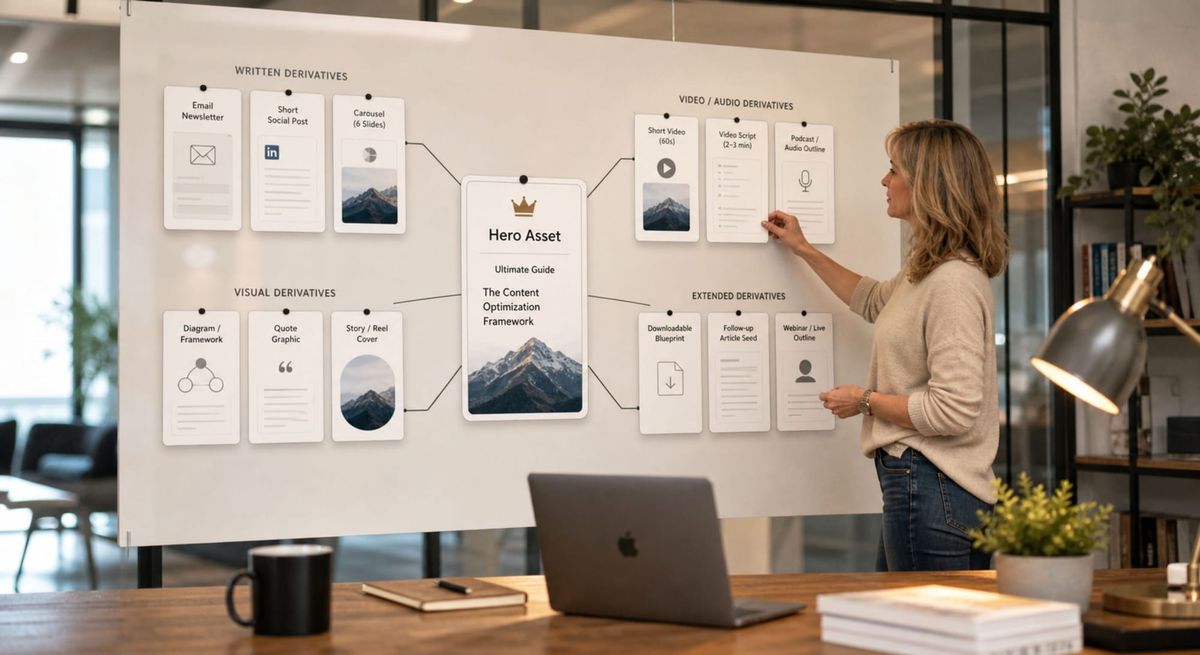
Every content team I have ever worked with or spoken to has the same problem. The calendar has 20 slots to fill this month. The team has enough energy to produce four pieces of genuinely good work. The gap between those two numbers is filled with rushed content, recycled ideas, and the vague anxiety that none of it is strategic enough, but there is no time to make it so, because next week's slots are already empty and waiting.
The problem is not output. It is architecture. Specifically: the belief that every calendar slot requires a fresh creative act, when it does not. It requires a derivative - a purposeful extraction from the single flagship piece that sits at the centre of the week. One piece of deeply researched, carefully framed, narratively governed content can fill twelve calendar slots across four channels, three funnel stages, and two weeks of distribution. Not by copying and pasting. By extracting, adapting, and redistributing what is already there.
That is the Hero Asset Model. And it is the framework that makes the governed content calendar we built in the previous article sustainable at real-world scale.
What Makes Something a Hero Asset
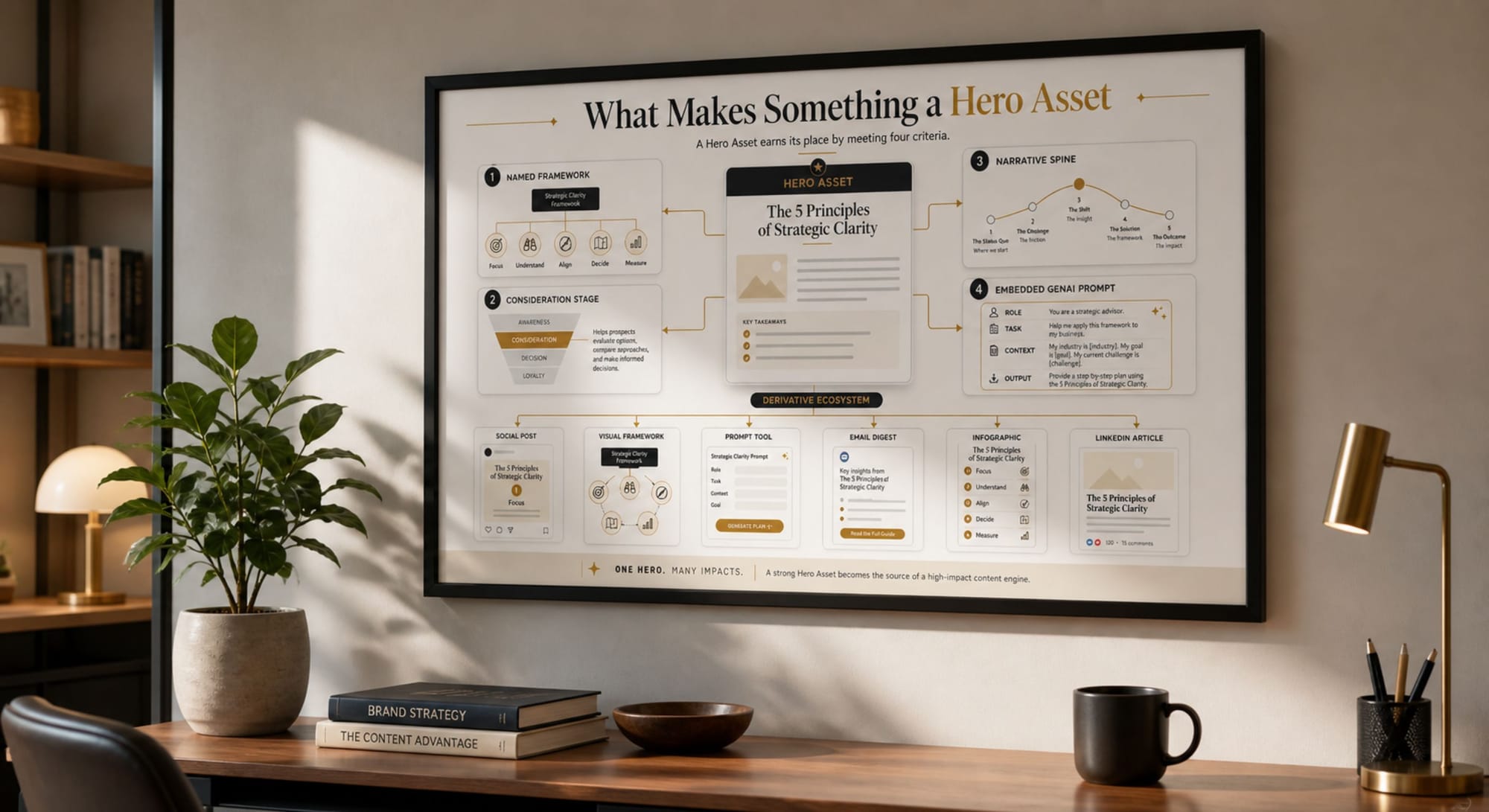
Not every piece of content qualifies as a Hero Asset. A Hero Asset is not simply your longest piece or your most recent article. It is the flagship content that earns its place at the top of the content hierarchy because it meets four specific criteria.
It is built on a named framework. A Hero Asset does not just cover a topic. It delivers a replicable structure - a model, a process, a set of named principles – that the audience can take away and use immediately. Frameworks are the raw material that derivatives are extracted from. An article that explains a concept without naming its parts has no architecture to repurpose.
It serves the Consideration stage of the funnel. Hero Assets live at the Consideration stage because that is where depth builds trust. Awareness content is too short to generate twelve derivatives. Conversion content is too specific. The long-form Consideration piece – the article that teaches something, names something, and proves something - is the content type that has enough substance to hold a full derivative ecosystem.
It connects to the Narrative Spine. Every Hero Asset must be traceable to a specific fragment of the brand's Narrative Spine. If the article cannot be placed within the Hero's journey from Ordinary World to Special World, it is not a Hero Asset - it is a standalone piece. Standalone pieces produce one slot. Narrative-connected pieces produce twelve.
It has a GenAI prompt embedded in it. This is the practical test. A piece of content that contains a framework and a prompt has, by definition, three extractable formats already: the article itself, the framework as a visual, and the prompt as a standalone tool. The remaining nine derivatives flow from those three. A piece without a prompt rarely has enough structured content to generate a full derivative set.
The Hero Asset rule: If you cannot identify four named components within a piece of content (four principles, four steps, four distinctions, four questions) it is not dense enough to be a Hero Asset. Go back and build the framework before you build the derivatives.
The Twelve Derivatives
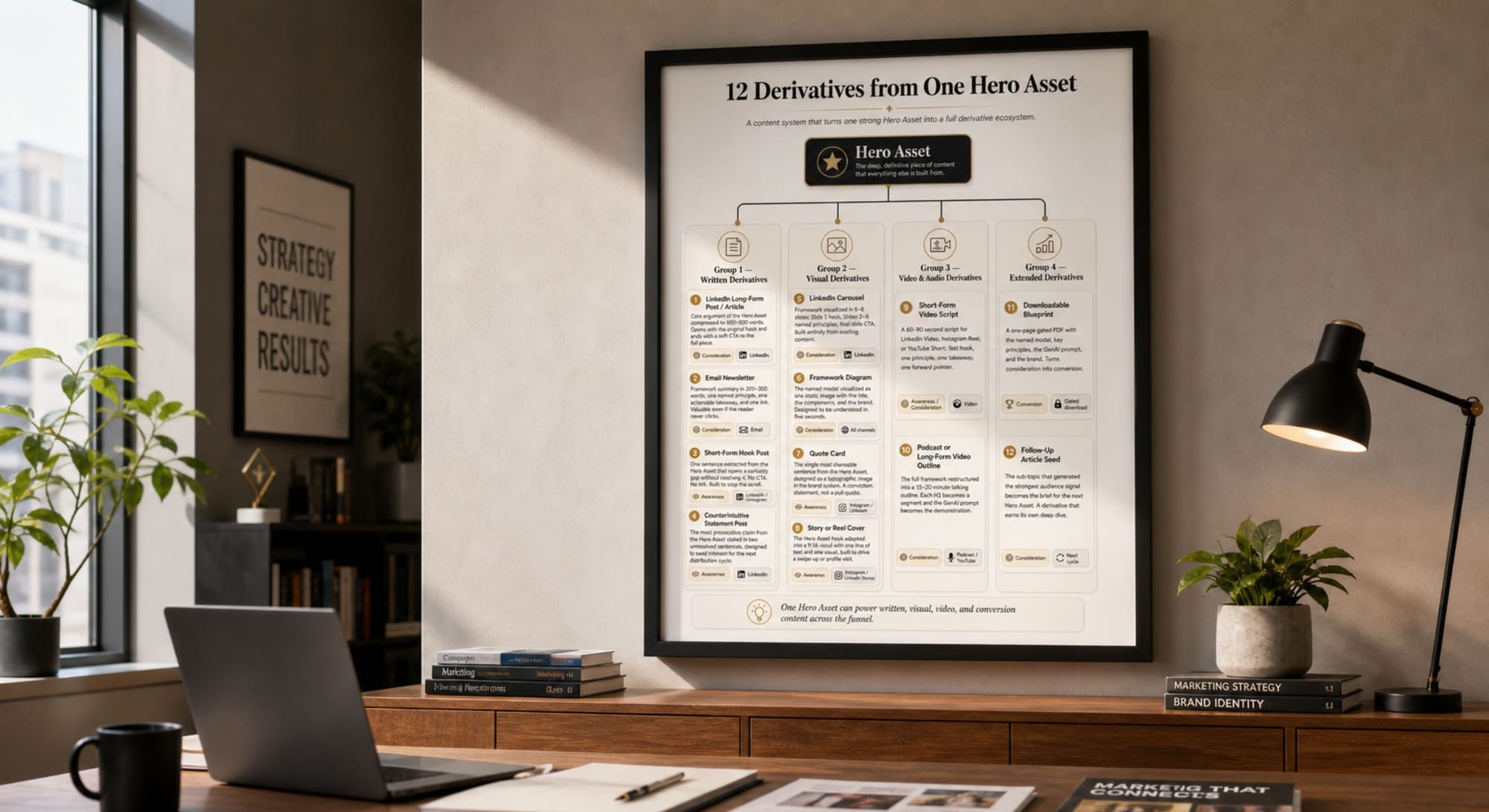
Every Hero Asset generates twelve derivatives, organised into four groups of two to three items. Each group serves a different distribution purpose. Together they cover the full channel ecosystem (long-form written, short-form social, visual, and extended), without a single piece requiring original research or a new creative brief.
Group 1 – Written Derivatives
- LinkedIn Long-Form Post/Article
The core argument of the Hero Asset compressed to 600-800 words. Leads with the hook from the original article. Ends with a soft CTA pointing to the full piece.
Consideration · LinkedIn - Email Newsletter
The framework summary in 200-300 words – one named principle, one actionable takeaway, one link. The subscriber who does not click still leaves with something useful.
Consideration · Email - Short-Form Hook Post
One sentence extracted from the Hero Asset that opens a Curiosity Gap without resolving it. No CTA. No link. This is Daily Hub content – its only job is to make the audience stop scrolling.
Awareness · LinkedIn / Instagram - Counterintuitive Statement Post
The most provocative claim from the Hero Asset, stated in two sentences and left unresolved. Seeds the audience's interest in the full framework for the following week's distribution cycle.
Awareness · LinkedIn
Group 2 – Visual Derivatives
- LinkedIn Carousel
The Hero Asset's framework visualised as 6-8 slides. Slide 1: the hook. Slides 2-6: one named principle per slide. Slide 7: Slide 8: the CTA. Built entirely from existing content – no new thinking required.
Consideration · LinkedIn - Framework Diagram
The named model from the Hero Asset visualised as a single static image – the kind that gets saved and reshared. The title, the components, and the brand. Nothing else. Designed to be understood in five seconds without reading the article.
Consideration · All channels - Quote Card
The single most shareable sentence from the Hero Asset, set as a typographic image in the brand's visual system. Not a pull quote – a conviction statement. The sentence that makes someone send the image to a colleague.
Awareness · Instagram / LinkedIn - Story or Reel Cover
The hook of the Hero Asset adapted as a 9:16 static or motion graphic for Stories. One line of text. One visual. Its job is to drive a swipe-up or a profile visit - not to explain the framework.
Awareness · Instagram / LinkedIn Stories
Group 3 – Video & Audio Derivatives
- Short-Form Video Script
A 60-90 second script for a LinkedIn Video, Instagram Reel, or YouTube Short. Hook in the first 3 seconds. One principle from the framework. One takeaway. One forward pointer. Built directly from the Hero Asset's opening and first H3 section.
Awareness / Consideration · Video - Podcast or Long-Form Video Outline
The Hero Asset's full framework restructured as a talking outline for a 15-20 minute episode or video. Each H2 section becomes a segment. The GenAI prompt becomes the practical demonstration. No script – the structure already exists.
Consideration · Podcast / YouTube
Group 4 – Extended Derivatives
- Downloadable Blueprint
The Hero Asset's framework condensed into a one-page PDF – the named model, the key principles, the GenAI prompt, and the brand. Gated by email. This is the Conversion asset that turns a Consideration reader into a subscriber or lead without requiring a sales conversation.
Conversion · Gated download - Follow-Up Article Seed
The one sub-topic inside the Hero Asset that generated the most engagement - the comment, the reply, the DM - becomes the brief for next cycle's Hero Asset. Not a new creative decision. A promoted derivative that earns its own deep dive based on audience signal.
Consideration · Next cycle
The Production Sequence
The derivatives are only efficient if they are built in the right order. The wrong sequence - trying to produce derivatives before the Hero Asset exists in its final form - produces content that contradicts itself, because the framework is still shifting as the writing develops. The right sequence is strict.
Publish the Hero Asset first. Every derivative is extracted from the published version - not from a draft, not from the brief, not from notes. The published version is the source of truth. Any framework that changes in editing changes every derivative that references it.
Extract Group 1 next, within 24 hours of publishing. The LinkedIn long-form post, the newsletter, and the two short-form posts are written while the framework is freshest in the writer's mind and while the article is in its initial distribution window. These four derivatives extend the reach of the publication day without requiring a single new idea.
Build Group 2 in the following two days. The carousel, the framework diagram, and the quote card are visual translations of what is already written. Brief a designer - or use GenAI image tools – with the exact text from the article. No interpretation required. No creative direction beyond "take the framework and make it visual".
The compounding effect: A team that produces one governed Hero Asset per week and extracts all twelve derivatives has filled a content calendar with 48 pieces of content per month, from four flagship pieces. The volume is not the point. The narrative coherence is. Every one of those 48 pieces connects to the same Narrative Spine, serves a defined funnel stage, and was briefed before it was produced.
Three Mistakes That Break the Model
Mistake #1: Producing derivatives before the Hero Asset is final
This is the most common production error, and the most expensive. A team that writes the carousel while the article is still in draft produces a visual framework that no longer matches the published text. A newsletter sent before the article is live points to a page that does not exist yet. The Hero Asset must be in its final, published form before a single derivative is produced. No exceptions. The efficiency of the model depends entirely on the stability of the source.
Mistake #2: Treating all twelve derivatives as mandatory every week
The Hero Asset Model is a maximum, not a minimum. Not every Hero Asset will generate all twelve derivatives at the same quality. Some pieces produce exceptional carousels but weak video scripts. Others generate immediate engagement signals that make the follow-up article seed obvious within 48 hours. The model is a menu, not a checklist. Produce the derivatives that the specific Hero Asset can genuinely support, and stop when the extraction starts producing thin content that dilutes the original rather than extending it.
Mistake #3: Repurposing without re-contextualising
The most visible failure in derivative production: content that has been copied from one format into another without being adapted for the context, the channel, or the audience's state of mind in that channel. A LinkedIn carousel that is simply the article broken into bullet points is not a derivative - it is a reformatted document. A derivative adapts the content to the new format's native language. The carousel tells the story visually. The short-form post opens a gap instead of filling one. The email teaches one principle instead of summarising ten. Repurposing without re-contextualising produces content that feels lazy, because it is.
How to Use GenAI as Your Derivative Production Engine
Once the Hero Asset is published and the framework is fixed, GenAI can produce the first draft of most written derivatives in minutes. Not because it understands the strategy – it does not – but because derivative production is a structured transformation task, and structured transformation is exactly what GenAI does well when the brief is precise.
You are the Senior Content Strategist for [Brand Name].
A Hero Asset has been published. Your task is to extract a specific derivative from it.
The Hero Asset: [Paste the full published article text here]
The Derivative Requested: [Choose one]
- LinkedIn long-form post (600-800 words, Consideration stage, ends with CTA to full article)
- Email newsletter (200-300 words, one principle, one takeaway, one link)
- Short-form hook post (1-2 sentences, Awareness stage, opens a Curiosity Gap, no CTA)
- Counterintuitive statement post (2 sentences, the most provocative claim, left unresolved)
- LinkedIn carousel outline (8 slides: Hook / Principle 1 / Principle 2 / Principle 3 / Principle 4 / Takeaway / CTA)
- Quote card text (1 sentence, the most shareable conviction statement from the article)
- Short-form video script (60-90 seconds: 3-second hook / one principle / one takeaway / forward pointer)
- Downloadable Blueprint text (framework title / 4 named components / one-line brand statement)
Brand Voice: [upload]
Narrative Spine Fragment This Pielce Expresses: [Ordinary World / Transformation / Special World]
Funnel Stage: [Awareness / Consideration / Conversion / Retention]
Rules:
- Every derivative must open with The Hero's experience, not the brand's product.
- The framework terminology from the Hero Asset must be preserved exactly - do not paraphrase named principles.
- The derivative must be self-contained – a reader who has not seen the Hero Asset must still find it valuable.
- For Awareness derivatives: no product mention, no CTA beyond a soft forward pointer.
- For Consideration derivatives: end with one soft CTA that advances the relationship without demanding a decision.
Output: First draft of the requested derivative only. No commentary. No alternatives unless asked.
Run this prompt separately for each derivative type. Do not ask GenAI to produce all twelve at once, since the quality of each derivative depends on the prompt being specific about what that format requires. Validate every output against the Hero Asset before publishing. GenAI extracts what the brief tells it to extract. Whether the right principle was selected, and whether the tone matches the brand voice, is a judgment only you can make.
Final Thought
The content teams that burn out are not the ones without enough ideas. They are the ones rebuilding from scratch every week, treating every calendar slot as an original creative act. The Hero Asset Model does not reduce the creative ambition - it concentrates it. One piece of genuine thinking, one named framework, one well-governed brief. Then extract, adapt, and distribute what is already there.
Twelve derivatives from one piece is not a productivity hack. It is what happens when the narrative architecture is solid, the framework is named, and the production sequence is followed without shortcuts. The thinking happens once. The reach compounds indefinitely.
Are you producing content or are you extracting everything your best content already contains?
Recommended Use Cases:
 Diana Socaciu