Positioning Before Promotion: Why Both B2B and B2C Brands Start With Clarity
Most marketing plans open with a content calendar and a budget. Almost none of them open with a clear answer to the most important question in marketing - positioning.

Over 20+ years of reviewing marketing plans – across automotive, fashion, and technology – I've noticed a remarkably consistent pattern. Teams open with tactics. A content calendar, a paid media budget, a social strategy, a campaign brief. What they almost never open with is a clear, specific answer to the most fundamental question in marketing: Why would anyone choose you over someone else?
That question isn't answered by a tagline. It isn't answered by better creative or a bigger budget. It is answered by positioning. And positioning is the prerequisite for everything else. Whether you're selling enterprise software to a procurement committee of seven or fashion to a 28-year-old scrolling Instagram at 11pm, the sequence is the same: clarity first, communication second.
Reversing that sequence is one of the most expensive habits in marketing. Not because it produces bad campaigns – it might produce technically good ones. But because a well-executed campaign in the service of unclear positioning is just well-organized noise. In this article, I will walk you through the positioning framework I use before any campaign begins, and how GenAI can accelerate the clarity work that most teams either rush or skip entirely.
What Positioning Actually Is and What It Isn't
Positioning is not a tagline. It's not a Unique Selling Proposition (USP) statement. It's not the "About" section of your website or the elevator pitch your sales team uses at conferences.
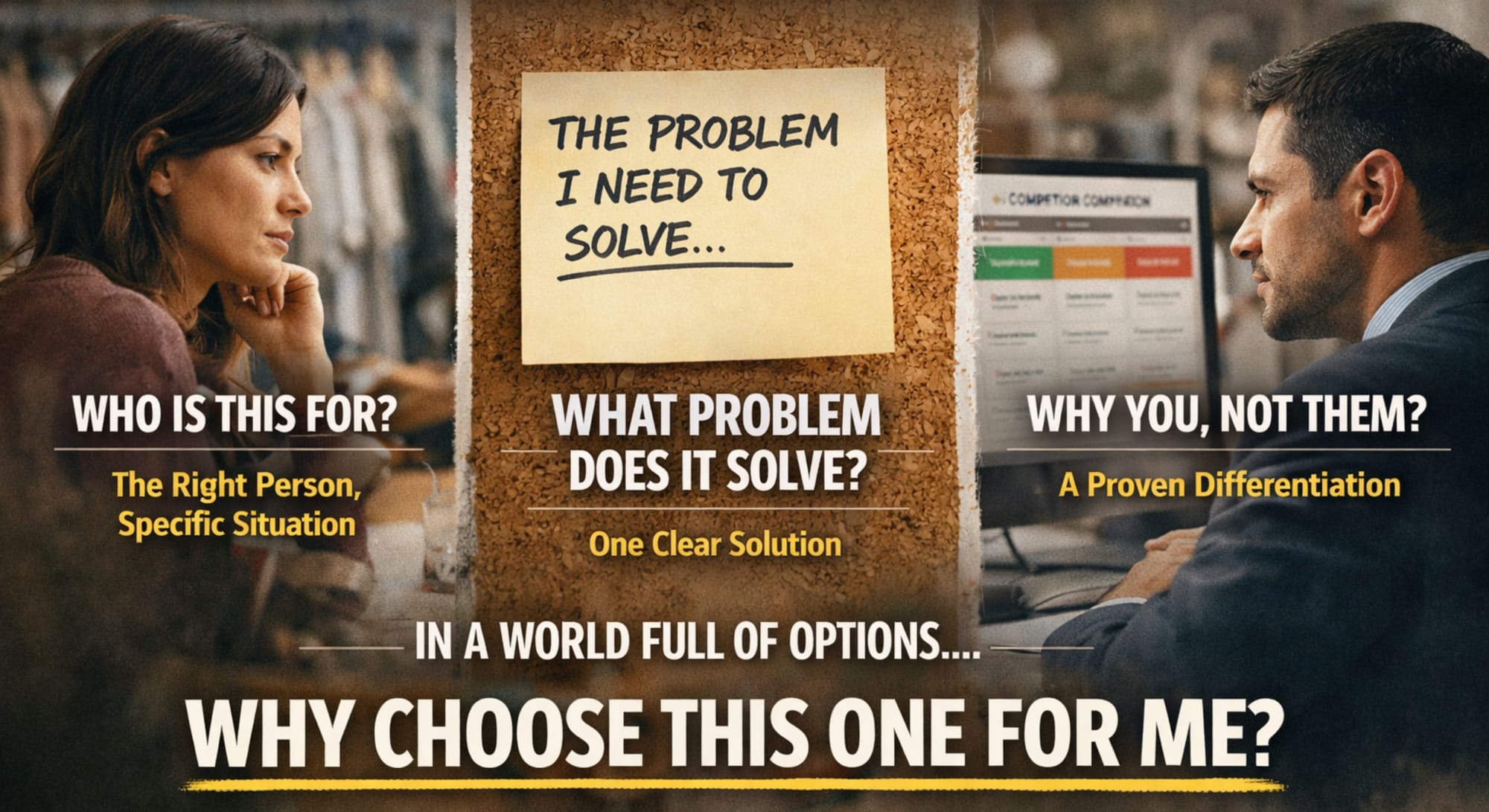
Positioning is the answer to a precise cognitive question your buyer asks - often unconsciously: "In a world full of options, why does this particular one exist for me?"
Al Ries and Jack Trout, who formalized the concept in the 1980s, defined it as the mental space a brand occupies relative to its competitors. That framing is still correct - but it omits a critical practical implication: positioning is not claimed. It is earned through consistent proof.
You can write "the most trusted platform for B2B teams" on your homepage. That is not positioning. Positioning happens when a procurement manager thinks of your name the moment she is handed a new brief. It happens when a consumer in a boutique immediately knows what a brand stands for before reading a single word on the label.
Strong positioning answers three questions simultaneously, and specifically:
- Who is this for? Not "businesses" or "women aged 25-45." A person with a specific situation, responsibility, and problem.
- What specific problem does it solve? Not every problem. One problem, stated precisely.
- Why you, not them? A differentiated reason grounded in proof, not aspiration.
If your current marketing collateral cannot answer all three clearly in a single sentence per question, you don't have positioning. You have a description.
Most brands believe they have positioning because they have a value proposition statement. What they actually have is a list of features framed as benefits. That is not the same thing. The sign of missing positioning isn't confusion; it's sameness. When your content, ads, and sales pitch could just as easily be published by three of your competitors, you have a sameness problem. And sameness is invisible in a crowded market.
The Positioning-Promotion Confusion
Most marketers use the words "positioning" and "promotion" as if they operate at the same level of the marketing architecture. They do not.
Positioning is the strategic decision. It defines the specific place your brand occupies in the mind of a specific audience – relative to every alternative they have. It answers three questions that no campaign can answer on your behalf: What do we deliver? For whom, precisely? And why us instead of anyone else?
Promotion is the execution layer. It is how you communicate the positioning – through campaigns, content, advertising, social media, email, and every other channel at your disposal. Promotion amplifies what is already there. It cannot create what is not.
The confusion between the two is the most common structural failure I encounter across both B2B and B2C organisations. The consequences are consistent regardless of industry: content that says everything and means nothing, campaigns that generate impressions but not recognition, and a brand that is visible but not remembered.
The strategic rule: Promotion without positioning is noise at scale.
B2B and B2C: Same Logic, Different Stakes
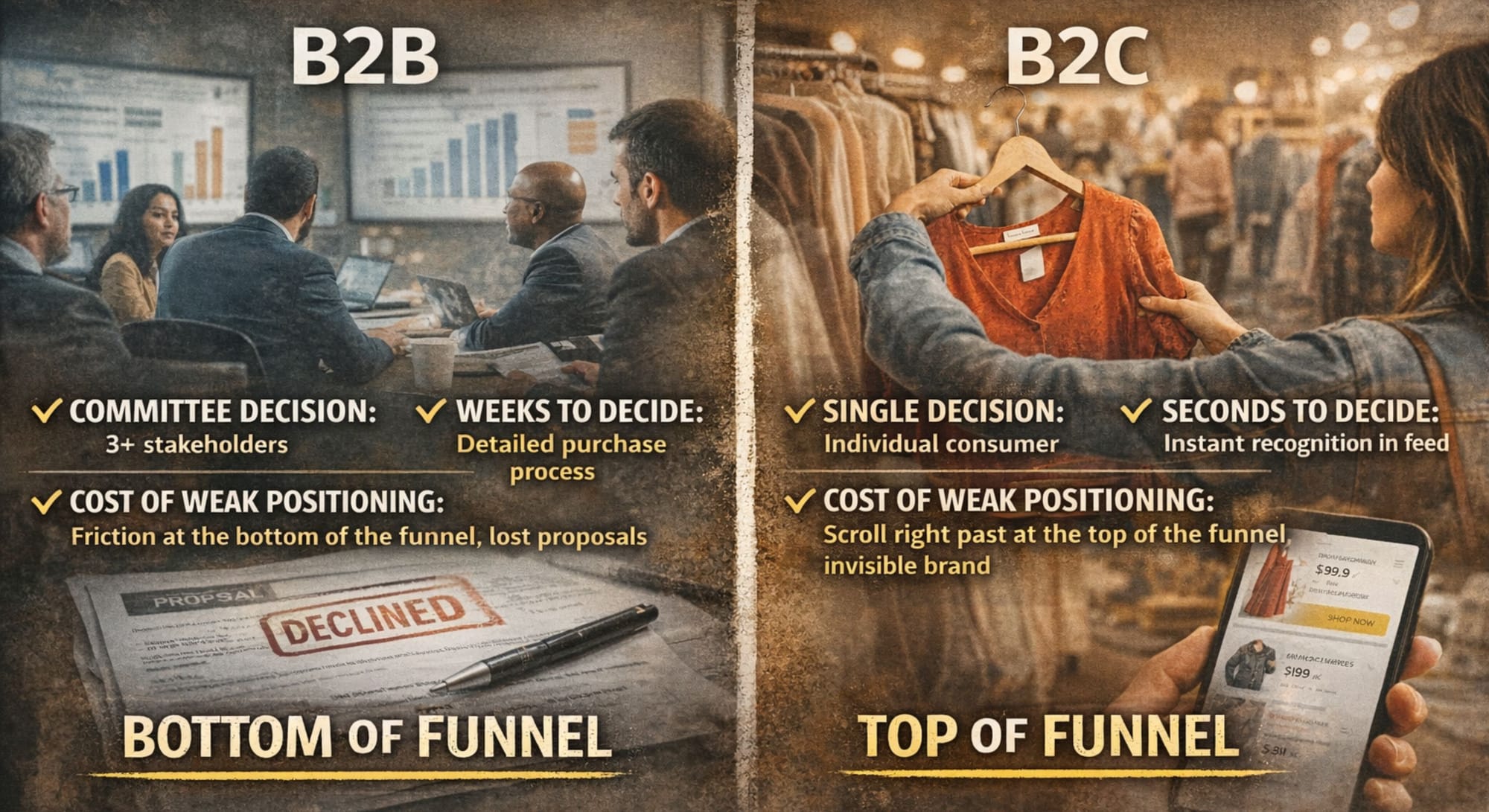
The principles of positioning are universal. But how positioning plays out - and where weak positioning costs you - differs meaningfully between B2B and B2C contexts.
| DIMENSION | B2B | B2C |
|---|---|---|
| Decision-maker | Committee of 3-7+ people, each with different priorities | Individual (or household), single decision arc |
| Time to decision | Weeks to months - multiple touchpoints and reviews | Minutes to days - often one or two touchpoints |
| Primary driver | Risk reduction + demonstrable ROI | Desire + identity + emotional resonance |
| What clarity does | Removes friction across a long, multi-stakeholder buying cycle | Triggers instant recognition and desire in the scroll |
| Cost of weak positioning | Lost deals you never hear about - eliminated before shortlist | Scrolled past in 1.3 seconds - invisible in the feed |
In B2B, weak positioning tends to cost you at the bottom of the funnel. You get to the proposal stage and lose – or worse, you never get shortlisted at all. The buyers can't articulate why you're different, so they default to the safer, better-known option. You rarely hear about these losses.
In B2C, weak positioning costs you at the top of the funnel. The scroll. A consumer has no obligation to stop and engage. If your brand doesn't communicate clearly and compellingly within two seconds, the algorithm serves the next option.
The urgency of clarity differs. The necessity of it does not.
The Three Decisions That Define a Position
Positioning is not a tagline. It is not a mission statement. It is not a set of brand values listed on an internal slide deck that nobody reads after the offsite. Positioning is the answer to three precise questions, and the answer to each one must be specific enough to exclude something.
Decision 1: The Audience – Who It Is For
Positioning requires an audience narrow enough to mean something. The instinct in most organisations – especially those with aggressive growth targets – is to make the audience definition as broad as possible. The logic feels sound: more people in the target, more potential revenue. In practice, the opposite is true. The broader the audience definition, the less specific the positioning can be, and the less it resonates with anyone.
A position defined for "marketing professionals" means nothing. A position defined for "marketing directors in B2B software companies scaling from 50 to 200 employees" is specific enough to drive every creative decision downstream – from the hook of every piece of content to the subject line of every email.
The audience decision also requires one clause that most brand teams refuse to write: who this is not for. Exclusion is not a failure of ambition. It is the mechanism that makes the positioning credible to the people it is designed for.
Decision 2: The Promise – What You Deliver
Your positioning promise is the one specific outcome your brand delivers that is worth the customer's time, attention, and money. Not a category. Not a feature set. A single, specific transformation from one state to another.
The test of a genuine promise is simple: if your competitor could say the same thing without lying, it is not a promise, it is a category description. "We deliver results" is a category description. "We cut your content production time by half without losing brand coherence" is a promise. One of those sentences is positioning. The other is wallpaper.
Decision 3: The Distinction – Why You, Not Them
Distinction is the most uncomfortable of the three decisions because it requires you to say something your competitors cannot credibly claim. Not "we are better". Better at what, measurably, provably, in a way that matters to the specific audience you have defined? That is a distinction.
"Better" is an aspiration dressed as a position. Distinction does not have to be a product feature. It can be a methodology, a philosophy, a specific type of client result, or even the way you work. What it cannot be is interchangeable with what the brand beside you says about itself.
Positioning Is Not a One-Time Event
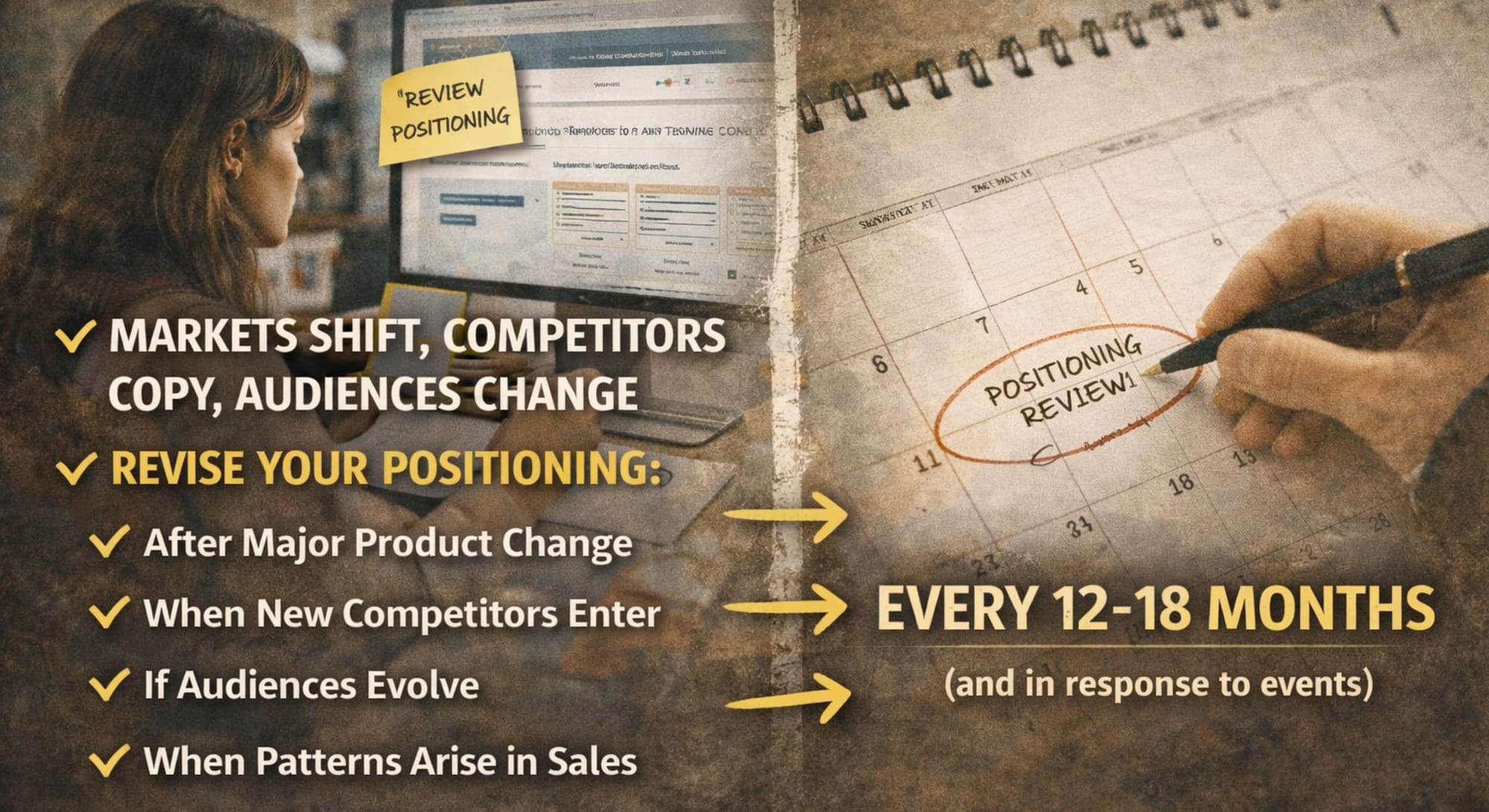
The final thing to understand: positioning must be revisited. Markets shift. Competitors copy your differentiators. Audiences evolve. A positioning that was sharp and resonant two years ago may have become generic today; not because you changed it, but because the landscape around it changed.
A practical rule: review your positioning every 12-18 months, and immediately when any of the following occur:
- A significant product change, new offer, or entry into a new market segment
- Entry of a major new competitor - especially one with more resources and similar messaging
- A meaningful shift in your audience's priorities (economic disruption, regulatory change, cultural shift)
- A recurring pattern in sales conversations where prospects ask the same confused question – that confusion is your positioning gap made visible
The discipline of positioning is not glamorous. It does not produce an immediately visible campaign or a shareable piece of content. But it is the structural foundation that determines whether every campaign you run afterward lands or misses. And it is always – always – worth doing before you spend the first euro on promotion.
Positioning Mistakes That Cost Campaigns Their Impact
Mistake #1: Confusing a tagline with a position
A tagline is the compressed, memorable expression of a position. A position is the strategic decision the tagline is built to express. Brands that write the tagline first and reverse-engineer the positioning from it have the sequence exactly backwards. The tagline is the output of the positioning work. It is never the starting point.
Mistake #2: Building a position that tries to include everyone
The most common positioning failure is the refusal to exclude. When a positioning statement is reviewed by a committee of stakeholders, each one insists their segment and their use case is included. The result is a position so broad it occupies no specific place in anyone's mind. The narrower the position, the stronger the resonance with the people it is designed for – and paradoxically, the wider the word-of-mouth reach it generates.
Mistake #3: Running separate positioning frameworks for B2B and B2C
Organisations running both lines of business often build entirely separate positioning systems for each – different frameworks, different processes, different brand teams. In most cases, this creates internal fragmentation that the customer experiences as inconsistency. The same three decisions apply to both. The inputs differ. The architecture does not.
Mistake #4: Treating positioning as a one-time exercise
Markets move. Competitors reposition. Customer needs evolve. A positioning statement built in 2022 may no longer reflect the competitive reality of 2026 – especially in categories being reshaped by GenAI. Positioning is not a document you create once and archive. It is a living strategic decision that should be reviewed whenever the market shifts meaningfully or your own capabilities change enough to alter your genuine distinction.
Mistake #5: Launching campaigns before the positioning is agreed internally
This is the most expensive mistake of the five. When the positioning is not internally agreed - when Sales describes the brand differently from Marketing, when the website says one thing and the sales deck says another – every campaign amplifies the inconsistency. Before the first campaign brief is written, the positioning must be documented, agreed, and translated into a Brand Manual that governs every downstream communication decision.
Using GenAI to Pressure-Test Your Positioning
Once you have a working positioning statement, GenAI is genuinely useful; not to write your positioning for you, but to stress-test it. The tool surfaces weaknesses you've become too close to the work to see yourself. Use a version of this GenAI prompt as a diagnostic before any major campaign or rebrand:
You are a Senior Brand Strategist with extensive experience positioning B2B and B2C brands in competitive markets.
I will share a draft positioning statement with you. Your task is to pressure-test it across three dimensions:
1. THE AUDIENCE TEST: Is the audience defined narrowly enough to drive creative decisions - or is it a demographic so broad it produces no useful direction? If it fails, suggest what additional exclusion or specificity would make it actionable.
2. THE PROMISE TEST: Is the promise specific enough to be meaningful - or is it a category description that any competitor could claim? If it fails, rewrite it with one more level of specificity.
3. THE DISTINCTION TEST: Is the distinction something this brand can genuinely own or is it an aspiration any brand in the category might express? If it fails, suggest what kind of proof or specificity would make it credible.
After the three tests, deliver ONE sentence – the sharpest version of this positioning statement - that passes all three tests simultaneously.
Draft positioning: [Paste your positioning statement here]
Rules:
- Every finding must reference the specific language in the draft.
- No generic positioning advice. Everything must be specific to this draft.
- If a dimension passes, say so explicitly; not every element needs fixing.
Run this prompt before any campaign brief is written. The 20 minutes it takes will prevent months of execution built on a foundation that was never solid.
Validate the result. Use your own market knowledge and competitive intelligence to evaluate the output. GenAI reads your words; it does not know your market, your competitors, or the nuances of your category. Apply your strategic judgment before acting on any finding.
Final Thought
Positioning is the one marketing decision that cannot be undone quickly. A failed campaign costs a budget cycle. Positioning built on the wrong foundation costs years - years of content that compounds the wrong impression, campaigns that train the wrong audience, and brand equity accumulated in the wrong direction.
The work is not complex. Three decisions: what you deliver, for whom precisely, and why you instead of anyone else. The discipline is in making those decisions specific enough to be useful - and having the strategic conviction to hold them when the pressure comes to make them broader.
Are you promoting a brand that is clearly positioned or spending budget to amplify an impression you have never consciously decided to build?
Recommended Use Cases:
 Diana Socaciu