Video & Scripting: Architecting the Brand's Visual Voice with GenAI
Learn hero-centric video scripting: connect business goals, scripts, visuals, and brand templates, then use GenAI to build storyboard-ready content fast.

Writing for video requires a shift in thinking: we aren't just writing words to be read - we are architecting an experience to be felt. If your script doesn't move the Hero from their Ordinary World into a Special World of possibility within the first few seconds, they will swipe past.
This is the article where the series comes full circle. We've covered strategy (Hero's Journey, personas, tone of voice), content (hooks, copywriting), and the visual layer (hierarchy, contrast, white space). Video is where all of these converge - the medium that demands narrative, visual literacy, and brand governance working in sync, simultaneously, at speed.
Connecting Comms Goals to the Script
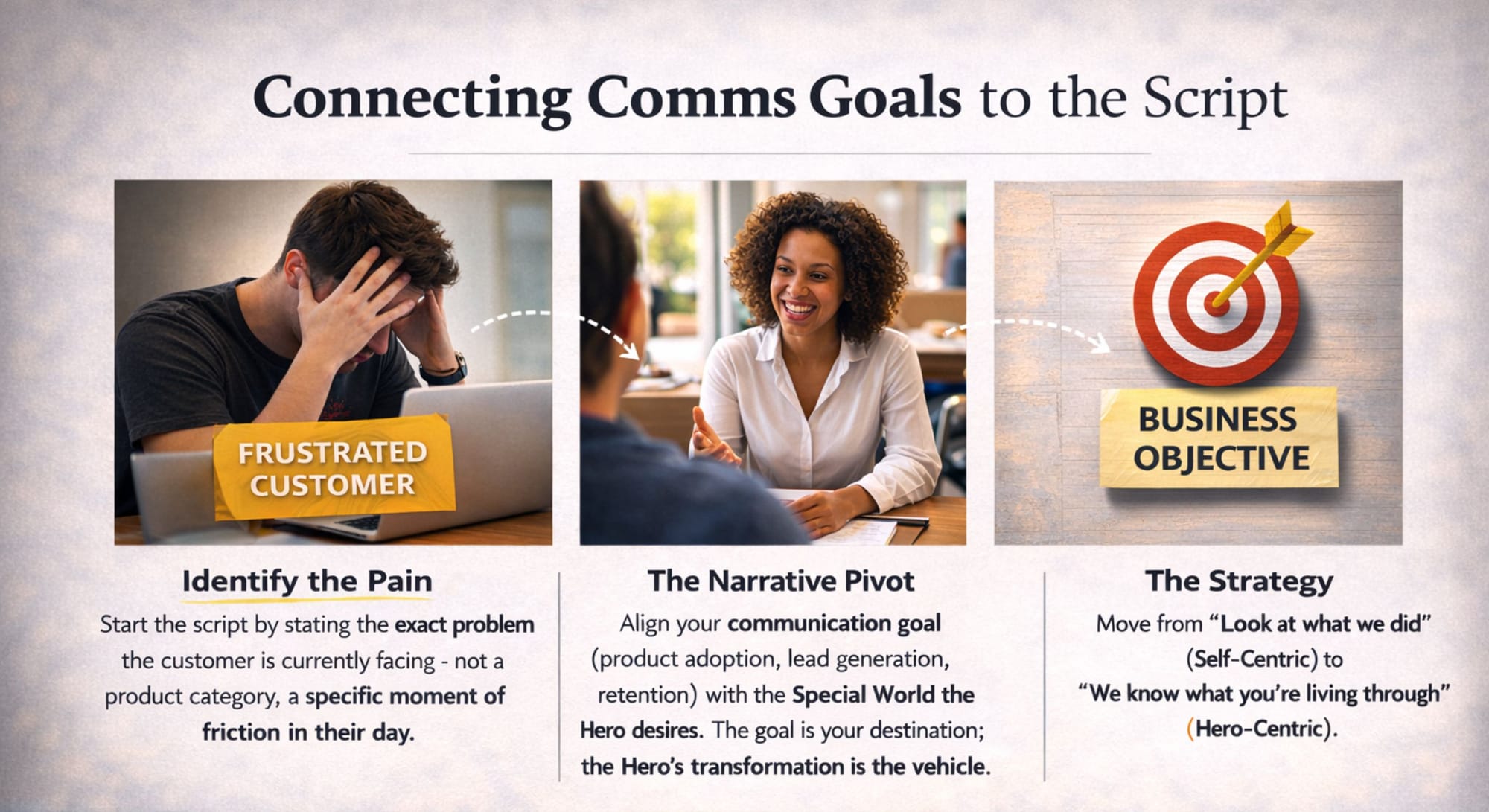
The first mistake in video production is starting with the format. Before the format, there must be a business objective - and that objective must be translated through the Hero's Lenses before a single word of script is written. We don't make videos to "increase brand awareness." We make them to acknowledge where the Hero is struggling and to provide a clear path toward a solution.
- Identify the Pain: Start the script by stating the exact problem the customer is currently facing, not a product category, a specific moment of friction in their day.
- The Narrative Pivot: Align your communication goal (product adoption, lead generation, retention) with the Special World the Hero desires. The goal is your destination; the Hero's transformation is the vehicle.
- The Strategy: Move from "Look at what we did" (Self-Centric) to "We know what you're living through" (Hero-Centric).
The biggest marketing mistake in video is making the brand the protagonist. If the video is about your trophies, it's a boast. If it's about the customer's problem, it's a life raft. One gets skipped. The other gets saved.
Linking Script with Visuals: The Visual Architecture
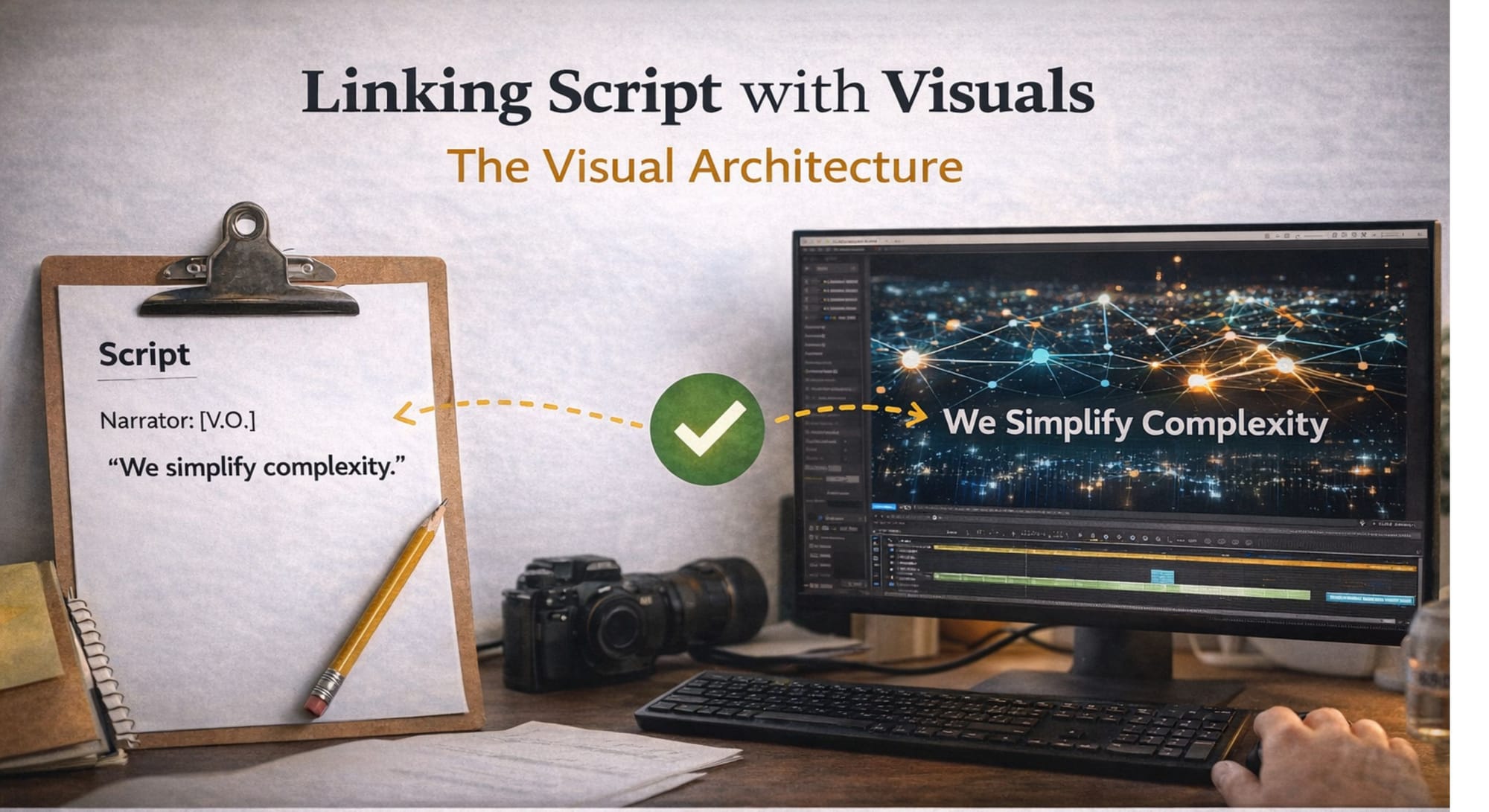
One common failure in video production is the "decoupled" experience, where the script says one thing and the visuals do another. The narrator says "we simplify complexity" while the screen shows a dense product demo. These disconnects don't just feel off; they destroy trust by sending contradictory signals simultaneously. We use Visual Literacy to ensure the eyes and the ears are receiving the same message at every moment.
Show, Don't Just Tell
If the script mentions a pain point, the visual must reflect that struggle. "Overwhelmed by data?" → show a cluttered screen, a stressed face, a desk buried in reports. "Clarity arrives" → the screen clears, the face relaxes, one clean dashboard appears. The visual must carry the narrative, not just accompany it.
Visual Hierarchy in Motion
Use hierarchy to ensure the eye moves naturally from text overlays (The Promise) to the core action (The Substance). On mobile, key text should appear at the top-center of the frame where the eye rests first. Every frame needs one focal point, if three elements compete simultaneously, the viewer retains none of them.
Narrative and Visual Contrast in Sync
Align your narrative "Aha!" moments with visual contrast moments. The Ordinary World of the problem should feel visually heavy: cluttered backgrounds, desaturated tones, tight framing. The Special World of the solution should feel open: clean backgrounds, brighter palette, wider shots. The visual contrast reinforces the emotional shift before the words do.

Working with Brand-Compliant Templates: From Vibe to Law
In the era of GenAI, scaling video production without governance is a brand risk. Every AI-assisted video that doesn't follow brand guidelines is a small inconsistency, and inconsistencies accumulate into a brand that feels fragmented and untrustworthy. Templates are not creative restrictions. They are the Scalable Systems that enforce consistency while allowing for creative agility.
- The Blueprint: Treat templates as the visual architecture of your brand. They ensure every Reel or Short adheres to established hierarchy and contrast rules – the right fonts, proportions, and text overlay placement --regardless of who creates the content.
- Narrative Consistency: Templates move your brand from chaos (inconsistent visual language across creators and channels) to law (documented, scalable systems that can be briefed, delegated, and replicated). A viewer should recognize your next piece of content within 2 seconds.
- Compliance as Empathy: When a video is brand-compliant, it feels familiar and trustworthy to the Hero. Familiarity reduces cognitive load – the viewer doesn't have to work to understand "who is this from?" That recognition validates the empathy and authority promised in the hook.
Video Scripting Mistakes That Cost You the Scroll
Mistake #1: Starting with the brand, not the problem
The first frame should never show your logo, office, or product in isolation. That's a self-centric signal that tells the viewer "this is an ad" – triggering the skip reflex before a single message has landed. Always start with the Hero's frustration. The brand earns its place in the Bridge or Core, after empathy has been established.
Mistake #2: Decoupling the script from the visual brief
Writing the script and briefing the visual team as two separate, sequential steps produces decoupled content. The script should include visual direction for every key narrative moment, as an integrated storyboard, not a separate document. Every claim in the script needs a visual counterpart that reinforces it, not merely decorates it.
Mistake #3: Ignoring the template as a narrative tool
Templates are often treated as a compliance checkbox, applied after the creative is done. Applied correctly, the template is a creative starting point: it gives the script writer a defined canvas (aspect ratio, safe zones, text placement) that shapes narrative decisions from the first line. Write inside the template, not around it.
How to Use GenAI as Your Video Storyboard Architect
Use GenAI as a co-pilot to ensure your visuals and script are perfectly synced before you film. Misalignment caught in the script phase costs nothing. Misalignment caught in the edit costs the entire shoot.
You are a Senior Video Scriptwriter and Storyboard Director specializing in narrative marketing and the Hero's Journey framework.
We are writing a 60-second script for [Project Name].
The Hero: [Persona name + primary emotional state].
The Problem: [Specific pain point – an emotional frustration, not a functional gap].
The Goal: [Comms objective – e.g., product adoption, lead generation, brand trust].
The Template: [Describe brand template constraints – aspect ratio, text safe zones,
brand palette, tone].
Task: Generate an integrated script and storyboard that:
1. Starts with an Inciting Incident (0–3s) – a question or visual that stops the
scroll by naming the Hero's specific frustration.
2. Links every script line to a specific Visual Metaphor that shows (not tells)
the transformation.
3. Suggests where to place Text Overlays using the F-Pattern for mobile retention.
4. Marks narrative "Aha!" moments and aligns them with visual contrast cues
(Ordinary World vs. Special World).
5. Ensures tone remains Empathetic and Authoritative — never self-centric.
Output: Time-coded script (0:00–0:60) with one-line visual direction per segment and a flag for any moment where the brand risks becoming the protagonist.
Validate the result. Does every visual direction reinforce the narrative? Is the Hero the protagonist in every frame? Does the template feel like a creative foundation, not a constraint? Apply your own marketing judgment - GenAI provides the structure, you provide the strategic lens.
Final Thought
Video is the ultimate tool for Visual Literacy. When we connect strategic goals to a Hero-centric script and anchor them with intentional, brand-compliant visuals, we aren't just making "content", we are meeting the Hero exactly where they are struggling and guiding them to a solution.
Is your video a brand trophy, or a GenAI-powered map to the Special World of the Customer?
Recommended Use Cases:
 Diana Socaciu