The Hero's Map: Architecting the 4 Steps of the Customer Journey
Turn the funnel into a Hero’s Journey: map Awareness, Consideration, Conversion, and Retention - plus a GenAI prompt to architect each step.

A successful journey isn't a straight line. It is a narrative arc where the individual is the protagonist and our brand is the Life Raft. If we make the brand the hero, our content becomes a boast. If we make the customer the hero, our content becomes a solution.
The traditional marketing funnel – Awareness, Consideration, Conversion, Retention – is a useful skeleton, but it is built around what the business needs from the customer. When we map those same four stages onto the Hero's Journey, we shift the perspective entirely: we start measuring what the customer experiences at each step. That shift changes every creative decision – what we say in the hook, how we structure consideration content, what we prioritize on the landing page, and how we design the post-purchase experience. Here is the full map, stage by stage.

Step 1 – Awareness: The Ordinary World & The Inciting Incident
At this first stage, the individual is in their "Ordinary World". They are experiencing a specific frustration, but they are often unaware that a solution exists. They are not searching for a brand; they are scrolling through their feed, living inside their problem. We have exactly 2 seconds to earn their attention and validate that struggle, not to sell, but to recognize.
- Primary Touchpoints: Short-form video (Reels, Shorts), social media feeds, and targeted search results.
- The Goal: To act as the Inciting Incident – the Hook – that interrupts the scroll and makes the Hero feel seen.
- The Approach: Use a Hero-Centric hook that names a specific internal frustration, not a product category or feature list.
- Comms Adjustment: Use narrative contrast to break through the "Daily Noise" and open a Curiosity Gap. State the problem so precisely that the Hero immediately assumes you have the answer.
- Visual Strategy: Place text overlays where the mobile eye naturally rests – the F-Pattern (top-left to center) - and use high visual contrast between text and background to stop the scroll.
Example: Instead of "Our fitness app has 500 workouts" (Brand-Centric), open with: "Is your current workout routine feeling like a second job you didn't sign up for?" (Hero-Centric). Same product, completely different perspective.

Step 2 – Consideration: Evaluating the Mentor
The Hero has noticed us. Now they are evaluating: is this brand a trustworthy Mentor, or just more noise with a better hook? This is the Bridge in the customer journey - the space where we connect their validated pain to our specific solution. The customer is not yet ready to buy. They are ready to learn. And learning requires trust, not pressure.
- Primary Touchpoints: Long-form articles, email newsletters, "How-to" guides, and case studies.
- The Goal: To build Empathy and Authority simultaneously, proving we understand the problem and that we know how to solve it.
- The Approach: Move away from polished, abstracted studio content and toward Authenticity. Show real people solving real problems in recognizable contexts.
- Comms Adjustment: Switch from "Look at what we did" (Brand-Centric) to "We know what you're living through" (Customer-Centric). Every headline, case study, and testimonial should be told from the Hero's perspective.
- Visual Strategy: Use White Space – the "Breath of the Hero" – to prevent an overwhelming information dump. Structure content with the Inverted Narrative Pyramid.
Example: A video of a real person integrating a healthy habit into a chaotic, messy morning builds far more trust than a brand-centric "trophy" video shot in a perfect studio. The Hero recognizes themselves in the first; they feel excluded from the second.
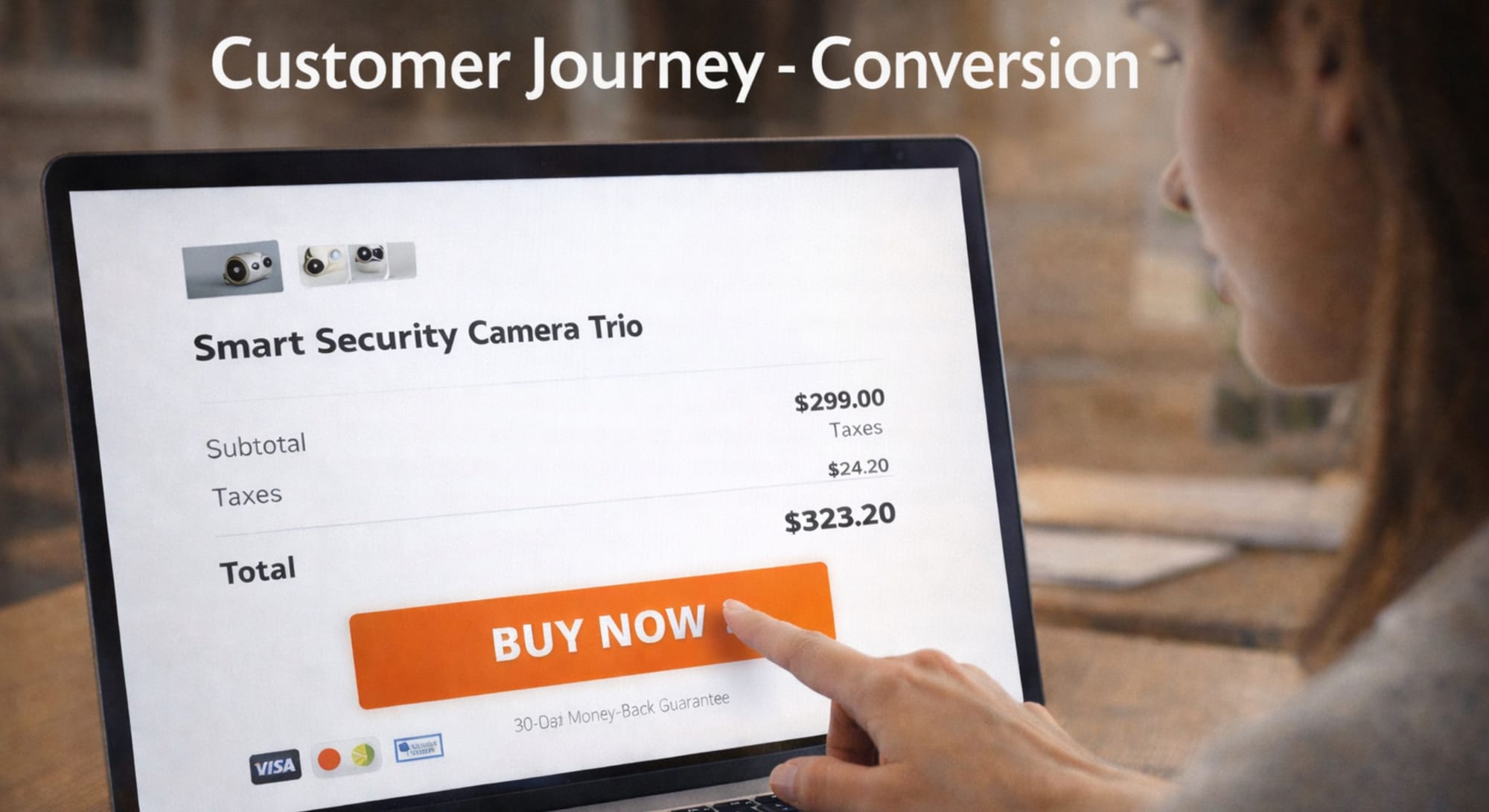
Step 3 – Conversion: Crossing the Threshold
The conversion is the Core of the customer journey, the moment the Hero commits to the transformation. This is when they stop evaluating and decide to cross the threshold into the Special World. Visual Literacy becomes operationally critical here: if the page is visually cluttered, if the CTA competes with three other elements, if the hierarchy is unclear, the Hero hesitates. Hesitation kills conversions.
- Primary Touchpoints: Landing pages, product descriptions, pricing tables, and checkout screens.
- The Goal: To provide narrative satisfaction, to make the Hero feel that choosing this solution is the only logical next step.
- The Approach: The CTA must be the undeniable visual Focal Point of the entire page. One clear action, not five.
- Comms Adjustment: Apply the Hero's Lenses: Is the path clear? Can the Hero understand what happens next in 2 seconds? Remove everything that doesn't serve that question.
- Visual Strategy: Use high Value Contrast and Size Contrast to make the choice visually obvious. Surround the CTA with White Space so the eye has nowhere else to go.
Example: A subscription page with intentional white space, a single Massive Headline, and one isolated CTA button. The Hero isn't lost in aesthetic chaos – the design itself guides them to the threshold.
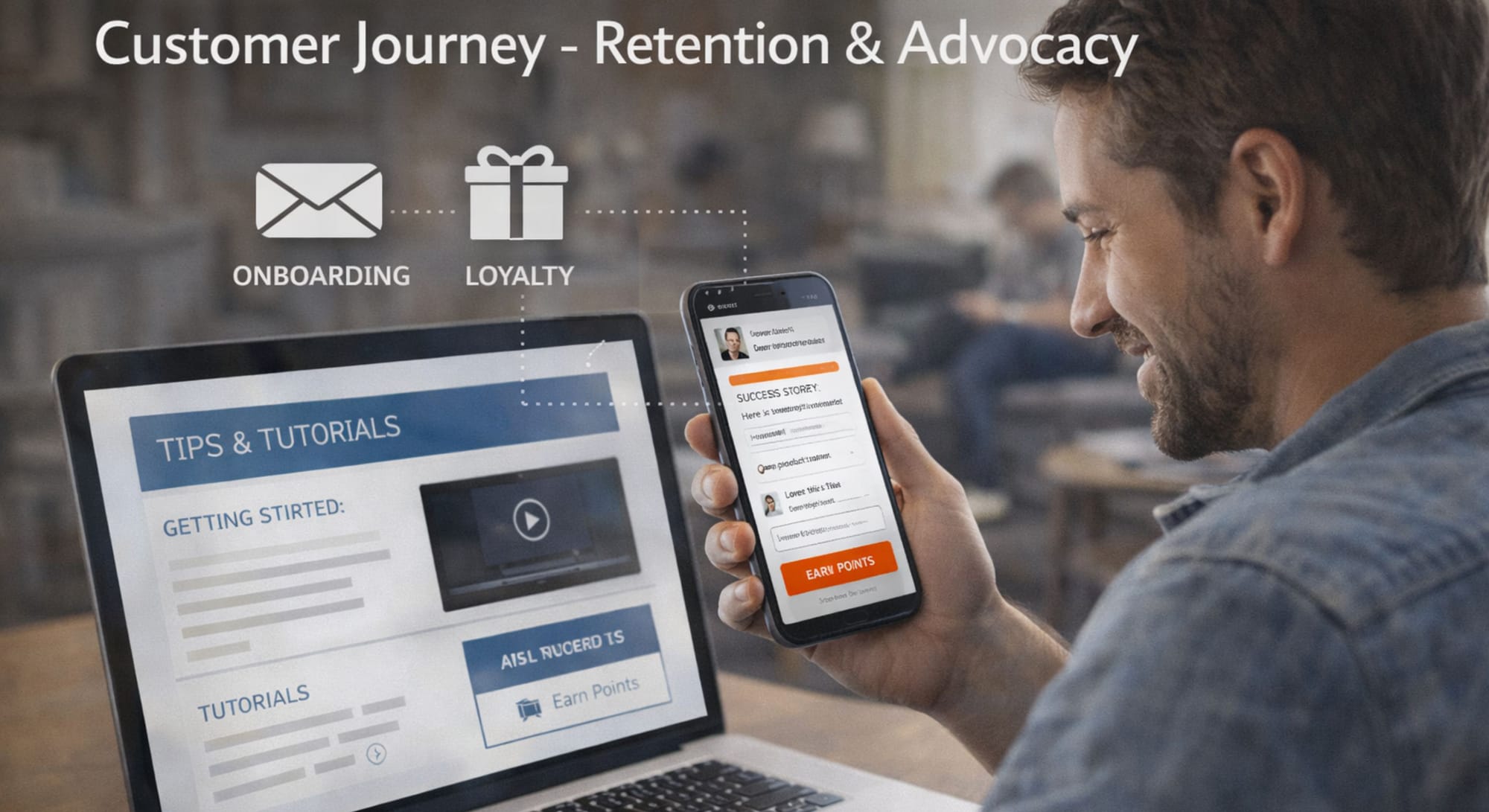
Step 4 – Retention & Advocacy: The Return with the Elixir
The customer journey doesn't end at the purchase. That is where a transactional funnel ends - not a narrative arc. In the Hero's Journey, the Hero must return to their Ordinary World, but transformed. They carry the "Elixir" – the new knowledge, the new capability – and they share it. In 2026, Dwell Time and long-term utility are the metrics of trust.
- Primary Touchpoints: Onboarding emails, community forums, tutorials, loyalty programs, and re-engagement campaigns.
- The Goal: To turn a satisfied customer into a successful protagonist – someone whose transformation story becomes the brand's most credible voice.
- The Approach: Provide high-utility "How-to" content that ensures genuine product adoption. Don't just celebrate the sale; empower the usage.
- Comms Adjustment: Close the Curiosity Gap completely by giving the customer the specific knowledge needed to maintain the transformation. The journey arc should feel complete.
- Visual Strategy: Use Micro-Headings and F-Pattern design in all onboarding and tutorial materials – helping the Hero scan, absorb, and apply information on mobile at their own pace.
Example: Automated follow-up guides providing the exact "Magic Tools" needed to maintain the transformation long-term - not a generic "thanks for your purchase" email.
Journey Mapping Mistakes to Avoid
Mistake #1: Treating every touchpoint as a Conversion point
Not every piece of content should ask for the sale. Awareness content that hard-sells signals that the brand cares more about its funnel than the Hero's readiness. Each stage has one job - let it do that job before advancing.
Mistake #2: Abandoning the Hero after the sale
Most marketing budgets are spent on Awareness and Conversion. Retention is left to automated, disconnected system emails with zero narrative continuity. If the post-purchase experience feels completely different from the marketing experience, the Hero feels misled. Tone, voice, and visual language must remain consistent from the hook to the onboarding sequence.
Mistake #3: Mapping the journey once and never revisiting it
Customer behavior, platform algorithms, and content formats change. A journey map built in Q1 may no longer reflect how the Hero moves by Q3. Treat the map as a living document - pressure-test it quarterly with real data (dwell time, scroll depth, drop-off points, CTA conversion rates) and update the narrative at each stage accordingly.
How to Use GenAI as Your Journey Architect
Use GenAI as a co-pilot to pressure-test every stage of this customer journey map before you launch a campaign or publish a new content sequence.
The prompt:
You are a Senior Strategic Marketer specializing in the Hero's Journey framework and customer experience design.
I am mapping the customer journey for [Product/Service Name].
The Hero: [Persona name + primary frustration].
The Comms Goal: [e.g., increase product adoption / drive newsletter signups].
Task: Audit and architect the 4 steps of this journey:
1. Awareness: Write one Hero-Centric Inciting Incident hook (max 2 sentences)
that names the exact frustration and opens a Curiosity Gap.
2. Consideration: Suggest a visual or narrative "Bridge" that builds empathy
through authenticity - not brand-boasting.
3. Conversion: Define the primary visual hierarchy for the landing page
to ensure a clear "Aha!" moment and one undeniable CTA.
4. Retention: Suggest one post-purchase "Elixir" communication that empowers
the Hero to successfully use the solution.
Ensure the brand remains the Guide - not the Protagonist - throughout.
Output: Present as a 4-step map with one concrete example per stage.
Validate the result. Use your own expertise and judgment to make sure the output reflects your brand's reality. GenAI provides the structural map, you provide the strategic and human context. When in doubt, edit using your marketing expert lenses.
Final Thought
When we speak the language of the Hero's Journey, we stop being "critics" and start being Co-Architects of our customer's success. A disconnected funnel creates friction. A cohesive narrative creates momentum.
Are you building a brand trophy, or are you providing a map to the Special World?
Recommended Use Cases:
 Diana Socaciu