The Gateway to Attention: Mastering the Hook in Narrative Marketing
Master the hook in narrative marketing: build hero-centric hooks that stop the scroll, avoid clickbait, and use GenAI to generate high-converting options fast.

We've all felt the pressure to "be catchy". We spend hours on a blog post or an email only to have it ignored because the subject line didn't land. We A/B test headlines endlessly. We rewrite opening sentences three times. And still – silence.
The problem isn't that we're bad writers. The problem is that we're writing hooks about the wrong subject. Most hooks are about the brand, and the audience doesn't care about the brand. They care about themselves. Their problems. Their time. Their decisions. In this article, I'll show you the framework behind hooks that actually work: why the hook is the most critical moment in your entire content architecture, what makes the difference between a hook and clickbait, and how to use GenAI to generate dozens of options in minutes, without losing the human relevance that makes them land.
Why the Hook Is the Most Underinvested Moment in Marketing
Here's a sobering reality: the average person makes the decision to keep reading, watching, or listening within the first 2-3 seconds of encountering your content. That's the hook window. Everything you've built after that moment – the argument, the data, the offer, the CTA – is invisible to anyone who didn't make it past line one.
Yet most marketing teams invest the majority of their time in the body of the content and treat the hook as an afterthought. The presentation is polished. The case study is beautifully structured. The email is well-segmented. And the subject line was written in 60 seconds before hitting send.
That's backwards. In narrative marketing, the hook is the Inciting Incident – the moment the Hero's Ordinary World is interrupted by a possibility. Without a strong inciting incident, the story never begins. Without a strong hook, your content never gets read.
We only have about 2 seconds to earn 2 minutes of someone's time. If we don't hook them by acknowledging their journey, they will never see the value we've worked so hard to create.
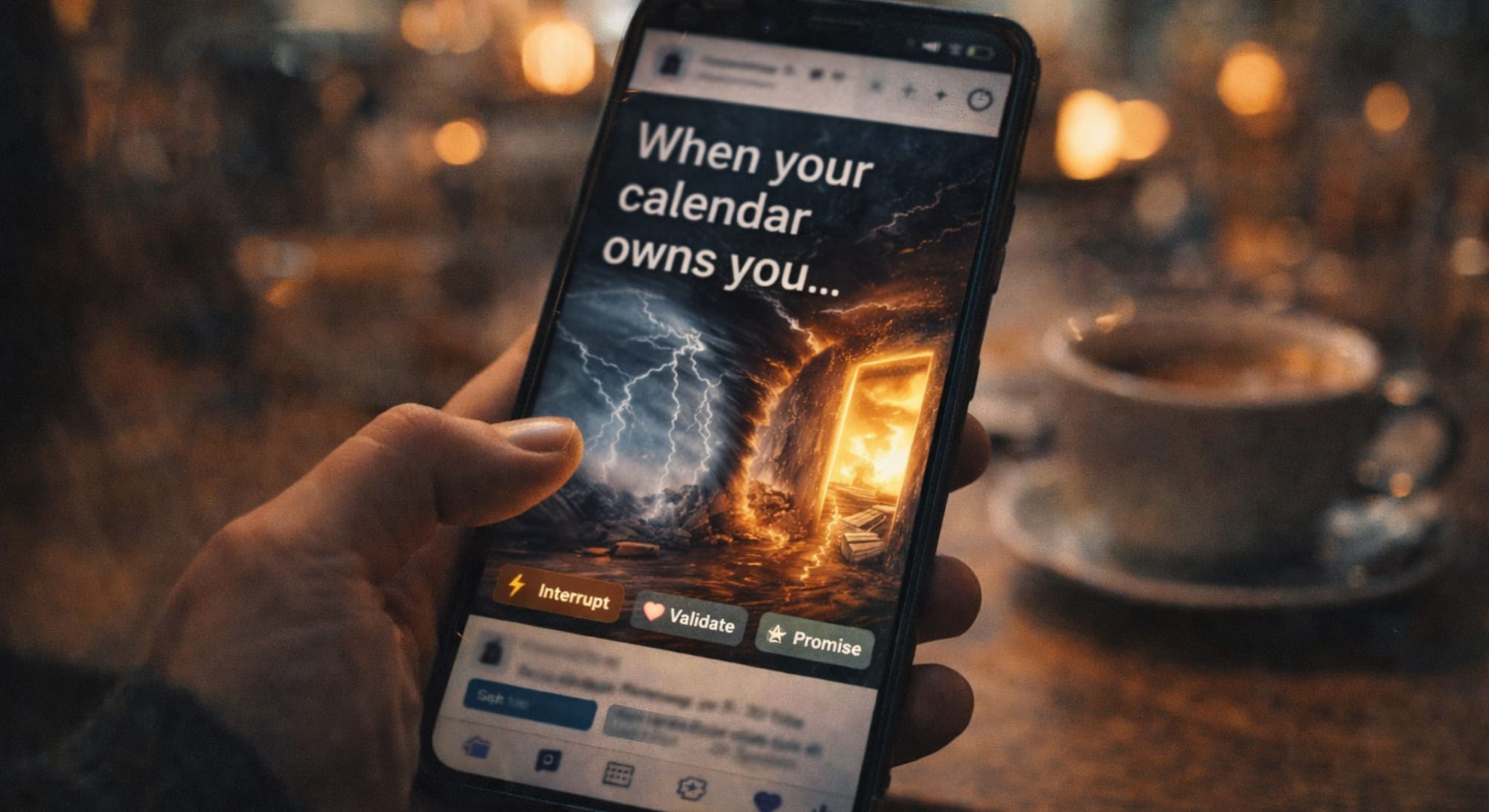
The Hook as the Inciting Incident
In the Hero's Journey framework, the story doesn't start until something happens to the Hero. A call to adventure. A disruption. A moment where staying in the Ordinary World is no longer an option.
The hook is that moment, applied to content. We aren't just writing a headline; we are identifying the exact moment the customer's problem becomes unavoidable. The hook doesn't introduce your brand. It introduces the Hero's struggle.
To be effective, every hook must do three things:
1. Interrupt: It stops the physical act of scrolling by addressing a specific pain point, not a category, not a demographic, but a specific moment of friction the reader recognizes from their own life.
2. Validate: It shows the Hero that you understand their current struggle. This is empathy in action, not sympathy, not pity, but recognition. "I see exactly where you are right now".
3. Promise: It hints at a transformation or a "Special World" – the possibility that things could be different – without giving the resolution away. This is the gap that pulls the reader forward.
Remove any one of these three elements and the hook weakens. Interrupt without validation and you're just loud. Validate without a promise and you're just commiserating. Promise without interruption and you're talking to people who weren't listening in the first place.
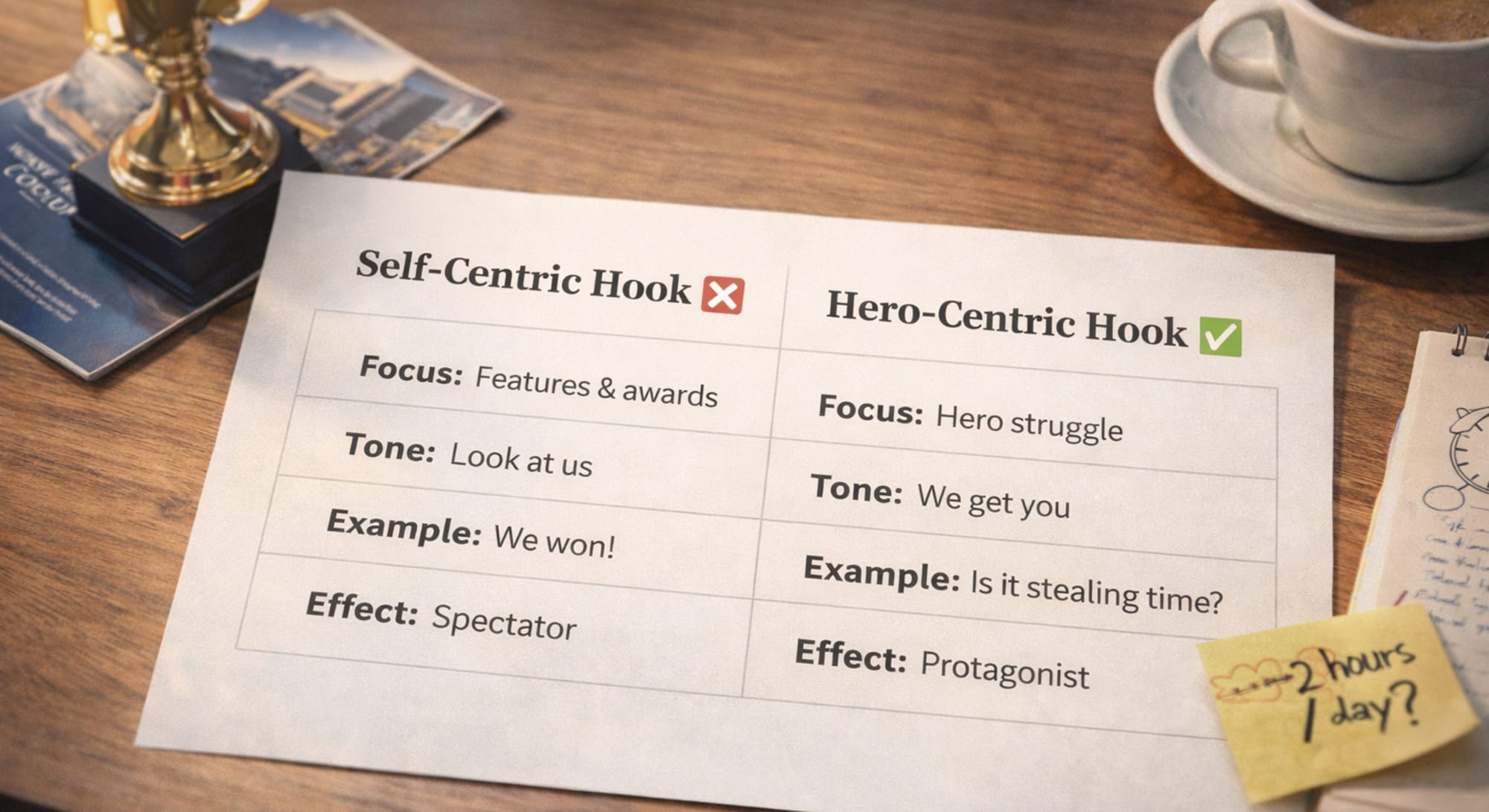
Self-Centric vs. Hero-Centric Hooks
The biggest mistake in hook writing is centering the brand instead of the customer. If the brand is the Hero, the hook is a boast. If the customer is the Hero, the hook is a life raft.
Self-Centric Hook  | Hero-Centric Hook  |
|---|---|
| Focus: Our features or achievements | Focus: The Hero's struggle or desire |
| Tone: "Look at what we did." | Tone: "We know what you're living through." |
| Example: "Our software just won 'App of the Year'!" | Example: "Is your current software stealing 2 hours of your day?" |
| Effect: The reader feels like a spectator | Effect: The reader feels like the protagonist |
The strategy shift is simple, but profound: stop trying to be the most interesting person in the room and start being the most interested in the Hero's problem.
Notice the difference in the examples above. "App of the Year" is impressive, but it's about the brand. "Is your software stealing 2 hours of your day?" speaks directly to a lived frustration. One asks the reader to applaud. The other asks the reader to recognize themselves.
Types of Hooks That Work (With Examples)
Not all hooks use the same mechanism. Here are the five most reliable types - each creating narrative tension in a different way:
1. The Pain Point Hook
State the exact frustration without softening it.
"You wrote the best article of your career. Nobody read it."
2. The Counterintuitive Hook
Challenge a widely held belief, create cognitive dissonance.
"The more content you publish, the less your audience trusts you."
3. The Curiosity Gap Hook
Name the outcome but withhold the method, force the reader forward.
"I cut our content production time by 60% without losing quality. Here's what changed."
4. The Stakes Hook
Show the cost of inaction, what happens if the Hero stays in the Ordinary World.
"Every day your brand sounds inconsistent is a day you're training your audience to ignore you."
5. The Recognition Hook
Describe a specific scene the reader has lived through, make them feel seen.
"It's 4:45pm. The campaign goes live tomorrow. The brief just changed."
The strongest hooks often combine two types - usually Pain + Curiosity Gap, or Recognition + Stakes. Experiment with combinations once you're comfortable with each type individually.
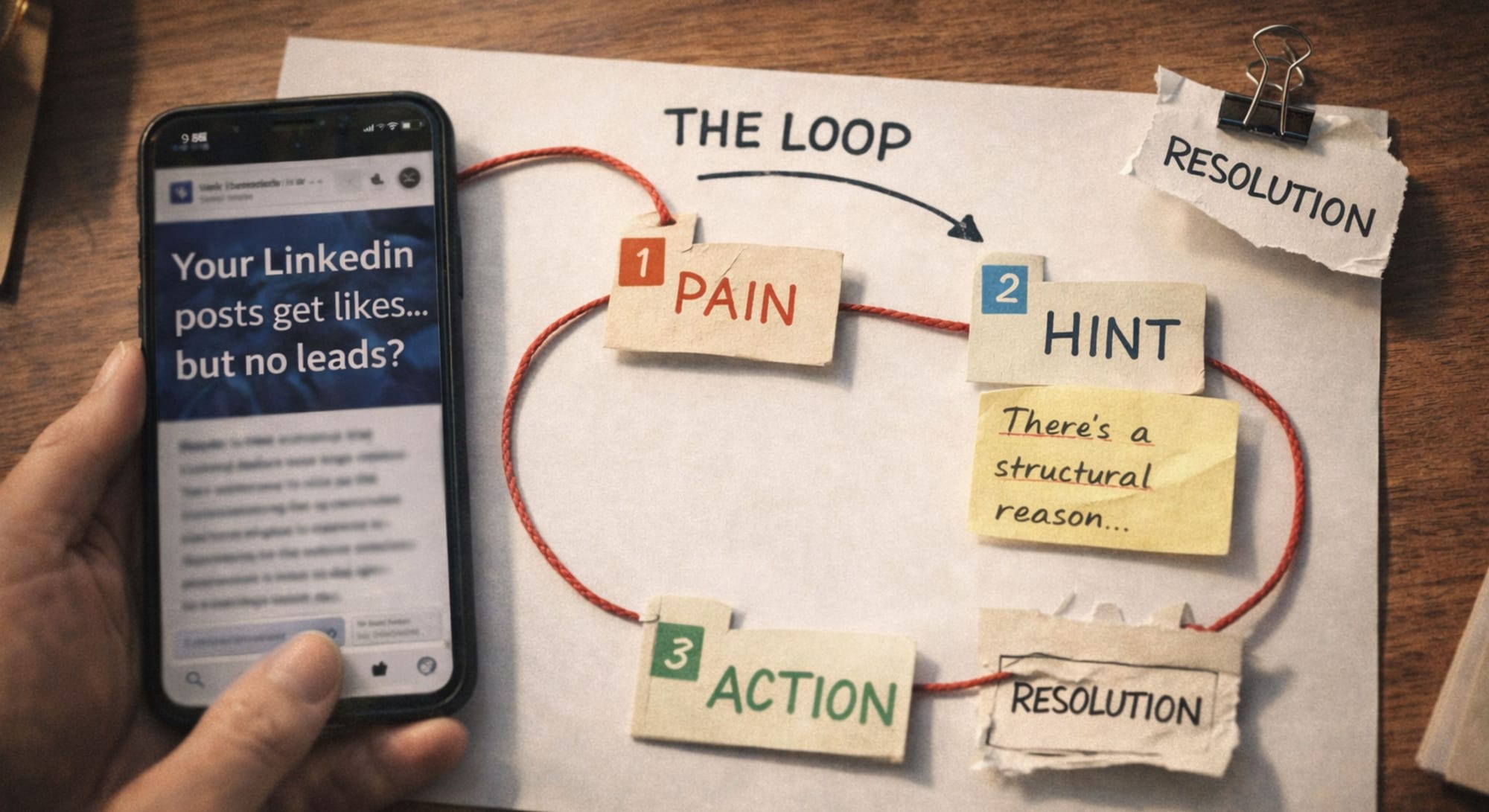
The Tension Resolution Gap: How Great Hooks Keep People Reading
A great hook doesn't just stop the scroll - it creates Narrative Tension. It opens a loop in the reader's brain that can only be closed by reading the next sentence. Psychologists call this the Zeigarnik Effect: incomplete tasks occupy mental space until they're resolved. A great hook is an incomplete task.
You create this tension using the Curiosity Gap, the deliberate distance between what the reader knows and what they sense they're about to learn:
Step 1 - Identify the Pain
State the problem they are currently facing. Be specific. "Brands struggle with content" is too vague. "Your LinkedIn posts get likes from colleagues but never generate leads" is a pain point.
Step 2 - Hint at the Plan
Mention that a solution exists without giving it away. "There's a structural reason for this - and it has nothing to do with your writing quality". The reader now has to keep reading to close the loop.
Step 3 - Invite Action
Give them the first step toward resolution. "Here's the framework I use to fix it in every brief I write". Now the promise is concret, and the reader is already inside the story.
Hook Mistakes That Kill Good Content
Mistake #1: Being clever instead of clear
Wordplay and wit are memorable, after the reader already trusts you. In a cold hook, clarity wins over cleverness every time. If a reader has to re-read the hook to understand it, they won't. They'll scroll past it. Save the wit for the body of the content, once you've earned their attention.
Mistake #2: Making a promise you don't keep
Clickbait works once, and destroys trust permanently. If your hook promises "The 3 words that will double your conversion rate" and the article delivers generic advice, you haven't just lost that reader. You've trained them to distrust every future hook you write. The promise in the hook must be a preview of the actual content, not a lure.
Mistake #3: Writing one hook and moving on
Professional copywriters write 10-20 hook variations before choosing one. Most content creators write one and publish it. The gap in quality between your first hook and your tenth is enormous, because the first one is what you think the reader wants to hear, and the tenth is what you've discovered actually resonates. Use GenAI to close this gap at speed.
Mistake #4: Ignoring the channel context
A hook for a LinkedIn article, an email subject line, and a Meta ad operate under completely different constraints – different formats, different mindsets, different reading speeds. A 40-word hook works on a blog. It fails as an email subject line. Always write hooks for the specific channel, not as a generic opening.
How to Use GenAI as Your Hook Generator
GenAI can generate dozens of hook variations in seconds - but only if you provide the right narrative context. A prompt like "Write 5 hooks for our new product" produces generic output. A prompt that includes the persona, the pain point, the channel, and the tone constraint produces hooks that feel written by someone who knows your customer.
Here is the prompt template I use:
You are a Senior Copywriter specializing in narrative marketing and the Hero's Journey framework.
We are writing a series of hooks for [Project Name / Campaign].
The Hero: [Insert Persona Name + their primary emotional state].
The Problem: [Insert specific internal pain point - not a functional feature gap, but an emotional frustration].
The Guide's Tool: [Insert your product/service in one sentence].
The Channel: [LinkedIn article / Email subject line / Meta ad / Instagram caption - specify one].
The Tone: [Empathetic and Authoritative - never clickbait].
Task:
Generate 5 hooks for this channel that:
1. Start with the Hero's internal frustration (not the product feature).
2. Create a Curiosity Gap regarding our solution - hint at transformation without revealing it.
3. Avoid clickbait by grounding each hook in a specific, recognizable moment or feeling.
4. Stay within platform constraints (LinkedIn: up to 40 words / Email subject: under 60 characters / Ad: under 125 characters).
Output format:
For each hook, provide:
- The hook text
- The hook type (Pain Point / Counterintuitive / Curiosity Gap / Stakes / Recognition)
- A one-sentence explanation of the emotional mechanic it uses
Run this prompt three times, once per primary channel, and you'll have 15 hook options to choose from in under five minutes. Then apply your own judgment: which one sounds most like your brand? Which one would stop you in the feed?
From Hook to Content: Maintaining Narrative Tension Throughout
The hook opens the loop. The content must close it, but not immediately. Narrative tension must be maintained throughout the piece, not just in the first sentence.
Every paragraph should do one of three things:
- Deepen the problem - show the reader a dimension of their pain they hadn't fully articulated yet
- Build toward the solution - move the story forward without resolving it prematurely
- Deliver a micro-reward - give the reader something useful or surprising that justifies continuing
If a paragraph does none of these three things, it breaks the tension, and risks losing the reader at paragraph four instead of paragraph one. The hook brought them in. The structure keeps them there.
Final Thought
The hook is the gateway. But what comes after – the argument, the structure, the substance – is what builds the trust that converts attention into action.
Are we shouting into the void or are we meeting the Hero exactly where they are struggling?