From Narrative to Pipeline: How Great Storytelling Actually Generates Leads
Brand storytelling and lead generation are treated as opposing disciplines competing for the same budget. They are not. Great narrative is not decoration on top of a demand engine, it is the demand engine. Here is the mechanism that turns a Hero's Journey into pipeline.
There is a division in most marketing organisations that everyone accepts and almost nobody examines. On one side sits the brand team: narrative, positioning, storytelling, the long game. On the other side sits the demand team: pipeline, leads, conversion, the numbers for this quarter. The two are funded separately, measured separately, and quietly regard each other with suspicion. The brand team thinks demand gen is short-termist and corrosive to the brand. The demand team thinks brand is unaccountable and expensive. And in the annual budget conversation, they compete, as if storytelling and pipeline generation were rival claims on the same money.
This division is not just unproductive. It is based on a misunderstanding of how demand actually forms. Great narrative does not sit above the demand engine as an expensive luxury the revenue team tolerates. Great narrative is the demand engine, the specific mechanism by which a stranger becomes aware, becomes interested, becomes convinced, and becomes a lead. Storytelling that does not generate demand is not too much storytelling. It is storytelling disconnected from the journey it was supposed to move someone through.
This article opens the demand gen series. Everything this series has built on the strategic and content side – the positioning, the narrative architecture, the Hero's Journey funnel – connects here to the commercial outcome it was always meant to produce. This is where story becomes pipeline.
Why the Brand-Versus-Demand Divide Is a Category Error
The brand-versus-demand divide assumes the two are different activities, when they are in fact the same activity measured at two different points in time. Brand storytelling is demand generation with a longer lag. Demand generation is brand storytelling at the moment of decision. The only real difference is when the effect shows up, and the organisational habit of measuring them separately, on different timescales, is what makes them look like opponents.
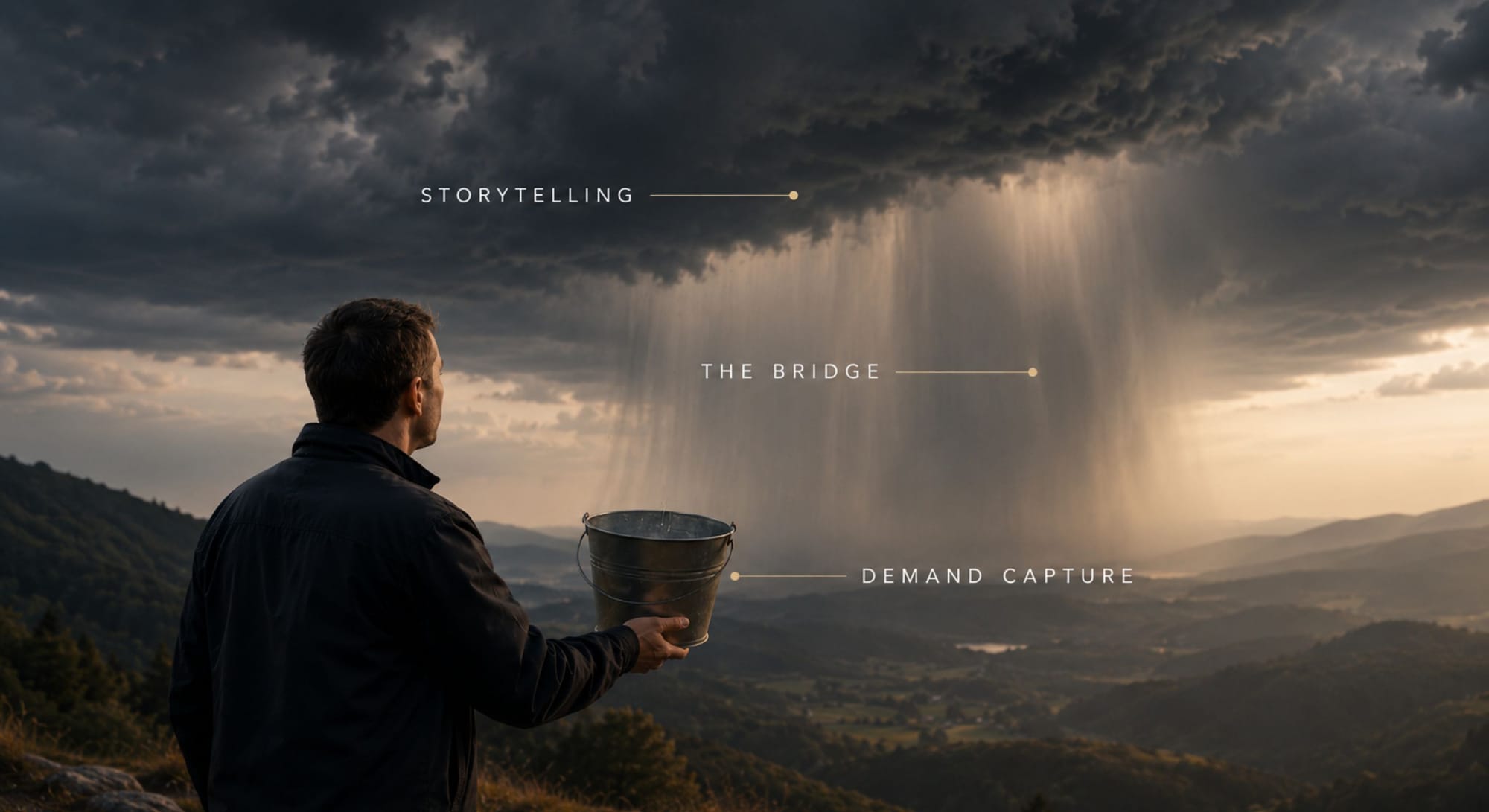
Consider what actually happens when a lead converts. Someone fills in a form, and the demand team attributes the lead to whatever touchpoint immediately preceded it: a paid ad, a search, a gated download. But that final touchpoint did not create the demand. It captured it. The demand was created earlier: in the article the person read three weeks ago, the point of view that reframed how they saw their problem, the narrative that made them believe change was possible and this brand understood their situation. The story built the demand. The form merely collected it. Measuring only the form is what makes storytelling look like it does not generate leads, when in fact it generated the very lead the form is taking credit for.
The bridge principle: Demand does not happen at the bottom of the funnel. It is created at the top and captured at the bottom, and the thing that creates it is narrative. A form does not generate demand any more than a bucket generates rain. Storytelling is the weather system. The demand team has been measuring the bucket and concluding the sky does nothing.

The Narrative-to-Pipeline Mechanism
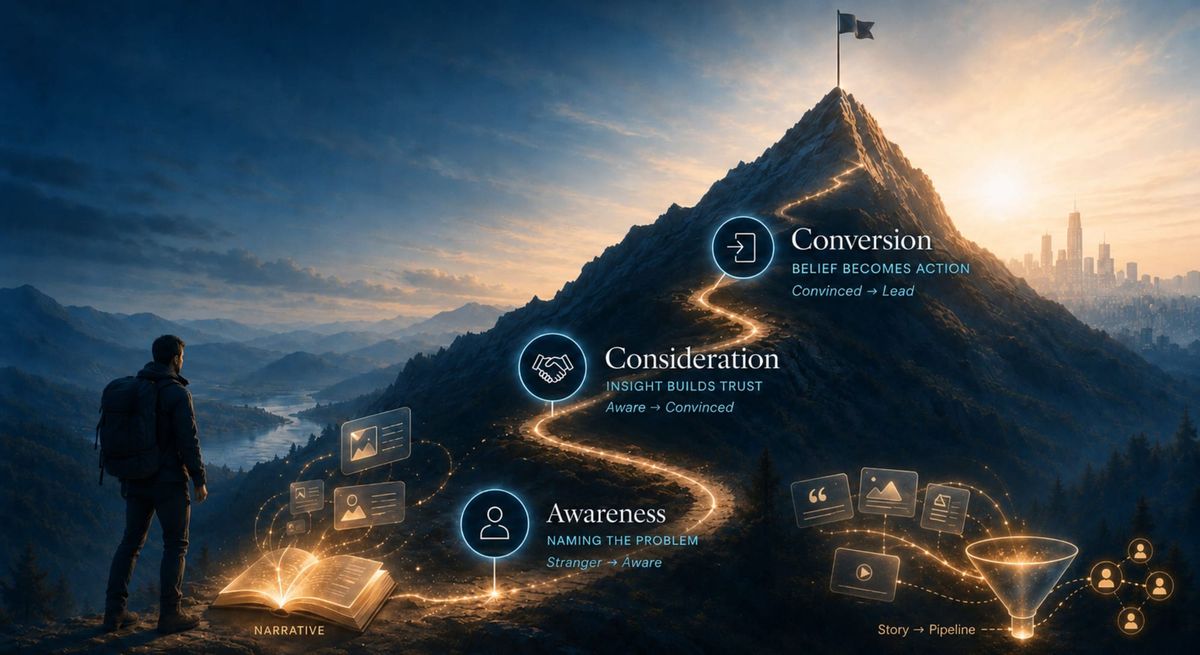
If narrative generates demand, the useful question is: through what mechanism, exactly? The answer is the Hero's Journey funnel from earlier in the series, but read now not as a content model, but as a demand model. Each stage of the story does a specific commercial job. The narrative moves The Hero from one psychological state to the next, and each transition is a step toward becoming a lead.
Awareness Stage
The Ordinary World – Naming the Problem Creates Recognition
Stranger → Aware
Demand begins the moment a stranger recognises their situation in your narrative. The story names The Hero's Ordinary World, the specific frustration, the unspoken problem, the tension they live with but have not fully articulated.
Recognition is the first commercial event: the moment the reader thinks "this is about me" is the moment a stranger becomes a prospect. No offer, no pitch, no product. Just the accurate naming of a problem the audience did not know anyone else understood. This is where demand is born, and it is pure narrative.
The commercial job: Convert strangers into people who recognise they have the problem you solve. Measured by reach among the right audience and the depth of engagement, not by leads.
Consideration Stage
The Guide Appears – Insight Builds Trust
Aware → Convinced
Once the audience recognises the problem, the narrative earns the right to reframe it. This is where the brand appears, not as The Hero, but as The Guide who has seen this problem before and understands it more deeply than the audience does.
Trust is built through insight, not persuasion: every genuinely useful idea the narrative delivers is a deposit in the trust account that the eventual conversion draws on. The audience moves from "this is about me" to "these people understand this better than anyone else I have found". That shift is the demand deepening.
The commercial job: Convert aware prospects into people who trust the brand's authority on the problem. Measured by returning engagement, content depth, and subscription, the leading indicators of pipeline.
Conversion Stage
The Call to Adventure – Belief Becomes Action
Convinced → Lead
Only after recognition and trust does the invitation to act land. By the time a well-built narrative asks The Hero to take a step (a demo, a conversation, a trial), the audience is already convinced the brand understands their world and can guide them through it.
The conversion is not where persuasion happens. It is where prior persuasion is collected. A lead generated here is not the product of the form or the offer. It is the product of the whole narrative that made the person ready to say yes before they were asked. The demand team captures this lead, but the narrative created it.
The commercial job: Convert convinced prospects into leads. Measured by conversion rate and lead quality, which are high precisely because the narrative did the convincing upstream.
The mechanism, made explicit: Recognition creates demand. Trust deepens it. The invitation captures it. Each of the three is a narrative act with a commercial consequence, and skipping the first two does not remove them from the process, it just means someone else's narrative did that work, and you are paying to convert an audience a competitor's story already shaped. The teams with the cheapest, highest-quality pipeline are the ones whose own narrative did the recognition and trust work, so the conversion step is collecting demand they created rather than renting demand someone else did.

Why Story-Led Pipeline Is Cheaper and Higher Quality
The commercial case for narrative is not soft. It is an efficiency argument, and it is the argument a revenue-accountable marketer should care about most. A lead generated by a narrative that did the recognition and trust work is cheaper and better than a lead bought at the point of conversion, for reasons that are structural, not sentimental.
It is cheaper because demand you create is less expensive to convert than demand you compete for. When your narrative made someone aware of their problem and built their trust, the conversion is the cheap final step of a process you owned from the beginning. When you skip the narrative and buy leads at the bottom, you are bidding against every competitor, for the attention of people whose problem-awareness and trust were built by somebody else, or by nobody, which is why they convert reluctantly and expensively. This is the same dynamic the paid media article named: a funnel fed only at the bottom runs dry and dear.
It is higher quality because a lead that arrives already convinced by your narrative arrives pre-qualified. They understand the problem the way you framed it, which means they value the solution the way you built it. They are, by the time they convert, already aligned with your point of view, which is why story-led leads close faster and churn less. The narrative did not just generate the lead. It pre-sold the relationship.
Three Mistakes That Sever Narrative From Pipeline
Mistake #1: Measuring narrative on conversion-stage metrics
The fastest way to kill story-led demand is to judge the awareness-stage narrative by bottom-funnel metrics. An article whose job is recognition (turning strangers into people who know they have the problem) will look like a failure if measured on immediate lead generation, because generating leads is not its job. Judged that way, it gets cut, and the recognition work that fed the entire funnel disappears. Each narrative stage must be measured on the commercial job it actually does: recognition and engagement at the top, trust and return at the middle, conversion only at the bottom. Measuring the whole narrative on the bottom-funnel number guarantees the top gets defunded.
Mistake #2: Rushing to the invitation before recognition and trust exist
Under pipeline pressure, the temptation is to skip to the call to action, to ask for the demo before the narrative has done the recognition and trust work. This produces the high-spend, low-conversion pattern every demand team knows: plenty of offers pushed, few taken, because the audience was invited to act before they were made ready to. An invitation that arrives before recognition and trust is not demand generation. It is interruption, and it converts like interruption. The narrative sequence is not optional decoration, it is the mechanism that makes the eventual ask land.
Mistake #3: Building a beautiful narrative that connects to no commercial step
The opposite failure is equally real, and it is the one that gives storytelling its unaccountable reputation. A brand builds a genuinely lovely narrative (evocative, well-crafted, admired) that is connected to no funnel stage and no commercial job. It creates recognition that leads nowhere, because there is no considered path from the story to a next step. This is the storytelling the demand team is right to be suspicious of: narrative as self-expression rather than narrative as a demand mechanism. The fix is not less story. It is connecting every piece of the story to the commercial step it is meant to produce.
How to Use GenAI to Map Your Narrative to Pipeline
Auditing whether a narrative actually connects to pipeline (stage by stage, story act to commercial job) is a structured analysis task. GenAI is useful for running that map and exposing the gaps where the story does recognition work that leads nowhere, or asks for conversion the narrative has not earned.
Run this Prompt:
I will share my current marketing narrative and content. Map it to the narrative-to-pipeline mechanism and expose where story and commercial outcome are disconnected.
MY NARRATIVE AND CONTENT:
- The core narrative / point of view: [Describe or paste]
- The main content pieces and where they sit: [List with their intended stage if known]
- The current conversion points (where we ask for the lead): [Describe]
- How each piece is currently measured: [Describe]
MAP AND DIAGNOSE:
1. RECOGNITION (Awareness): Does the narrative clearly name the audience's Ordinary World (the problem) in a way that creates "this is about me" recognition? Or does it lead with the brand and the product? Flag any awareness content that pitches before it names the problem.
2. TRUST (Consideration): Does the narrative build authority through genuine insight, positioning the brand as The Guide? Or does it push toward conversion too early? Identify where trust is built and where it is skipped.
3. CONVERSION (Invitation): Is the ask made only after recognition and trust are established? Flag any conversion point that arrives before the narrative has earned it.
4. THE MEASUREMENT MISMATCH: Flag any narrative stage being judged on a commercial metric from a different stage, especially awareness content measured on lead generation.
5. THE DISCONNECTS: Identify any content that is doing narrative work connected to no commercial step, AND any conversion point asking for action the narrative has not made the audience ready to take.
OUTPUT:
- A stage-by-stage map of where narrative connects to pipeline and where it breaks.
- The single highest-leverage fix, the one connection that, repaired, would most improve the flow from story to lead.
Rules:
- Treat storytelling as a demand mechanism. Never recommend cutting narrative to "focus on conversion"; recommend connecting it.
- Be specific to the content provided. Name the actual gaps, not generic advice.
Validate the map against what you know about your buyers and your sales motion. GenAI can trace the logic from story stage to commercial step and expose the disconnects, but it does not know your actual conversion data or the qualitative signals from your sales team about which narratives close. Use it to find where story and pipeline have come apart. The judgment about how to reconnect them, and which fix matters most this quarter, remains yours.
Final Thought
The divide between brand and demand is one of the most expensive false choices in marketing. It funds two teams to do halves of a single job, measures each in a way that makes the other look wasteful, and leaves the organisation buying at the bottom of the funnel the demand its own narrative should have created at the top. Storytelling and pipeline were never opponents. They are the same mechanism, measured at different moments, and the marketers who understand that stop asking whether to invest in brand or demand, because they can finally see that great narrative is the most accountable demand generation there is.
This is the bridge. Everything the strategic and content chapters built (the positioning, the narrative, the Hero's Journey) was always meant to arrive here, at the commercial outcome. Story is not the thing you do instead of generating pipeline. Story is how pipeline gets generated, if you build it to connect.
Is your narrative generating the demand your forms take credit for or are you paying to convert an audience someone else's story already shaped?
Recommended Use Cases:
 Diana Socaciu