PPC Is Not a Strategy: How Paid Media Fits Into a Bigger Marketing Story
Paid media is a distribution layer, not a strategy. The teams getting the best return on PPC are not the ones with the best bid management; they are the ones who built a full-funnel narrative for the traffic to land in. Here is how paid media actually fits.
Here is a conversation that happens in B2B marketing teams more often than anyone would like to admit. Leads are down. The pipeline looks thin for next quarter. Someone – often someone senior, often under pressure – says the words: "Let's put more budget into paid". The PPC spend goes up. For a few weeks, the lead volume responds. Then the cost per lead creeps higher, the lead quality drifts lower, and the same conversation happens again 3 months later, with a bigger number attached.
This is not a PPC problem. PPC is doing exactly what it is designed to do: buy attention and route it to a destination. The problem is that "more paid" was treated as a strategy, when it is a distribution decision. And a distribution decision made without a strategy underneath it does not fail loudly. It fails expensively, one budget cycle at a time.
This article corrects the most common campaign planning mistake in B2B: committing paid budget before the strategy that should govern it exists. Building on the Campaign Blueprint from the previous article, it shows where paid media actually belongs in the structure, and why the teams getting the best return on spend are rarely the ones thinking hardest about bids.

The Category Error at the Heart of Paid Media
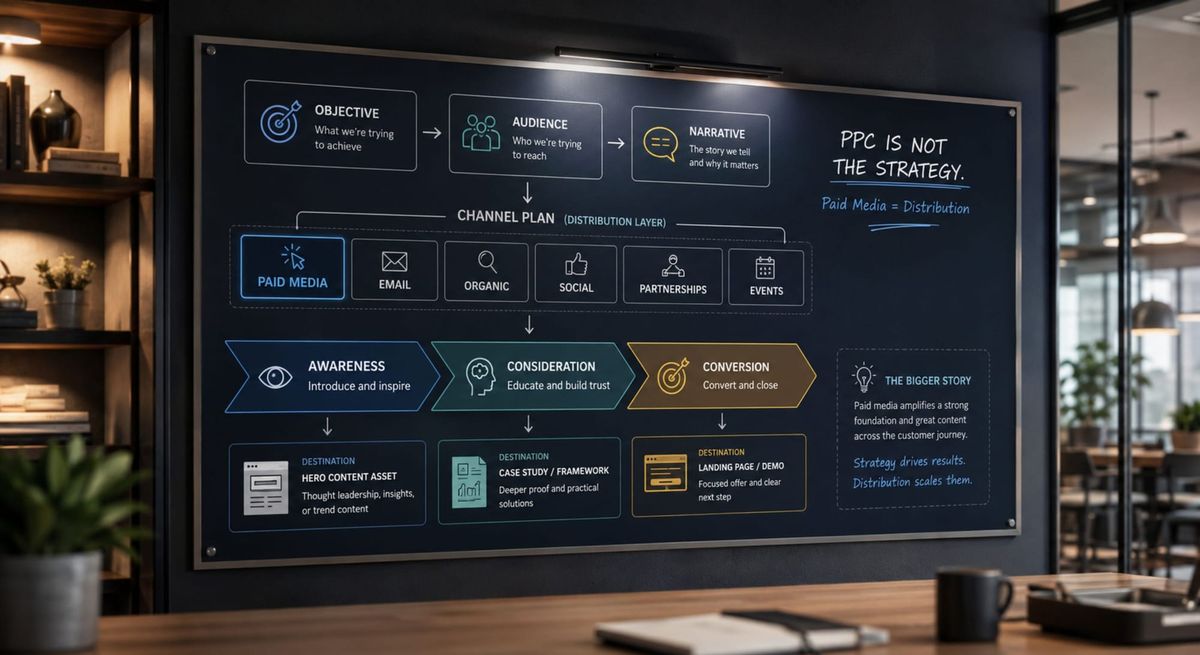
The phrase "paid media strategy" contains a category error so common that most marketers no longer notice it. Paid media is not a strategy. It is a channel, a way of distributing a message to an audience. Strategy is the layer that decides what the message is, who the audience is, and what you need them to do. PPC executes that decision at the awareness and acquisition stages. It does not make the decision. It cannot.
The confusion matters because it determines where the budget conversation starts. When a team treats paid media as a strategy, the planning conversation begins with "how much should we spend and on which platforms?". When a team treats paid media as a distribution layer, the conversation begins with "what is the objective, who is the audience, what is the narrative – and therefore, what role does paid play in delivering it?". The first conversation produces a media plan. The second produces a campaign. Only one of them converts reliably.
The category principle: Strategy decides what must be true. Distribution decides how the message reaches the audience. Paid media is distribution. When you put a distribution layer in the strategy seat, you optimise the delivery of a message you never strategically defined, which is how teams spend more every quarter to acquire leads that convert less.
Where Paid Media Actually Belongs in the Blueprint
In the six-layer Campaign Blueprint, paid media is a Layer 4 decision and part of the Channel Plan. It serves the Narrative built in Layer 3, reaching the Audience defined in Layer 2, to deliver the Objective set in Layer 1. It is never the first decision. It is the fourth. And its job is determined entirely by the three layers above it.
This is why "let's spend more on paid" fails as a strategy. It is an attempt to fix a Layer 1 problem – a thin pipeline, which is an objective-and-audience question – by adjusting a Layer 4 lever. More distribution of an undefined message to an unclear audience does not solve the strategy gap. It funds it. The budget goes up, the architecture stays broken, and the paid channel faithfully delivers more of the same underperforming traffic to the same under-built destination.
When paid media is correctly positioned as a distribution layer, a different question becomes possible, and it is the question that separates teams that get return on spend from teams that simply spend. Not "how much should we put into paid?", but "what is each stage of the funnel asking paid media to do, and what does the audience need to find when the paid click delivers them?".

The Full-Funnel Role of Paid Media
Paid media does a different job at each stage of the funnel, and the most expensive PPC mistake in B2B is using it for only one stage while expecting full-funnel results. Performance teams default to bottom-of-funnel acquisition, because that is where the attribution is cleanest. But a funnel fed only at the bottom runs dry, because there is no top-of-funnel demand replenishing it. Here is what paid media is actually for, stage by stage.
Awareness – Paid as Demand Creation
Filling the top
At the awareness stage, paid media introduces the brand to an audience that does not yet know it has the problem the brand solves. This is the stage performance teams most often skip, because it does not attribute cleanly to a conversion.
But a funnel with no awareness spend is a funnel that can only harvest existing demand, and existing demand is finite, expensive, and contested by every competitor bidding on the same intent. Awareness paid media creates the demand that the rest of the funnel later converts.
What it delivers to: A Hero Asset that names the audience's Ordinary World struggle, not a product page. The click lands on recognition, not a pitch.
Consideration – Paid as Trust Acceleration
Deepening the middle
At the consideration stage, paid media re-engages an audience that has encountered the brand and is now evaluating. Retargeting, content distribution, and lead-nurture campaigns live here.
The job is not to push for the conversion; it is to deliver the trust-building content that moves The Hero from aware to convinced. Paid media at this stage that pushes a hard conversion offer, too early, is the most common cause of high-spend, low-conversion B2B campaigns: the audience was rushed across the threshold before they were ready to cross it.
What it delivers to: Long-form content, case studies, and frameworks; the consideration-stage assets that build authority. Never a demo request as the first ask.
Conversion – Paid as Demand Capture
Closing the bottom
At the conversion stage, paid media captures audiences who are actively searching for a solution – high-intent search, branded terms, comparison queries. This is where most B2B paid budget already goes, and where it does work well.
The problem is never that conversion-stage paid is wrong. It is that conversion-stage paid is treated as the whole strategy, when it is only the harvest of demand that the awareness and consideration stages created.
What it delivers to: A focused landing page with one CTA and the social proof positioned at the threshold; the conversion asset, not a generic homepage.
The full-funnel truth: A B2B team that spends only on conversion-stage paid is bidding against every competitor for the same finite pool of in-market buyers, which is why their cost per lead rises every quarter. A team that also funds awareness and consideration is creating its own demand, which is cheaper to capture because the audience already knows and trusts the brand by the time they are ready to convert.
Why "More Budget" Is Almost Never the Answer
When pipeline is thin, more paid budget feels like the responsive, decisive move. It is usually the wrong one; not because paid media is ineffective, but because a thin pipeline is rarely a distribution problem. It is almost always an architecture problem wearing a distribution disguise.
If leads are expensive and low-quality, the question is not "how much more should we spend?". It is diagnostic, and it runs up the blueprint. Is the conversion-stage landing page actually built to convert, or is paid traffic landing on a generic page? Is there any consideration-stage content for the audience to trust before they are asked to convert? Is there any awareness spend creating demand, or is the team only harvesting a shrinking pool? Is the audience even defined sharply enough for the targeting to find the right people? Every one of those is a question about a layer above distribution. None of them is solved by raising the Layer 4 budget.
The most valuable thing a CMO reviewing media investment can do is refuse the "more budget" conversation until the architecture questions have been answered. Sometimes the answer genuinely is more budget, when the architecture is sound and the channel is simply under-funded. But that is the rare case, not the default. The default is that "more paid" is being asked to compensate for a strategy that was never built.
Three Mistakes That Make Paid Media Look Like It Failed
Mistake #1: Funding only the bottom of the funnel
The cleanest attribution sits at the conversion stage, so that is where performance teams concentrate spend. The result is a funnel that harvests demand without creating any. For a while it works, because there is existing demand to capture. Then the in-market pool is exhausted, the cost per lead climbs, and the team concludes that "paid is getting more expensive", when in fact they built a harvesting operation with no planting season. The fix is to fund awareness and consideration even though they attribute less cleanly, because they are what make the conversion stage affordable.
Mistake #2: Sending paid traffic to a destination that was not built for it
A common and expensive pattern: significant budget drives qualified clicks to a homepage, a generic product page, or a form that asks for everything before offering anything. The targeting was right. The creative was right. The click happened. And then the audience landed somewhere that was not built to receive them at their stage of the journey. Paid media is only as good as the destination it delivers to. An awareness click that lands on a demo request form is wasted. A conversion click that lands on a blog post is wasted. The destination must match the stage.
Mistake #3: Judging paid media on a single stage-blind metric
Cost per lead is the metric most B2B teams use to judge all paid media, and it is the wrong metric for 2 of the 3 funnel stages. Awareness paid media should not be judged on cost per lead, because its job is not to produce leads, it is to create the demand that later becomes leads more cheaply. Judging awareness spend on immediate lead generation guarantees it gets cut, which guarantees the funnel runs dry. Each stage needs its own metric, tied to its own job. A single stage-blind metric makes the most valuable spend look like the worst-performing spend.
How to Use GenAI as Your Paid Media Diagnostic
Before committing or increasing paid budget, the underlying architecture should be diagnosed, because most paid media problems are architecture problems in disguise. This prompt runs that diagnosis, forcing the question up the blueprint before any budget decision is made.
A team is considering committing or increasing paid media budget to address a pipeline or lead problem. Before any budget decision, diagnose whether this is genuinely a distribution problem or an architecture problem in disguise.
THE SITUATION:
- The problem as stated: [e.g. "leads are down", "cost per lead is rising", "pipeline thin for next quarter"]
- Current paid media spend and channels: [Describe]
- Current funnel-stage spend split (awareness / consideration / conversion): [Describe, or note if unknown]
- What paid traffic currently lands on: [Describe the destinations]
- How paid media is currently measured: [Describe the metric(s)]
RUN THE DIAGNOSIS UP THE BLUEPRINT:
1. OBJECTIVE: Is there a specific objective, or is "more leads" standing in for one?
2. AUDIENCE: Is the audience defined sharply enough for targeting to find the right people?
3. NARRATIVE: Is there trust-building content for the audience to encounter, or only conversion offers?
4. CHANNEL/STAGE SPLIT: Is spend concentrated only at the bottom of the funnel? Is awareness demand being created or only harvested?
5. DESTINATION: Does each paid click land on a destination built for that funnel stage?
6. MEASUREMENT: Is paid media judged by one stage-blind metric, or does each stage have its own?
OUTPUT:
- State whether the core problem is most likely DISTRIBUTION (genuinely needs more/better paid) or ARCHITECTURE (a higher layer is broken and more budget would fund the gap).
- Identify the single highest-leverage fix: the one change most likely to improve return on existing spend before any budget increase.
- Only recommend a budget increase if the architecture above distribution is genuinely sound.
Rules:
- Default to diagnosing architecture before recommending spend. "More budget" is the rare correct answer, not the default.
- Be specific to the situation provided. No generic media-planning advice.
Validate the diagnosis with your own knowledge of the business, the sales cycle, and the competitive context. GenAI checks the logic of the funnel architecture; it cannot see your actual conversion data, your sales team's lead-quality feedback, or the competitive dynamics in your category. Use the diagnosis to ask sharper questions before the budget meeting. The decision to spend remains yours.
Final Thought
Paid media is one of the most powerful distribution tools in marketing. It is also one of the most misused; not because teams manage it badly at the execution level, but because they ask it to be a strategy when it is a channel. The teams getting the best return on PPC are not the ones with the most sophisticated bid management. They are the ones who built a sound objective, a sharp audience, and a real narrative; and then used paid media to distribute that narrative to the right people at the right stage.
Paid media does not create good campaigns. It distributes them. Put a distribution layer in the strategy seat and you will spend more every quarter to achieve less. Put it where it belongs – Layer 4, serving the 3 layers above it – and the same budget starts converting, because for the first time it has somewhere worth sending the traffic.
Is paid media distributing a strategy you have actually built or is it being asked to be the strategy you never did?
Recommended Use Cases:
 Diana Socaciu