USE CASE: How to Turn an Accountancy Firm’s Thought Leadership into a Pipeline of Enquiries
A real-world GenAI marketing use case: how a B2B accountancy firm with respected thought leadership and a pipeline that ignored it built the narrative-to-pipeline mechanism, connecting its point of view to demand generation so its expertise actually produced client enquiries.

Turning narrative into pipeline is the missing link between brand storytelling and commercial outcomes, the reason a firm’s thought leadership so often earns respect, but not enquiries. This is what building that link looks like in practice: how an accountancy firm connected its Hero’s Journey narrative to a demand engine, so the expertise it was known for finally generated the pipeline it deserved.
The Context: a Respected Voice, a Pipeline that Ignored It
A B2B accountancy firm (accounting, tax and advisory) that had done the difficult work of building a real brand narrative: a genuine point of view on its clients’ problems, thought leadership its market actually read, a story about how it thinks and what it stands for. It also ran demand generation: ads, a “book a consultation” form. Both existed. What didn’t exist was any connection between them.
The Challenge: the Thought Leadership and the Pipeline Lived in Separate Worlds
The firm’s thought leadership built credibility and regard that the demand generation never captured; the demand generation chased enquiries the content had never warmed. So the firm had a reputation for expertise and a pipeline that didn’t reflect it , because nothing connected the two. The “brand versus demand” split, run as two separate efforts, quietly guarantees this: content that earns respect, but not enquiries, and lead forms that generate volume, but not trust. And it wastes the narrative’s real power, most buyers of accountancy services aren’t actively looking at any given moment; they switch when something changes, and it’s a firm’s point of view, not its “book a consultation” button, that reaches them in the meantime and earns the call when the moment comes. The missing piece was never more thought leadership or more lead forms. It was the mechanism between them, the path that lets the narrative itself do demand-generation work.
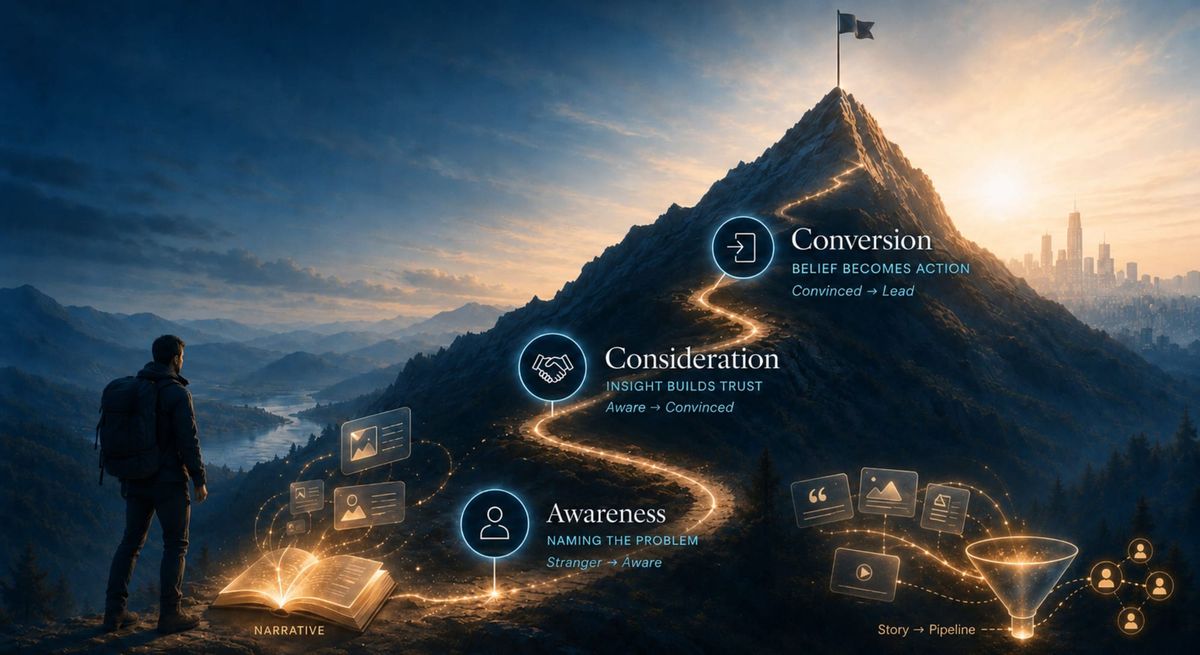
Great storytelling has to lead somewhere: Great thought leadership doesn’t generate enquiries by being great, it generates them by leading somewhere. A point of view people admire but never act on isn’t a demand engine; it’s a monument. The missing link is a path: a next step at every stage that turns a reader into an enquiry, without which even the sharpest expertise just builds a reputation someone else converts.
The GenAI Workflow: Build the Narrative-to-Pipeline Mechanism
The fix was to stop running brand and demand as strangers and build the mechanism that connects them: to make the firm’s narrative itself generate enquiries. Working from the firm’s existing Hero’s Journey narrative – the client cast as the hero facing a real problem, the firm as the guide – the team used GenAI to map the story onto the client’s buying journey: at each stage, realising there’s a problem (a tax exposure, a growth crunch, a compliance risk), weighing whether and how to get help, choosing a firm, what does the client-hero need next, and what commercial next-step fits there without breaking the story? GenAI helped identify those moments and draft the connective tissue: the gated “health check” or guide a business owner weighing advisers would genuinely want, the nurture sequence that carries the narrative forward while moving them toward a conversation, the call-to-action that reads as the natural next step rather than an interruption. The thought leadership stopped being a monument people admired and became a path people walked, and walking it turned a reader into an enquiry. Same expertise; now it led somewhere.
You are a marketing strategist helping a B2B accountancy firm turn its existing thought leadership into a demand engine, connect its point of view to a pipeline of enquiries. Here is our brand narrative / point of view, our ideal client, and our services: [paste].
1. Map our narrative onto the client’s buying journey (problem-aware → weighing whether/how to get help → choosing a firm). At each stage, name what the client needs next, and the commercial next-step that fits there naturally (a diagnostic/health-check, a guide, a consultation offer).
2. For each stage, draft the connective piece (the gated asset, nurture step, or CTA) that carries the narrative forward AND moves them toward becoming an enquiry, without turning it into a bait-and-switch.
Work only from the real narrative and services I gave you, do NOT invent a point of view we don’t have, and do NOT state any technical tax or accounting specifics without flagging them for a qualified person to verify. Make no guarantees of financial outcomes. Prioritise the RIGHT enquiries (clients we genuinely fit), not just more, and flag anything manipulative or over-gated. Mark assumptions as CONFIRM WITH ME.
The caveat that decides whether this works: A narrative-to-pipeline mechanism amplifies whatever narrative you feed it, which is the catch. Connect a generic point of view (“trusted advisers, proactive service”, which every firm claims) to a set of CTAs and you don’t get a demand engine; you get junk enquiries generated faster, and content that now feels like a trap. The narrative has to be genuinely differentiated and true (the firm’s real perspective and expertise) and that part GenAI can’t manufacture; it comes from the partners.
Three more, and one is specific to this field. The mechanism must not turn the story transactional: over-gate everything and bolt on aggressive CTAs, and you spend the trust the thought leadership built: the very asset that made it worth connecting to pipeline. It generates enquiries; it doesn’t win the engagement, the consultation, the fit and the proposal decide that, so don’t credit the content with the whole client. And, crucially for accountancy: GenAI will state technical tax and accounting specifics confidently and sometimes wrongly, and a firm’s credibility can’t survive published errors or implied guarantees of outcomes, so every technical claim is checked by a qualified professional before it goes out, and the content promises a point of view, never a financial result. GenAI builds the bridge; the truth of the narrative, the restraint not to cheapen it, and the professional accuracy of every word stay human.
The Result: the Point of View Started Generating Pipeline
The firm’s thought leadership started generating pipeline. By building the mechanism that connected the narrative to the client’s buying journey, the firm closed the gap between the two worlds it had been running separately: the point of view people respected now carried them, stage by stage, toward becoming enquiries, because at each point there was a next step that fit both the expertise and the engagement. The enquiries were better as well as more: business owners the firm’s perspective genuinely resonated with, who arrived already warmed and self-selected, rather than cold form-fills the content had never touched. And because the connective steps were built to feel like the natural next step rather than an interruption, and because every technical word was checked; the mechanism generated demand without spending the trust the thought leadership had earned. No invented figures here: the change is that the firm stopped running brand and demand as strangers, and let its best thinking do the commercial work it had always been capable of but never connected to.
Recommended KPIs to Follow
This is a bridge between brand and demand, so measure the bridge: does the narrative produce enquiries, are they better enquiries, and does engagement actually convert? Here’s where the evidence sits and the direction this should push things. The point is the direction of travel, not a promised number.
Narrative-Sourced Enquiries & Pipeline
Whether the firm’s thought leadership now generates enquiries and pipeline (consultations booked, RFP or proposal invitations, new-client conversations) rather than only reputation. It’s the whole point of the mechanism: expertise that leads somewhere commercial.
Benchmark: Direction, not a promise: in the Edelman-LinkedIn B2B study, ~86% of decision-makers say they’d invite an organisation that consistently produces high-quality thought leadership to an RFP – yet only ~38% of producers expect it – and Edelman notes strong thought leadership attracts RFPs and contributes to closed deals (Edelman-LinkedIn). Self-reported, treat as direction, but the fit for professional services is strong.
Enquiry Quality / Fit (warmed vs cold)
Whether narrative-sourced enquiries are better (a stronger fit for the firm, warmer, more likely to convert and to accept premium fees) than cold form-fills. A thought-leadership-driven engine’s real advantage is quality, not raw volume.
Benchmark: Direction, not a promise: ~73% of decision-makers trust an organisation’s thought leadership more than its marketing materials when judging capability, ~90% say it makes them more receptive to outreach, and ~60% say it makes them willing to pay a premium (Edelman-LinkedIn) – exactly how firms like an accountancy are chosen.
Engagement-to-Enquiry Conversion (the bridge)
The mechanism’s efficiency: what share of narrative engagement actually takes the next step and becomes an enquiry. This is the number that tells you the bridge is load-bearing, not decorative, and where to tighten each connective step.
Benchmark: No clean public figure, an internal metric; baseline the rate at which readers of the firm’s thought leadership take a lead-generating next step, and watch it as you tune each stage’s CTA.
Narrative-sourced pipeline is the goal, enquiry quality is the edge, engagement-to-enquiry is the diagnostic. And a warning that echoes the attribution case: the content-to-enquiry link is genuinely hard to attribute cleanly, so read these directionally, a point of view that warms a buyer for months rarely gets the last-click credit it earned. The external figures are self-reported; treat them as direction.
Why this Transfers
Any firm that has invested in thought leadership, but sees it produce reputation rather than pipeline has the same missing piece: not more content, not more lead forms, but the mechanism between them. The transferable move is to map your narrative onto the buyer’s journey and build a genuine next step at every stage; so engagement compounds into an enquiry instead of evaporating as respect. A point of view that leads nowhere looks more like a monument than a demand engine.
Recommended Articles:
 Diana Socaciu