USE CASE: How to Run A/B Tests on a Small List Without a Data Science Team for a Premium Jewelry Brand
A real-world GenAI marketing use case: how a premium jewelry brand with a small list and no statistician used GenAI to design lightweight A/B tests and read the results honestly, including learning to treat “we can’t tell” as a real answer.
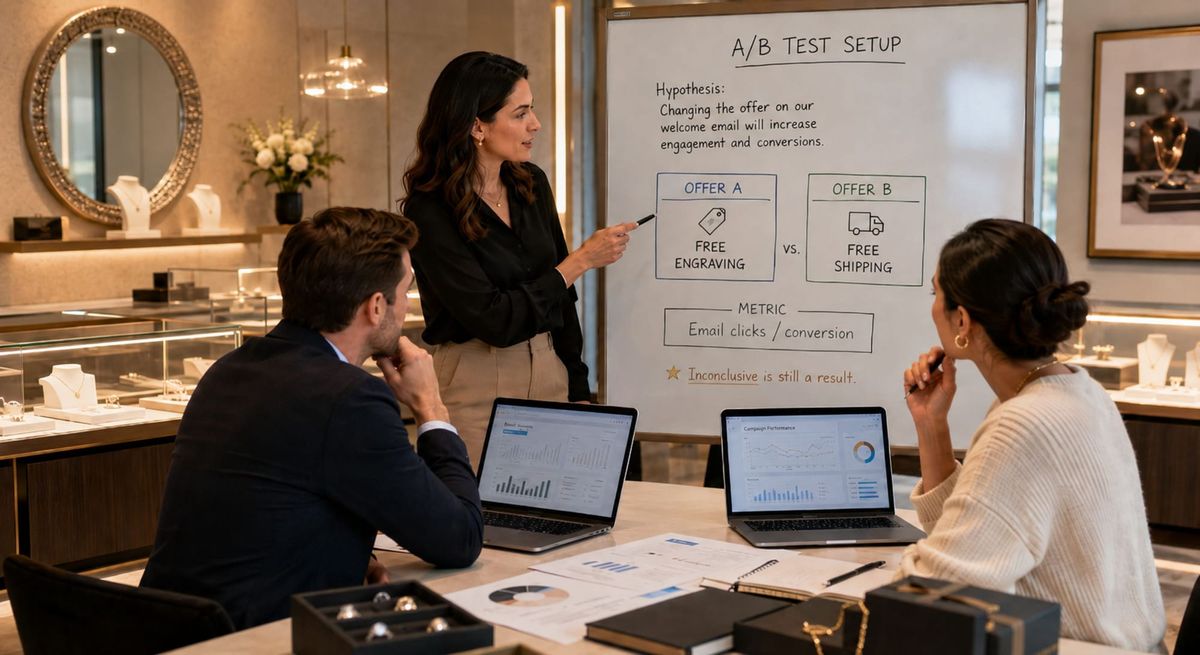
A/B testing on a small list is possible without a data science team, as long as you respect what a small sample can and can’t tell you. This is what that looks like in practice: how a premium jewelry brand used GenAI to design lightweight offer tests and, more importantly, to read the results with the honesty a small list demands.
The Context: a Brand that Wanted to Test, and Couldn’t
A premium, branded online jewelry store with a small, valuable email list. It had real questions worth answering – did the free-engraving offer beat free shipping, did this launch message outpull that – and a sensible instinct to test rather than guess. What it didn’t have was anyone who could run a test and trust the answer.
The Challenge: No Way to Test Offers on a Small List
The brand hit two walls at once. It had no data science team, and no one who could confidently design an experiment or judge whether a result meant anything; and its list was small, small enough that the half-remembered statistics said you’d never reach “significance” anyway. So it did what most lean teams do: it stopped testing and went on guessing, occasionally “trying something” and reading the tea leaves afterwards, which is worse than not testing, because it produces confident conclusions from noise. The two walls fed each other: without expertise, a small-list result looked either meaningless or, more dangerously, like a clear winner that was really just chance. What was missing wasn’t data, it was a way to design a test worth running and read its result honestly, without a statistician in the room.
“Inconclusive” is a real result: You don’t need a data science team to experiment, but you do need to respect what a small list can and can’t tell you. It can’t reveal which word won; it can reveal which offer did. The real danger of testing without a statistician isn’t a wrong test, it’s a confident winner drawn from noise. “Inconclusive” is a result, and on a small list it’s often the honest one.
The GenAI Workflow: Lightweight Design, Honest Reading
The fix was to use GenAI as the data-science help the brand didn’t have, for two specific jobs, and no more. First, lightweight design: the team told GenAI what it wanted to learn and how small its list was, and GenAI helped shape a test the list could actually answer: one clear hypothesis, two variants different enough to produce a detectable effect (a real offer difference, not a one-word tweak), the groups split cleanly, and the sample and end-date fixed in advance so no one could peek and stop early. Second, honest reading: when the results came in, GenAI helped interpret them with the humility the numbers demanded, was the difference big enough, given the small sample, to be more than chance, or was the honest answer “we can’t tell”? Crucially, GenAI was told to treat “inconclusive” as a legitimate and likely outcome, not to hunt for a winner. The brand didn’t gain a data science team; it gained the ability to run one honest test at a time and know what it did and didn’t prove.
You are the data-science marketer helping a small premium jewelry brand. We want to test an offer on a SMALL email list and we have no statistician.
DESIGN: here’s what we want to learn and our rough list size: [hypothesis + list size]. Help us design a lightweight A/B test the list can actually answer: one clear hypothesis; two variants different enough to produce a detectable effect on a small sample (tell me plainly if what we want to test is too subtle to detect); a clean group split; and a sample size and end-date fixed in advance so we don’t peek and stop early.
READING (later): here are the results, [numbers]. Tell me honestly whether the difference is large enough, given our small sample, to be more than chance, and if the honest answer is “we can’t tell”, say so plainly. Do NOT declare a winner the data doesn’t support. Flag any way the test could be confounded (seasonality, unequal groups), and mark assumptions as CONFIRM WITH ME.
The caveat that decides whether this works: GenAI can lower the expertise barrier to experimentation, but it cannot lift the one limit that actually binds here: a small list can only detect large differences, and no amount of GenAI changes that maths. The real danger is the reading, not the design; asked “which one won?”, GenAI will tend to answer, naming a winner even when the numbers are noise, because being conclusive feels more helpful than being honest. Put plainly: GenAI genuinely helps with the swing (designing a bold enough test) and the maths (the significance check), and fails exactly at the verdict; so it has to be told, explicitly, that “inconclusive” is a valid and expected result, and that a false winner is worse than no answer. Three more. On a small list, test big, obvious differences, not subtle tweaks, a one-word change you can’t detect isn’t a test, it’s a waste of the list. Don’t peek and stop when it looks good: decide the sample and duration up front, because reading a running test until it “wins” manufactures winners from chance. And GenAI can’t see your setup, an unequal split, a confound, a seasonal spike will quietly ruin a test it can’t detect, so a clean design is on you. GenAI does the maths and can keep you honest; the discipline not to fool yourself stays human.
The Result: Testing Instead of Guessing Carefully
The brand started testing instead of guessing. It could now design an offer test its small list could actually answer, run it without peeking, and read the result with the honesty the numbers demanded: sometimes a real, detectable winner it could act on, and often an honest “we can’t tell from this”, which it learned to treat as information rather than failure. That honesty was the whole point, the alternative, a confident winner pulled from noise, would have sent the brand chasing offers that never really worked. GenAI did the design maths and the significance check the brand had no one to do, but it was pointed at the truth rather than a tidy answer. No invented figures here: the change is that a lean team without a statistician gained something better than a data science team it couldn’t staff; the ability to run one honest experiment at a time and know exactly what it proved.
Recommended KPIs to Follow
Experimentation is judged on the quality of the experiments and the honesty of the reading, not a win every time. Watch how you test, not just what wins. Here’s where the evidence sits and the direction this should push things. The point is the direction of travel, not a promised number.
Tests Run with a Valid Design
The share of tests with one clear hypothesis, a big-enough difference to detect, and a sample and end-date fixed before you start. It’s the difference between an experiment and “trying something”.
Benchmark: Direction, not a promise: peeking and stopping early inflates false positives roughly 3-5× (tests under 14 days can carry a ~61% false-positive rate), and on small samples the advice is to test bold changes, not micro-tweaks, with the sample pre-committed (roast.page; AI for Marketing).
Honest-Read Rate (inconclusive accepted, not forced)
How often an inconclusive test is called inconclusive, rather than talked into a winner. On a small list this should be the common outcome, treating it as a real result is the whole discipline.
Benchmark: It really is the norm: across large analyses, only ~20-22% of A/B tests reach statistical significance, roughly 78-80% are inconclusive, and that’s expected, not failure (Convert (28,304 experiments); VWO / Optimizely).
Validated Offers that Hold Up
Of the tests that did produce a winner, how many keep performing once rolled out. Small-sample “wins” are often exaggerated, so watching whether they survive contact with the full list is what separates learning from luck.
Benchmark: Direction, not a promise: the “winner’s curse” means underpowered wins are inflated by noise and routinely underperform once scaled, even at top firms, >1 in 4 “significant” results can be false, so re-test any large lift before betting on it (Kameleoon / Kohavi).
Valid design is the input, honest reading is the discipline, holding-up is the proof. The external figures come from experimentation platforms and researchers; treat them as direction, but note they point one way: most tests are inconclusive, and that’s normal. Your own honest track record is what matters.
Why this Transfers
Any lean team can now experiment without hiring a statistician; GenAI will design the test and do the maths. But the barrier to good experimentation was never only the maths; it was the honesty to see noise as noise, and that part doesn’t come in the box. The transferable move is to let GenAI handle the swing and the sums, test differences big enough for your list to detect, pre-commit and don’t peek, and insist that “we can’t tell” is a valid, frequent, and honest answer.
Recommended Articles:
 Diana Socaciu