Using GenAI for Strategic Exploration: Beyond Content Generation
GenAI cannot make a strategic decision. But used correctly, it can dramatically extend the range of options a strategist explores before making one. Here are the three modes of strategic GenAI use and how each one sharpens human judgment.

There is a particular kind of senior strategist I have met in almost every organisation over the last two years. They are sceptical of GenAI for the right reasons. They have watched their teams produce generic AI content. They have read enough marketing leaders proclaiming AI-driven transformation to recognise the genre. They have decided, defensibly, that GenAI is a tool for execution, and that the strategic thinking they do remains a human craft.
They are half right. GenAI is not a strategic decision-maker, and the strategist who treats it as one will produce strategy that is structurally average across every brand using the same tools. But the strategist who treats GenAI as only an execution tool is leaving something more interesting on the table: not a faster way to think, but a wider one.
The previous articles in this chapter have been about content production: where GenAI fits in the calendar, how to systematise prompts, to gate output. This week's article is about the upstream work. The thinking that happens before any content is written. The positioning conversation, the scenario planning, the brief development. The places where GenAI does not write the strategy, but where, used with discipline, it can dramatically extend the range of options the strategist considers before deciding.
Resolving the Apparent Contradiction
If you have followed this series, you may notice an apparent tension. The GenAI and Content article was explicit: strategic origination is Category 3 work, and Category 3 work is human. The Brand Safety and GenAI article was equally clear: GenAI cannot gate its own output, particularly on questions of strategic judgment. Now this article appears to argue for using GenAI in strategic work.
The tension is real and resolves on a single word: exploration.
Strategic origination – the actual decision about positioning, persona, narrative, direction – remains human work. The strategist still chooses. What GenAI extends is the range of options the strategist explores before choosing. The pressure-tests applied to the chosen direction before it is committed. The scenarios surfaced that the strategist might not have considered. The arguments against the decision that force a sharper version of it.
The distinction is not theoretical. A strategist who explores three positioning options and chooses one has made a different decision than a strategist who explores fifteen and chooses one, even if the final choice is identical. The exploration itself is the work. GenAI does not replace the choosing. It widens the choosing.
The strategic principle: Strategy is the discipline of choosing. The quality of any strategic choice is bounded by the quality of the exploration that preceded it. GenAI does not choose. But it can multiply the exploration, and that multiplier, used well, is the most senior-leverage application of GenAI in marketing today.

The Three Modes of Strategic GenAI Use
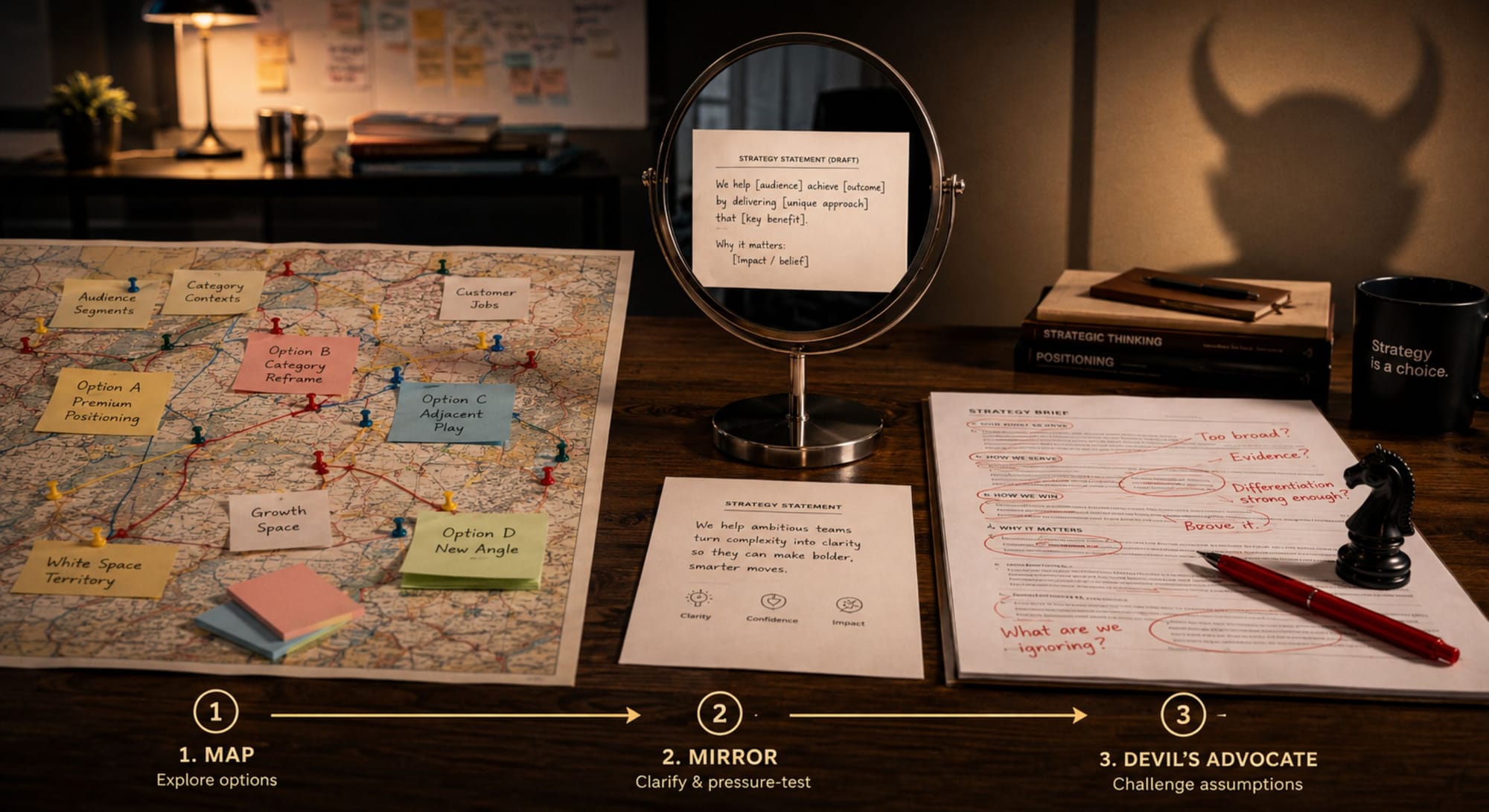
Every useful strategic application of GenAI falls into one of three modes. Each mode does a different job. Each one keeps the strategist in the decision seat. Together they cover the full upstream workflow, from generating options, to pressure-testing the chosen one, to arguing against it before commitment.
Mode 1 – The Mirror
Reflects the weaknesses in your thinking
Applied to existing strategy
Mirror Mode is GenAI applied to strategic thinking that already exists. A positioning statement you have drafted. A persona you have written. A brief you are about to send to an agency. The job is not to improve the artefact, but to surface the weaknesses you cannot see because you wrote it.
GenAI is unusually good at this because it has no investment in your decision. It reads the words on the page, not the intent in your head, which is exactly the perspective the strategist cannot achieve on their own work.
Strongest applications: Positioning statement pressure-test · Buyer persona depth audit · Creative brief gap analysis · Campaign concept readiness check · Narrative Spine coherence review
Mode 2 – The Map
Surfaces options you did not consider
Applied to unexplored territory
Map Mode is GenAI applied to the landscape of possibilities you have not yet explored. The angles you have not tried on this positioning. The personas adjacent to your core audience. The scenarios that could change the market in the next twelve months. The channels you have ruled out without examining. The job is breadth, not depth – to widen the field of options before the strategist narrows it.
GenAI cannot tell you which option is right. It can tell you which options exist. That distinction makes it useful at the moment in strategic work when narrowing too early is the single biggest risk.
Strongest applications: Scenario planning · Adjacent audience exploration · Alternative positioning angles · Competitive response options · Channel and format ideation
Mode 3 – The Devil's Advocate
Argues against your committed direction
Applied to convictions ready to ship
Devil's Advocate Mode is GenAI used as a structured opposer. The strategy has been chosen. The brief is written. The leadership team is aligned, perhaps too aligned. The job here is not to surface weaknesses or generate options. It is to argue, in good faith and with real force, that the chosen direction is wrong.
This is the mode most strategists never use, because it is genuinely uncomfortable, and it is the mode that catches the most expensive errors. Groupthink is a structural failure of mature teams. A GenAI Devil's Advocate is the cheapest available antidote, because it has no career interest in agreeing with the CMO.
Strongest applications: Pre-launch campaign critique · Major repositioning decisions · High-investment strategic bets · Late-stage brief review · Annual strategy validation
The three modes are not interchangeable. A strategist who uses Mirror Mode when they should be using Map Mode will refine a position they have not yet questioned. A strategist who uses Map Mode when they should be using Devil's Advocate Mode will generate more options instead of stress-testing the one they have chosen. Knowing which mode the work needs is the strategic skill. The prompts are simply how you operate it.
What This Looks Like in Practice
Strategic GenAI use is not a single workshop or a one-off consultation. It is a discipline applied across the strategic calendar, with each mode appearing at the moment it earns its place.
Before a positioning conversation begins, Map Mode generates the landscape: every credible positioning angle for the category, every adjacent audience the brand could plausibly serve. The strategist enters the conversation with twenty options on the table instead of three, which means the eventual choice is made against a real field rather than the first three ideas anyone happened to say out loud.
During the positioning conversation, Mirror Mode pressure-tests the emerging direction. The draft positioning statement is fed back through the audit prompts established in the positioning article. Weaknesses surface. The statement sharpens. The conversation moves faster because the easy critiques have already been absorbed and only the difficult judgments remain for the humans.
Before the final decision is committed, Devil's Advocate Mode argues the opposite case. Not to weaken the chosen direction, but to test whether it survives a real attack. If the position holds, the team commits with conviction. If it does not, the team has saved a year of executing the wrong strategy, and that single use of Devil's Advocate Mode has paid for every GenAI subscription the organisation will ever buy.
The senior leverage point: Junior marketers use GenAI to write faster. Senior strategists use it to think wider, sharper, and against themselves. The first multiplies output. The second multiplies the quality of every decision downstream, which is the only multiplier that actually compounds over a career.
Three Mistakes That Turn Strategic GenAI Into Strategic Drift
Mistake #1: Asking GenAI to make the strategic decision instead of supporting it
The most common failure: a senior strategist, having spent two productive hours using GenAI in Map Mode to explore positioning options, asks GenAI which option is best. GenAI answers confidently, plausibly, and on average correctly enough to feel persuasive. The strategist follows the recommendation. The decision is now anchored on the statistical average of how brands in the training data have positioned themselves. The position the brand actually needed, the one that required real market knowledge, real customer understanding, real competitive intuition, was in the option list. GenAI did not pick it because GenAI does not know your market. The fix is structural: never let the prompt ask "which is best?" The prompt asks "what are the trade-offs?". The decision stays human.
Mistake #2: Using GenAI to validate a decision you have already made
This is the failure mode disguised as success. The strategist has chosen a direction. They run a Mirror Mode prompt, but they write the prompt in a way that primes the answer: leading questions, loaded framing, omitting the inconvenient context. GenAI obliges. The output reads like external validation. The strategist now believes the decision has been pressure-tested when in fact it has been confirmed by a tool optimised to be agreeable. The cure is the third mode: every committed strategic direction must pass through Devil's Advocate Mode before it ships. The discipline of structured opposition is the only reliable defence against the confirmation-bias loop.
Mistake #3: Treating one GenAI session as a strategic process
The strategic value of GenAI is in repeated, modal application across a strategic question, not in a single comprehensive session. Map Mode in week one. Mirror Mode in week three after the team has drafted. Devil's Advocate Mode in week five before commitment. Each mode applied to the same question produces different outputs because the question has matured between sessions. A single session compresses everything into one undifferentiated artefact that the strategist then has to mentally separate. The modes exist because the strategic question changes shape as it develops. Treating them as one session collapses that development into noise.
The Strategic Exploration Master Prompt
One master prompt structure handles all three modes. The strategist specifies which mode is being invoked, and the prompt forces GenAI to stay in that mode rather than drifting toward generic helpfulness.
You are a Senior Marketing Strategist with 20 years of experience in B2B and B2C strategy, brand positioning, and creative strategy.
I am applying you in one of three strategic modes. Operate strictly in the mode I specify. Do not drift toward generic summary or recommendation.
The Mode for this Session: [Mirror / Map / Devil's Advocate]
IF Mirror Mode:
Your job is to surface weaknesses in the strategic artefact I share. Do not improve it. Do not rewrite it. Identify the specific weaknesses: what is missing, what is vague, what is internally inconsistent, what assumes context the reader will not have. Quote the exact problem language. Do not offer reassurance.
IF Map Mode:
Your job is to widen the landscape of options. I will share the strategic question or current direction. Generate 10-15 alternative angles, adjacencies, scenarios, or approaches the strategist has not yet explored. For each, name the option in one sentence and identify the specific trade-off it carries. Do not rank. Do not recommend.
IF Devil's Advocate Mode:
Your job is to argue, with real force and in good faith, against the strategic direction I share. Identify the strongest case for not doing this. Name the specific failure modes, the assumptions that could be wrong, the competitor responses that would invalidate it, and the conditions under which this decision becomes the wrong one. Do not soften. Do not balance with positives. Argue the opposing position with full conviction.
The Strategiv Artefact (or question):
[Paste here]
The Context (audience, market, competitive position, budget reality):
[Paste here]
Outout Rules:
- Stay in mode. If I asked for Mirror, do not Map. If I asked for Devil's Advocate, do not balance.
- Quote the specific language of the artefact wherever possible.
- Never tell me what to decide. Tell me what to consider before deciding.
- If I have not provided enough context to operate the mode usefully, say so and ask for the specific input you need.
Validate every output. The Mirror catches what you missed only if your market knowledge agrees the catch is real. The Map widens the field only if you recognise the options as plausible. The Devil's Advocate sharpens your direction only if you take the arguments seriously rather than dismissing them. The mode produces the structured input. You produce the decision.
Final Thought
The senior strategists who hold the line against using GenAI at all are protecting something real: the discipline of human judgment in strategic work. They are right that GenAI cannot make the choice. They are wrong if they conclude that GenAI therefore has no place in the room. Used as Mirror, Map, and Devil's Advocate, GenAI does not replace the strategist's thinking. It extends the range of thinking the strategist is able to do before deciding, and the decision, when it comes, is sharper for it.
Junior marketers use GenAI to produce more. Senior strategists use it to choose better. That difference is the most senior-leverage application of this technology in marketing, and it is the one almost no one is talking about, because it is the one that requires the most strategic discipline to operate.
Is GenAI helping you produce more or is it helping you decide better?
Recommended Use Cases:
 Diana Socaciu