USE CASE: How to Use GenAI as a Strategic Thinking Partner, Not Just an Output Machine in a Web Design Agency
A real-world GenAI marketing use case: how a web design agency that used GenAI only to produce deliverables learned to use it earlier, as a partner for strategic exploration, generating and pressure-testing options before any work began.
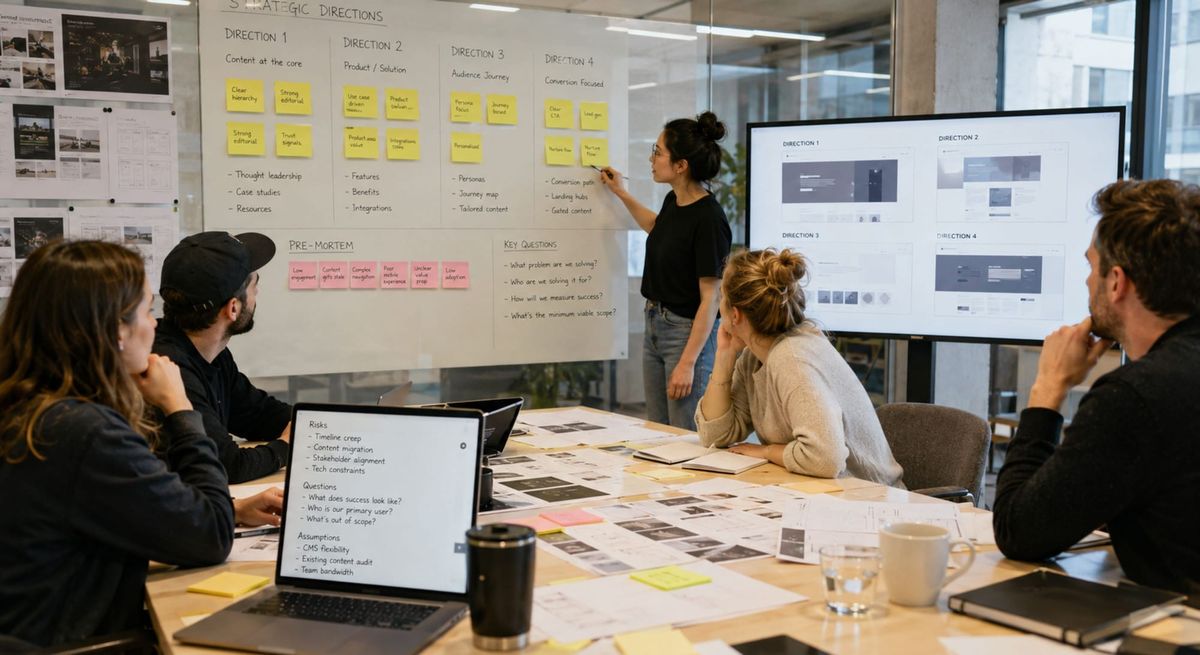
Most teams don't use GenAI for strategic exploration at all, they reserve it for output, after the thinking is done. This is what using it the other way looks like in practice: how a web design agency brought GenAI in before the answer, as a partner to widen and stress-test its options rather than a machine to type them up.
The Context: GenAI Everywhere, but Only at the End
A web design agency with GenAI woven through its production: drafting copy, generating layout variations, producing decks and pages at speed. By any measure it was an enthusiastic adopter. But look at when it used the tool, and a pattern emerged: GenAI only ever showed up at the output stage, once the real decisions had already been made.
The Challenge: GenAI Used for Output, Never for Thinking
Used only at the output stage, GenAI can only make you faster at executing decisions you have already taken. If the strategy behind a project was sound, you got it built quicker; if it was thin or unexamined, you produced thin work faster, and more of it. The agency’s scarcest, highest-value work – the strategic exploration, the pressure-testing of a client’s brief, the search for the angle no one else would find – happened entirely in human heads, under time pressure, and was often the first thing skipped when deadlines bit. The most capable thinking partner in the building was being used exclusively as a typist. The waste wasn’t using GenAI badly; it was using it late.
The biggest waste of GenAI is using it late: Used only for output, GenAI makes you faster at executing thinking you’ve already finished, and if that thinking was thin, you’ve just produced thin work faster. Its bigger lever is the one most teams never pull: bringing it in before the answer, as a partner to explore, challenge and pressure-test; not after, as a machine to type.
The GenAI Workflow: Bring It In Before the Answer
The shift was to use GenAI for the exploration that usually got squeezed. On a new project, instead of jumping to producing, the team used it to open the problem up: to generate genuinely different strategic directions rather than the one obvious one, to argue against the brief and surface what it might be missing, to run a pre-mortem – “it’s six months later and this failed; why?” – and to play devil’s advocate against the direction the team was already leaning. The point was never to let GenAI decide; it was to widen the space of options and stress-test the thinking before committing, so the team chose from several examined directions instead of the first plausible one. The output stage still happened, faster than ever; it just now sat on top of thinking that had actually been explored.
You are a strategic thinking partner for a web design agency, not a copywriter. We are exploring, not producing yet. Here is the project, the client, what we know about their market, and the direction we’re currently leaning: [paste].
Help us think, not agree:
1. Generate 4 genuinely different strategic directions, including at least one that contradicts where we’re leaning.
2. Argue against our current direction as hard as you can; what are we not seeing?
3. Run a pre-mortem: it launched and it failed; give the three most likely reasons.
Do NOT tell us which to choose; surface options and risks; the decision is ours. Where you’re missing context about the client or market, ask rather than assume, and mark guesses as CHECK WITH US.
The caveat that decides whether this works: GenAI’s instinct as a thinking partner is the opposite of what strategic exploration needs: it is agreeable. Ask it to explore and, left to itself, it will mostly validate where you’re already leaning, offer options that are variations on your own, and tell you your idea is strong, because agreeing is the path of least resistance. That is the failure mode: a sycophantic partner doesn’t widen your thinking, it flatters it. So exploration with GenAI only works if you deliberately push it the other way; make it contradict you, argue the opposite case, run the pre-mortem, and treat its agreement as worthless and its disagreement as the point. It also doesn’t have real judgement, and doesn’t know your client or market; it generates possibilities, it doesn’t weigh them. It is a thinking partner that expands and stress-tests the option space, not a thinking replacement that decides. Bring it in early, drive it toward divergence, and keep the judgement yours.
The Result: from Typist to Thinking Partner
GenAI moved upstream. Before producing anything, the team used it to widen the option space and stress-test the directionl; so projects started from a strategy that had been argued with, not just assumed. Directions got chosen from several examined alternatives rather than the first plausible one; briefs got challenged before work began rather than after a client did; and the pre-mortems caught failure modes while they were still cheap to fix. The output work still happened, and faster, but now it executed thinking that had actually been explored, not merely produced quickly. No invented figures here: the change is that the agency stopped using its most capable thinking partner exclusively to type, and started using it to think.
Recommended KPIs to Follow
Strategic exploration is hard to measure directly, so watch its fingerprints: are more options examined, are risks caught earlier, does the work win more often? Here’s where the evidence sits and the direction this should push things. The point is the direction of travel, not a promised number.
Options Explored Before Deciding
How many genuinely different directions get generated and seriously considered before a project commits, versus running with the first plausible one. It’s the most direct sign that GenAI has moved from output to exploration.
Benchmark: Decision research is blunt here: managers consider only one option about 71% of the time, and those single-option decisions fail ~52% of the time, versus ~32% when two or more alternatives are weighed (Paul Nutt, Ohio State / OSU). More examined options is a real edge, not a nicety.
Risks Surfaced before Launch
How many failure modes the pre-mortems and devil’s-advocate passes catch before work ships, rather than after a client does. Caught early, a flaw is a quick rethink; caught late, it’s a rebuild; so this is where exploration pays for itself.
Benchmark: No clean public figure, an internal metric; track issues caught at the exploration stage versus those that surface post-launch, and watch the balance shift earlier.
Pitch / Proposal Win Rate
For an agency, sharper strategic thinking should show up where it counts: in proposals that win because the angle is stronger and the brief better understood. Slow and multi-causal, so read it as a trend.
Benchmark: No reliable public figure for this attribution, an internal metric; baseline your win rate and watch whether explored-strategy pitches outperform first-idea ones.
The first 2 are the leading signals: more options, earlier risk-catching; win rate is the lagging one. And remember the trap: if GenAI only ever agreed with you, none of these will move. Track your own trend; the benchmark is context.
Why this Transfers
Almost everyone meets GenAI as an output tool, and most never graduate it past that, which leaves its largest lever untouched. The transferable move is to bring it in before the answer: to generate options you wouldn’t have, argue against your own direction, and pre-mortem the plan, provided you force it to diverge rather than agree, and keep the deciding to yourself. Used late, it makes you faster; used early, it makes you better.
Recommended Articles:
 Diana Socaciu