GenAI and the Content Calendar: How I Produce More Without Losing Quality
GenAI does not write better content. It writes more content. The teams using it well have stopped asking it to think - and started asking it to transform what they have already thought through.

Every content team I know has had the same private experience over the last two years. They adopted a GenAI tool because the productivity case was undeniable. They watched the volume go up. They watched the quality drift. And somewhere around the fourth or fifth piece that sounded technically correct and emotionally flat, they made the same quiet decision: this is faster, but I do not trust it to represent the brand.
The trust was right. The diagnosis was wrong. The problem was not the tool. It was the job they were asking the tool to do.
This article is about how I actually use GenAI inside my own content calendar - not the theory, not the prompt library, the operational decisions I make every week about what GenAI is allowed to touch and what it never gets near. The framework is simple. The discipline is everything.
The Productivity-Quality Trade-off That Is Not Real
The dominant assumption about GenAI in content production is that it forces a trade-off. More output, slightly weaker quality. The trade-off is "worth it" because the volume gains exceed the quality losses. Most content teams operating on this assumption have spent the last year producing more average content and calling it efficiency.
The trade-off is not real. It is a symptom of asking GenAI to do the wrong job. When GenAI is used for tasks it genuinely handles well, the quality does not drop – the volume increases without affecting the work that actually defines the brand. When GenAI is used for tasks it does not handle well, the quality drops sharply, and no amount of prompt engineering fully recovers it.
The teams producing more without losing quality have not found a better tool. They have made a sharper distinction between the work GenAI accelerates and the work it dilutes. That distinction is what makes the volume sustainable. Without it, every additional piece compounds the dilution.
The operational rule: GenAI is excellent at structured transformation. It is poor at original strategic thinking. Match the task to the capability and the quality holds. Mismatch them and the calendar fills with content that is technically correct and strategically empty.

Three Categories of Content Tasks: Where GenAI Belongs and Where It Does Not
Every task in a content workflow falls into one of three categories based on how much original strategic thinking it requires. The categories determine whether GenAI is an accelerator, an assistant, or a liability.
Category 1 – Where GenAI Excels: Structured Transformation
Tasks where the strategic thinking already exists in a finished piece, and the job is to convert that thinking into a different format, length, or channel. This is where GenAI earns its place in a content calendar. The Hero Asset is already published. The Narrative Spine is fixed. The framework is named. GenAI's job is purely mechanical: extract, adapt, redistribute.
Examples:
- Carousel extraction from a published article
- Email newsletter summaries
- Short-form social derivatives from long-form content
- Subject line variations
- Translation across languages
- Format conversion (article → script, article → outline)
- Quote card text extraction
Category 2 – Where GenAI Helps - Acceleration with Supervision
Tasks where the strategic thinking exists in your head or in a brief, but is not yet on the page. GenAI can produce a credible first draft - but the draft is a starting point, not an output. The supervision layer is non-negotiable here. The brief must be specific. The output must be edited heavily. The voice must be calibrated by a human who knows the brand.
Examples:
- First drafts from approved briefs
- Brainstorming hook variations
- Structuring a long-form outline from a framework you have already defined
- Generating three versions of a paragraph for selection
- Rewriting copy in a specified tone
Category 3 – Where GenAI Hurts - Strategic Origination
Tasks where the strategic thinking does not yet exist and needs to be created. GenAI cannot do this work. Asking it to these tasks is the single biggest source of quality drift in modern content operations. GenAI does not know your audience. It does not know your positioning. It does not know what your competitors are saying or what the market is tired of hearing. Anything it produces in this category is generic by default, and generic dressed in confident language is more dangerous than visibly weak content. If it lacks content, generic output is expected.
Examples:
- Defining the Narrative Spine
- Writing the buyer persona
- Choosing the positioning distinction
- Deciding which topic deserves a Hero Asset this month
- Selecting the angle for a new campaign
- Original creative concepts and brand voice creation
The teams producing more without losing quality have done one specific thing: they have stopped using GenAI for the last category entirely. Every minute saved on the first category tasks is a minute redirected toward the last category work – the human strategic thinking that GenAI cannot replace and that defines whether the published volume actually compounds into brand equity.
The Weekly GenAI Workflow
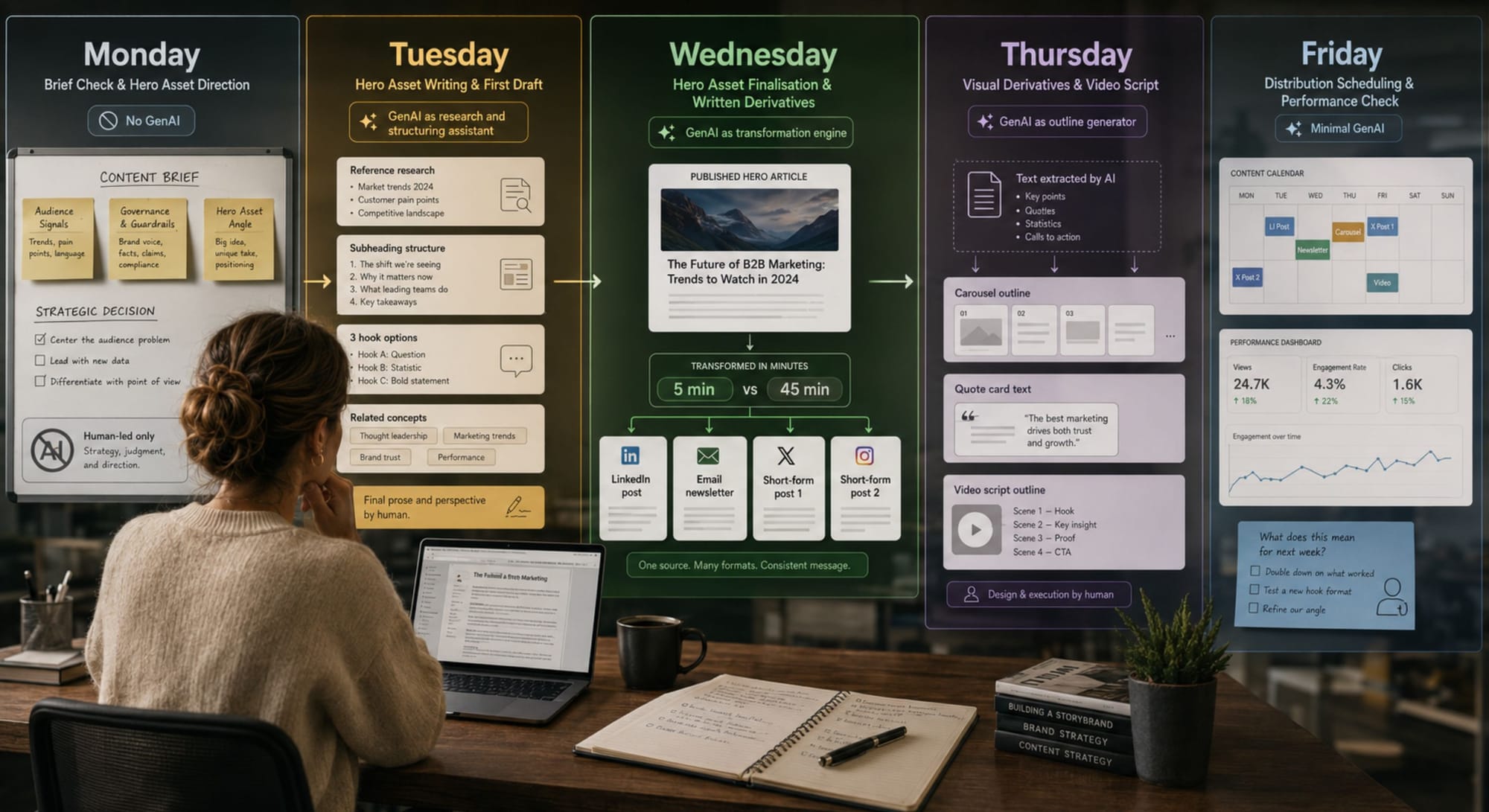
Here is how the three categories sort themselves across an actual production week. The cadence below is the rhythm I run my own calendar on, adapted from the four-week arc established in the Strategy-to-Calendar framework and the Hero Asset Model. GenAI appears in some days and is deliberately absent in others.
Monday: Brief Check & Hero Asset Direction
No GenAI
The week's strategic decisions are made by humans. The Brief Check ritual runs against the five governance rules. The Hero Asset angle for the week is chosen based on audience signals from last week's content. GenAI does not touch Monday work. If it did, the strategic decisions would inherit the average of the training data, and the entire week's content would compound from that average.
Tuesday : Hero Asset Writing & First Draft
GenAI as research and structuring assistant
Writing the Hero Asset is the second task category. The framework, the angle, and the Narrative Spine fragment already exist from Monday. GenAI helps with: pulling reference research, suggesting subheading structures, generating three different hook variations to choose from, surfacing related concepts I might have missed. It does not write the prose. The prose has to sound like me, and GenAI does not sound like me unless I have already shown it what I sound like - and even then, it produces something close enough to fool a reader and not close enough to fool an editor.
Wednesday: Hero Asset Finalisation & Written Derivatives
GenAI as transformation engine
The Hero Asset is published. Now the first category tasks begin. Within 24 hours, GenAI produces first drafts of the four written derivatives: the LinkedIn long-form post, the email newsletter, and the two short-form social posts. The strategic thinking is locked. The framework is named. The voice already exists on the page. GenAI is now doing pure transformation work and this is where the productivity multiplier actually lives. Each derivative draft takes 5 minutes instead of 45.
Thursday: Visual Derivatives & Video Script
GenAI as outline generator
The carousel structure, the quote card text, and the video script outline are extracted with GenAI assistance. The visual design and the actual video execution remain human work – GenAI cannot make taste decisions about composition, palette, or pacing. But the text content for each visual derivative is extracted from the Hero Asset using GenAI, then edited by me for voice consistency.
Friday: Distribution Scheduling & Performance Check
Minimal GenAI
Scheduling is operational. Performance signals from the previous week's content are read by a human, because the question "what does this data mean for next week's strategic direction?" is in the last task category, which is mine.
The compounding effect: One Hero Asset per week, written largely by me with GenAI as a structuring assistant, then transformed by GenAI into twelve derivatives I edit lightly: produces 48 pieces of governed content per month. The strategic thinking happens four times. The transformation happens 48 times. That ratio is what makes the calendar sustainable without quality drift.
Three Mistakes That Quietly Compound Quality Drift
Mistake #1: Using GenAI for category 3 tasks because the category 2 felt successful
The most predictable failure path. GenAI produces a credible first draft from a clear brief – category 2 tasks – and the success builds confidence. The team then asks GenAI to write the next brief itself, or to choose the next topic, or to define the angle. Each of those is category 3 tasks, and each compounds in the same way: the output is structurally fine and strategically average. By the time the team notices, three months of content have been produced from a foundation GenAI invented rather than the strategist defined.
Mistake #2: Skipping the human edit on category 1 derivatives
Transformation work is the lowest-risk GenAI use case, and that is exactly why teams skip the edit. The derivative reads well, the framework is preserved, the structure is correct. So the team publishes it directly. The problem appears subtly: the voice drifts. Not by much per piece, but across 48 derivatives a month, the cumulative drift is the difference between content that sounds like the brand and content that sounds like every other brand using the same tools. The human edit on every derivative is not a quality check on the framework. It is a voice calibration check on the prose.
Mistake #3: Generic prompts that produce generic outputs
"Write a LinkedIn post about X for our audience." This is the prompt that produces 80% of the mediocre AI content currently circulating. The output is structurally average across every brand in the training data, because the prompt asked for the average. The fix is to make the prompt specific enough to exclude the average: name the Hero, name the funnel stage, paste the brand voice rules, paste the published source content the derivative is extracted from. Generic prompts produce generic outputs. The quality of the output is a near-perfect mirror of the specificity of the prompt.
The Master Production Prompt
Most of the prompts I use across the calendar are variations on a single master structure. The structure forces the prompt to specify everything the output needs to inherit: the source content, the voice rules, the strategic context, and the exact transformation requested.
You are the Senior Content Strategist and Brand Storyteller for [Brand Name].
The Strategic Context (locked - do not modify):
- The Hero: [Persona name + one-sentence struggle]
- The Narrative Spine fragment: [Ordinary World / Transformation / Special World]
- The Funnel Stage: [Awareness / Consideration / Conversion / Retention]
- Brand Voice (3 adjectives): [Specify]
- Words we always use: [List 3-5]
- Words we never use: [List 3-5]
The Source Content (the published Hero Asset – your only source of truth): [Paste the full published article here]
The Transformation Task (Category 1 only - extraction and reformatting):
[Specify exactly: LinkedIn long-form post / Newsletter / Carousel outline / Hook variations / Subject lines / Video script / Quote card text]
Output Requirements:
- Word count or format constraint: [Specify]
- The opening must lead with The Hero, not the brand
- The framework terminology must be preserved exactly - do not paraphrase named principles
- The voice must match the source content tonally
- For Awareness derivatives: no product CTA, only a forward pointer
- For Consideration derivatives: one soft CTA that advances the relationship
Validation Rules:
- If the source content does not contain what the task requires, say so. Do not invent.
- Flag any sentence where the brand risks becoming the protagonist instead of the Guide.
- If the strategic context is missing a required field, name the gap rather than guessing.
Output: First draft of the requested transformation only. No commentary.
Validate every output before publishing. The prompt locks the strategic context - but the editorial judgment about whether the voice landed, whether the right angle was extracted, whether the framework was preserved without losing nuance, is the work GenAI cannot do for you. You provide the strategic intelligence. GenAI provides the production speed. That is the entire arrangement.
Final Thought
The content teams losing quality with GenAI are not the ones using it too much. They are the ones using it for the wrong jobs. GenAI does not have an audience. It does not have a positioning. It does not know what your readers are tired of hearing or what would surprise them next week. Asking it to make those decisions is asking the wrong tool to do the most important work.
Used inside the right architecture – strategy by you, transformation by it – GenAI does not dilute the brand. It extends the reach of the thinking you have already done. The volume compounds. The quality holds. Because the work that defines the brand never touched the tool that produces the noise.
Is GenAI extending the reach of your best thinking or quietly producing the average of everyone else's?
Recommended Use Cases:
 Diana Socaciu