Prompt Systems for Marketers: Moving From One-Off Requests to Reusable Frameworks
Most marketing teams have prompt chaos. The teams getting consistent output from GenAI have built a prompt system - structured, named, owned, and reviewed. Here is how to turn occasional prompts into operational infrastructure.

Open the workspace of almost any marketing team using GenAI today and the same artefact appears. A document called "AI Prompts" or "GPT Library" with 40, 60, sometimes 100 prompts pasted into it. Some are labelled. Most are not. There are three nearly identical versions of the same hook-writing prompt, written by three different people on three different Tuesdays, none aware the others exist. The team uses four of them regularly. The rest are abandoned drafts of a system that was never actually built.
This is not a documentation problem. It is a discipline problem. The team is treating every prompt as a creative act – a fresh attempt to phrase the request well - when the operational reality is that prompts are infrastructure. They should be designed once, named clearly, owned by someone, versioned over time, and reviewed on a cadence.
This article is about how to make that shift – from prompt chaos to a Prompt System. Not as a technical skill. As a marketing operations discipline.
Why Prompt Chaos Quietly Becomes a Quality Problem
The cost of prompt chaos is not the time wasted searching for the right prompt, although that cost is real. The deeper cost is the inconsistency in the output the team produces.
When every person writes their own prompt from scratch every time, every prompt produces a slightly different version of the same task. One writer's hook prompt over-indexes on curiosity. Another's over-indexes on pain. A third forgets to specify the persona. The outputs are all "fine" individually, but across 30 pieces of content a month, the brand voice fragments and the audience experiences a brand that feels strangely uneven without being able to name why.
This is the same governance problem the Brand Manual was built to solve for human-written content. The Prompt System is its counterpart for GenAI-assisted content. Without it, you have invested in a Brand Manual to keep human writing consistent, and then allowed every GenAI output to bypass that governance because the prompt that produced it was a one-off.
The operational rule: A prompt that runs more than three times in a month is no longer a request, it is a process. Processes belong in a documented system, not in a Slack thread. The teams that treat repeat prompts as processes get consistent output. The teams that treat them as fresh creative acts get drift.

The Three Layers of a Prompt System
A Prompt System has three layers, each answering a different operational question. Most teams build only the first layer – the prompts themselves – and skip the two layers that turn a collection of prompts into a system that actually compounds.
Layer 1 – The Anatomy
What makes an individual prompt reusable rather than situational. Every prompt in the system follows the same internal structure, so that anyone on the team can read it, run it, and trust it without having to reverse-engineer the original author's intent.
Layer 2 – The Library
How prompts are organised, named, and stored so that the right prompt can be found in under 30 seconds. Categorisation by task type. Naming conventions that signal exactly what the prompt does. Ownership that says who maintains it. Versioning that records what changed and why.
Layer 3 – The Evolution
How the system gets better over time. Which prompts are getting used, which are abandoned, which produce reliably strong output, which need a refresh. Without this layer, the library calcifies, prompts written in month one are still running in month nine, even when the strategic context has shifted.

Layer 1: The Anatomy of a Reusable Prompt
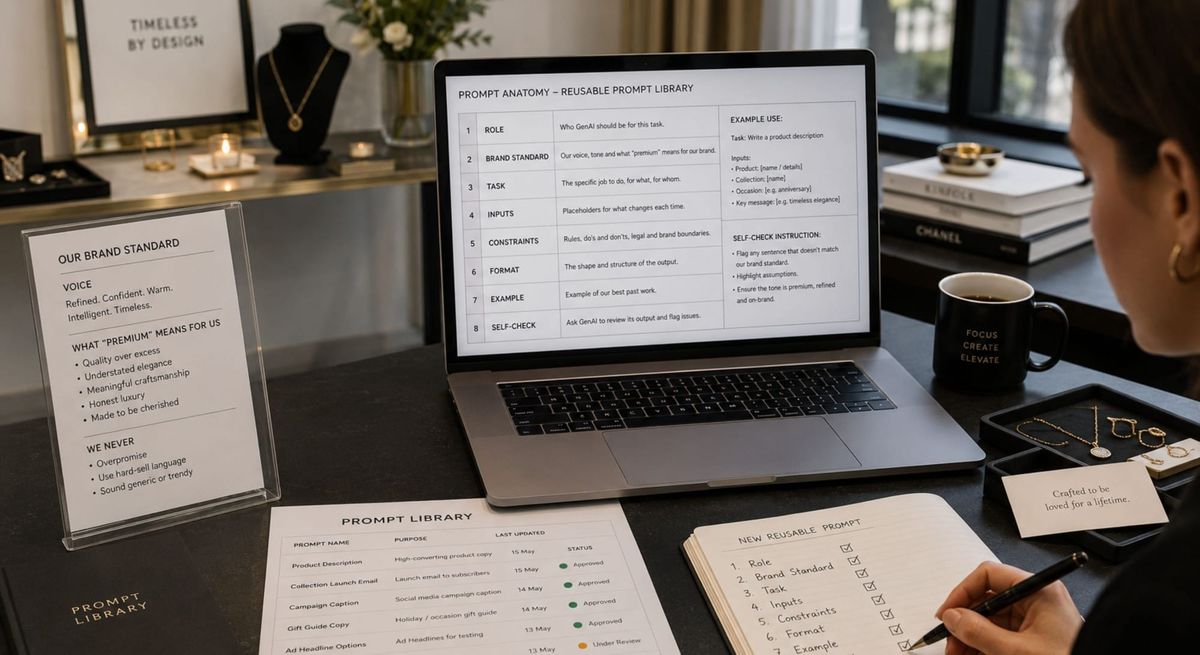
Every reusable prompt contains six components, in this order. The components are not optional. A prompt missing any of them is not yet a system component, it is a draft that will produce inconsistent output the next time someone runs it.
Component 1 - The Role
Who GenAI is being. Not "an AI assistant" – a specific named expert with a specific kind of expertise. "Senior Brand Strategist with 15 years of experience in B2B positioning" produces different output than "a marketing professional".
Component 2 – The Context
What GenAI must know before doing the task. The persona, funnel stage, brand voice rules, Narrative Spine fragment. The strategic input the team must complete before running the prompt.
Component 3 – The Source
The exact material the prompt operates on. The published article, the brief, the performance data. For transformation prompts, the source must be pasted in full – paraphrasing it first produces drifted output.
Component 4 – The Task
What GenAI is actually doing. One sentence, specific enough to exclude variation. "Write a LinkedIn post" is not a task. "Extract a 600-word Consideration-stage post, leading with The Hero's struggle" is a task.
Component 5 – The Rules
The constraints that prevent the most common drift modes. Words always used. Words never used. Whether the brand is allowed in the opening. What the CTA must do. The brand voice and funnel logic, made explicit.
Component 6 – The Output Spec
Exactly what the output must look like. Word count. Format. Whether commentary is allowed. If the output spec is vague, the prompt produces output that is also vague - and the editor pays the time cost.
A prompt with all six components produces consistent output across different users and different runs. A prompt missing any component produces output shaped by whichever component the user happens to have filled in mentally, which is the definition of inconsistent.

Layer 2: The Prompt Library
Once prompts are structured consistently, they need to be organised so the right one can be found instantly. The most useful organising principle is by job type -mapped directly to the three task categories from the previous article.
Section 1 – Transformation Prompts
Highest volume · Most used
Prompts that convert finished content into a different format, length, or channel. The largest section of the library because transformation is the highest-volume GenAI task.
Naming convention: [Source] to [Output] - Stage. Example: "Hero Asset to LinkedIn Long-form Post – Consideration".
Typical inventory: Hero Asset → LinkedIn long-form · Hero Asset → Newsletter · Hero Asset → Carousel outline · Article → Short-form hook · Article → Quote card · Article → Video script · Long content → Subject line variations
Section 2 – Acceleration Prompts
Medium volume · Heavy editing
Prompts that produce a first draft from an approved brief – the work moves from concept to text, but the text needs significant human editing before publication. Higher-stakes than transformation prompts because the strategic context is doing more of the work.
Naming convention: Brief to [Output Type] – Stage.
Typical inventory: Brief → Article outline · Brief → Article first draft · Brief → Email sequence · Brief → Hook variations (3) · Brief → Landing page copy first draft
Section 3 – Diagnostic Prompts
Low volume · High strategic value
Prompts that pressure-test existing material – content, briefs, positioning statements, even the prompt library itself. Used less frequently but earn their place because they catch problems before publication rather than after.
Naming convention: Audit – [What it Audits].
Typical inventory: Audit - Positioning Statement · Audit - Buyer Persona · Audit - Content Brief · Audit - Hero Asset before publication · Audit - Funnel-stage governance check
Every prompt in the library has an owner, a version number, a last-reviewed date, and a one-line note on what changed in the most recent update. The same governance discipline applied to brand guidelines and templates, applied to prompts.

Layer 3: The Evolution Loop
The Prompt System earns its compounding value through the third layer. A library that does not evolve becomes outdated within a quarter - strategic contexts shift, brand voice rules refine, and prompts that worked three months ago start producing slightly off output without anyone noticing why.
The evolution loop runs quarterly and answers four questions.
- Which prompts were used most? Heavy use signals value – these deserve refinement attention first.
- Which were abandoned? Abandonment is also a signal – either the prompt is no longer needed, or it never worked well.
- Which outputs required heavy editing? Heavy editing means the prompt is close enough to be useful but not close enough to publish. These are the highest-leverage prompts to refine.
- What strategic shifts has the team made? New persona research, sharpened positioning, a new funnel stage emphasis – every strategic shift requires the affected prompts to be updated, or the system starts producing content from an outdated foundation.
The compounding effect: A Prompt System reviewed every quarter improves measurably over a year. After 12 months, the same team running the same content workflow produces output that is faster, more consistent, and more brand-correct than what they produced at month one; not because they have learned to prompt better, but because the system has compounded their best decisions across every prompt in the library.
Three Mistakes That Keep Prompt Systems Stuck as Prompt Lists
Mistake #1: Saving prompts without naming them
A library of unnamed prompts is not a library, it is a graveyard of past work. The naming convention is what makes the library findable, and findable is what makes it used. Every prompt in the system needs a name that signals what it does, in fewer than ten words. If a team member has to read the first three lines of a prompt to know what it produces, the library has already failed.
Mistake #2: Letting everyone create their own prompts in parallel
The fastest way to ensure a Prompt System never forms is to let every team member maintain their own prompts in their own document. The library must have one canonical home, one owner per prompt, and one rule: a new prompt enters the library through a defined process - not by being saved somewhere convenient. A team member who needs a new prompt either finds it in the library, refines an existing one, or proposes a new one to the owner for inclusion. Parallel personal libraries produce the chaos the system was built to eliminate.
Mistake #3: Never reviewing the library
This is the silent failure mode that turns a working Prompt System back into prompt chaos within six months. Without the quarterly evolution loop, prompts written for last quarter's strategy are still running on this quarter's content. New team members add new prompts that duplicate existing ones because they did not know to look first. Versions multiply. Ownership gets fuzzy. The library becomes a museum of intent rather than a live system. The review cadence is not optional. It is the mechanism that keeps the system alive.
How to Use GenAI to Build the System Itself
The fastest way to start a Prompt System is to use GenAI to refine the prompts your team is already running. Most teams already have working prompts buried in Slack threads and on your drive. The job is not to invent new ones, it is to extract the working ones and restructure them to the six-component anatomy.
You are a Senior Marketing Operations Consultant with deep expertise in building prompt systems for marketing teams.
I will share a one-off prompt that has been used informally by our team. Your task is to restructure it into a reusable system component following the six-component anatomy.
The Anatomy (every reusable prompt must contain all six):
1. Role - Specific named expert, not "an AI assistant"
2. Context – Strategic inputs the prompt depends on (persona, stage, voice rules)
3. Source – The exact material the prompt operates on (where applicable)
4. Task – One sentence, specific enough to exclude variation
5. Rules – Constraints that prevent drift (vocabulary, structure, brand voice)
6. Output Spec – Exact format, length, and structure of the expected output
The One-Off Prompt to Refine:
[Paste the existing prompt here]
Your Task:
Step 1 – Diagnose: Identify which of the six components are missing or weak in the current prompt. State each gap explicitly.
Step 2 – Restructure: Rewrite the prompt with all six components present. Use placeholders in square brackets for any strategic context the user must fill in each time.
Step 3 – Name: Suggest a clear, findable name for this prompt following the convention "[Source] to [Output] - Stage" for transformation prompts, "Brief to [Output Type] - Stage" for acceleration prompts, or "Audit - [What it Audits]" for diagnostic prompts.
Step 4 - Categorise Place the prompt in one of three library sections - Transformation / Acceleration / Diagnostic - and explain why.
Rules:
- Preserve the original strategic intent. Do not invent new requirements.
- Flag any element of the original prompt that contradicts the six-component anatomy.
- If the original prompt is asking GenAI to perform a Category 3 task (strategic origination), say so explicitly and recommend that the task remain human.
Run this prompt on every working prompt your team already uses. The output is your library's first inventory: refined, named, categorised, ready for ownership assignment. Validate every output. The restructured prompts are starting points, not final versions. Run each one against three real pieces of content before adding it to the canonical library. If the output is consistent across all three runs, the prompt is system-ready. If the output varies meaningfully, the prompt still needs work.
Final Thought
Every marketing team I work with has a Brand Manual. Every marketing team has a content calendar. Most have a creative brief standard. Few have a Prompt System, and most of those that exist live in a document that nobody owns and nobody reviews. The gap is not technical. It is one of recognition: that prompts are infrastructure, and infrastructure needs maintenance.
The marketing operations leaders who treat prompt engineering as a discipline rather than a clever skill produce GenAI output that strengthens the brand over time. Everyone else produces output that drifts a little further from the strategy with every cycle. The difference is the system.
Does your team have a Prompt System or 47 prompts pasted into a document nobody reads?
Recommended Use Cases:
 Diana Socaciu