The ICP Is Not a Demographic: Building Buyer Personas That Actually Drive Strategy
Most Ideal Customer Profiles are demographic lists dressed up as strategy. Here is the framework that turns audience knowledge into every creative decision downstream.
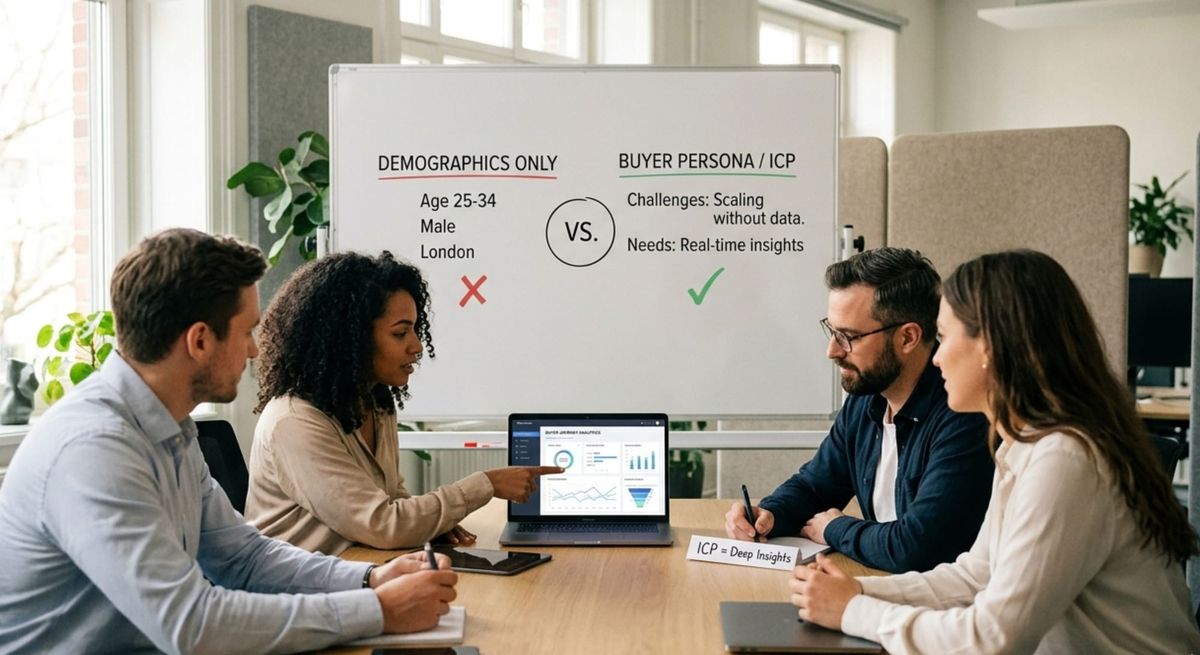
Over the years, I've sat in countless strategy sessions where someone points to a slide and says: "Our target audience is marketing managers, 28-45, working in companies with 50-500 employees." And everyone nods. The brief gets approved. The campaign gets built. Six months later, the campaign underperforms, not because the execution was poor, but because the foundation was wrong. A demographic is not an ICP. A job title is not a persona. And a strategy built on surface-level audience definitions will always produce surface-level results.
The ICP – the Ideal Customer Profile – is one of the most used and least understood concepts in marketing. Whether you're in B2B or B2C, getting this right is the difference between content that resonates and content that merely reaches.
In a previous article, I covered the foundational distinctions between segmentation, targeting, and buyer personas. This article goes one layer deeper into what makes an ICP genuinely strategic rather than merely descriptive, and how to build the three layers that turn audience knowledge into creative direction your entire team can use.
What an ICP Actually Is
ICP stands for Ideal Customer Profile. The word ideal does most of the work here, and most teams ignore it.
Ideal doesn't mean "anyone who could theoretically buy from us". It means the specific type of customer who gets the most value from your product or service, experiences the least friction in the buying process, and is most likely to stay, refer, and grow with you over time.
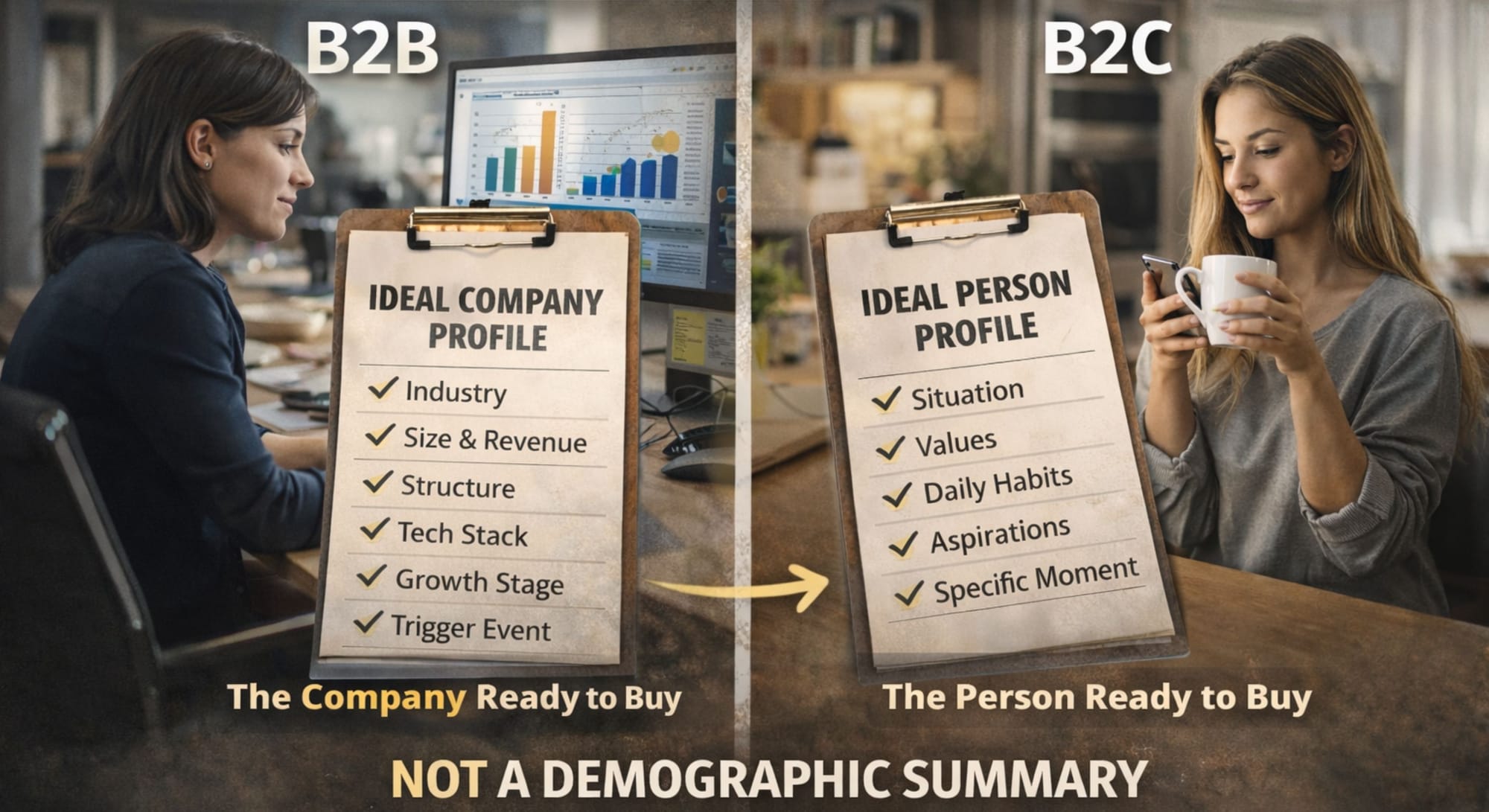
In B2B, the ICP typically describes a company profile: industry, size, revenue, structure, tech stack, growth stage, and the trigger event that makes them ready to buy now. In B2C, the ICP describes a person: their situation, values, daily habits, aspirations, and the specific moment in their life when your product becomes relevant.
What neither version of the ICP is: a demographic summary. Demographics tell you who someone is on paper. The ICP tells you why they buy, when they buy, and what they need to believe before they do.
Most teams define their ICP during initial strategy work - then never revisit it. But ICPs erode. As your product evolves, your pricing changes, and the market shifts, the customer who was once your ideal buyer may no longer be. An outdated ICP is worse than no ICP. It gives false confidence to decisions that are quietly pointing in the wrong direction.
The Persona Is Not the ICP, but You Need Both
The ICP and the buyer persona are related, but distinct. Confusing them is a consistent source of strategic drift – teams either collapse both into a single vague document, or they build personas without ever anchoring them to a clear ICP first.
| ICP | BUYER PERSONA | |
|---|---|---|
| What it defines | The type of customer or company that fits your offer | The specific human who makes or influences the buying decision |
| Level of abstraction | Category-level: firmographics or life-stage profile | Individual-level: motivations, fears, language, identity |
| Primary use | Targeting, segmentation, channel selection | Messaging, content direction, creative brief |
| B2B focus | Company profile + readiness and trigger signals | The 3-5 stakeholders in the buying committee |
| B2C focus | Life stage + situational profile | Emotional and identity drivers behind the purchase |
| Updated when | Business model or offer changes significantly | Audience research reveals new behavioural patterns |
Think of the ICP as the filter that tells you who to talk to. The persona is the map that tells you how to talk to them. You need both, and always in that order. Without the ICP, your personas have no strategic anchor. Without the persona, your ICP has no messaging application.
The Three Layers of a Strategic ICP
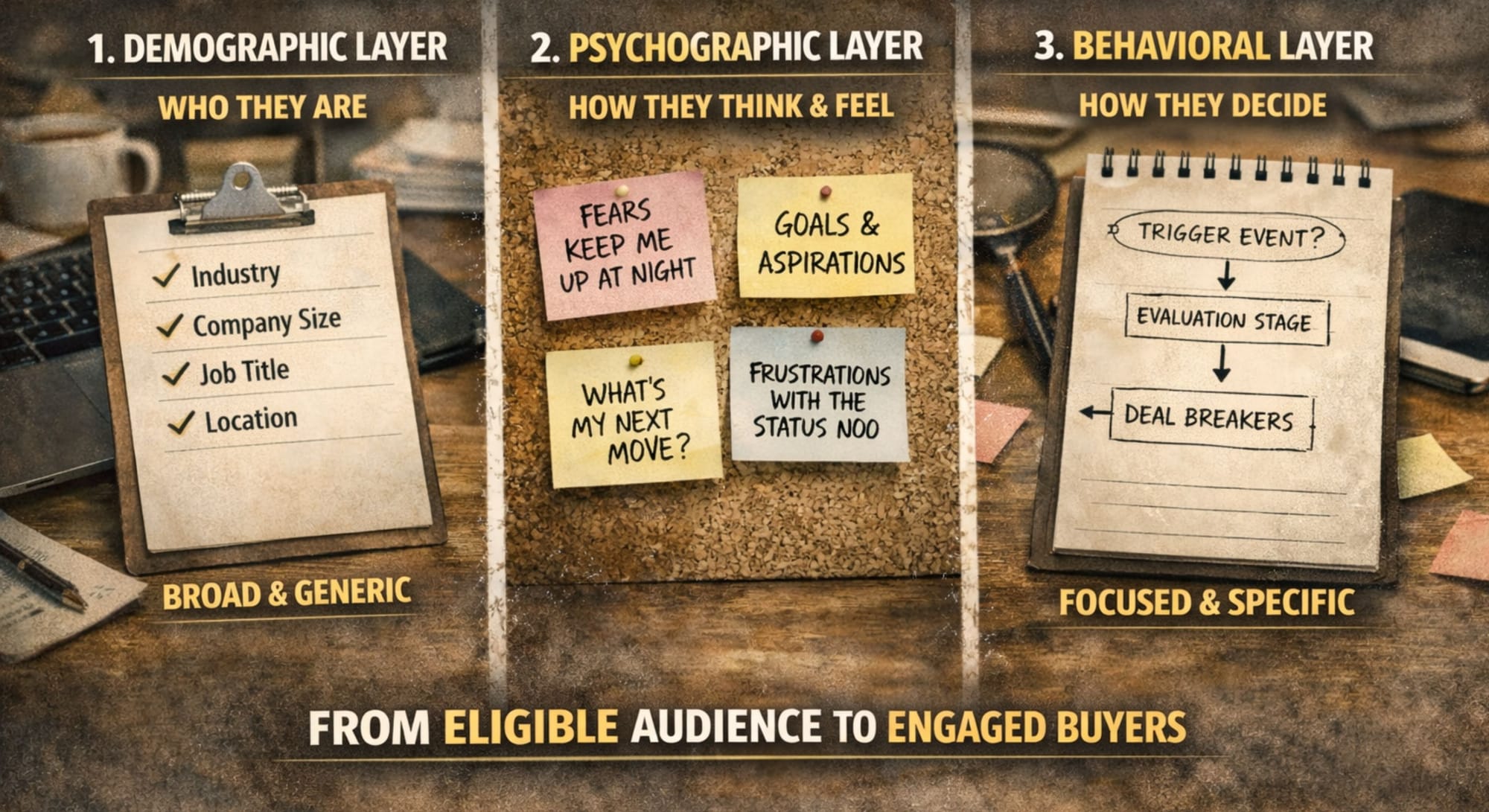
A demographic profile tells you who someone is. A strategic ICP tells you how they think, what they fear, and what triggers their decision. Those are three entirely different levels of knowledge - and they require three entirely different kinds of research to build.
Layer 1 – The Demographic Layer
Necessary but Insufficient
The Demographic Layer is where most ICPs stop. Company size, industry, geography, annual revenue, tech stack, job title, seniority level. These parameters are necessary; without them, you cannot target a campaign or size a market. But they produce no creative direction whatsoever.
Knowing that your ICP is "a marketing director at a B2B SaaS company with 100-500 employees" tells you nothing about what they are afraid of, what keeps them up at night, or what sentence in a subject line would make them stop scrolling on a Tuesday morning.
Use the Demographic Layer to define eligibility. Use the layers below to define resonance.
Layer 2 – The Psychographic Layer
Where Strategy Begins
The Psychographic Layer is where the ICP becomes strategically useful. It captures what your ideal customer believes, fears, values, and aspires to; the internal emotional landscape that shapes every decision they make, including the decision to engage with your brand or ignore it.
A Psychographic Layer built with sufficient depth answers five questions:
- What does this person believe about their current situation? Not what they say publicly – what they actually think is true.
- What are they afraid of? The professional fears that shape their risk tolerance and their resistance to change.
- What do they want to be seen as? The identity they are building or protecting – the professional self-image that your brand either supports or threatens.
- What do they secretly know is not working? The gap between their public confidence and their private diagnosis of the problem.
- What would a perfect outcome look like to them - in their own words? Not in your product language. In theirs.
These answers do not come from a survey. They come from sales call recordings, customer service transcripts, review platforms, LinkedIn comments, and direct conversations. GenAI can help you synthesise and structure this research at speed, but it cannot replace the raw input of real customer voices.
Layer 3 – The Behavioural Layer
How They Decide
The Behavioural Layer captures what your ideal customer actually does when they are moving through a decision - not what they say they do, but what the data shows. It is the layer that connects your ICP to your customer journey map and determines what kind of content you need to produce at each stage.
A complete Behavioural Layer answers three questions:
- What triggers the search? The specific event or accumulation of frustration that moves them from passive awareness to active consideration. This is The Inciting Incident - the moment the Ordinary World becomes intolerable enough to warrant a change.
- What does the evaluation process look like? How many stakeholders are involved? What evidence do they seek? What objections appear most reliably at what stage?
- What breaks the deal? The specific friction – in the copy, the pricing, the process, the proof - that sends them back to the Ordinary World instead of crossing the threshold into the Special World.
The strategic implication: An ICP built across all three layers does not just tell you who to target. It tells you what to write, what to show, what to prove, and what to avoid at every stage of the journey.
A demographic profile does none of those things.
What a Strategic ICP Actually Looks Like in Practice
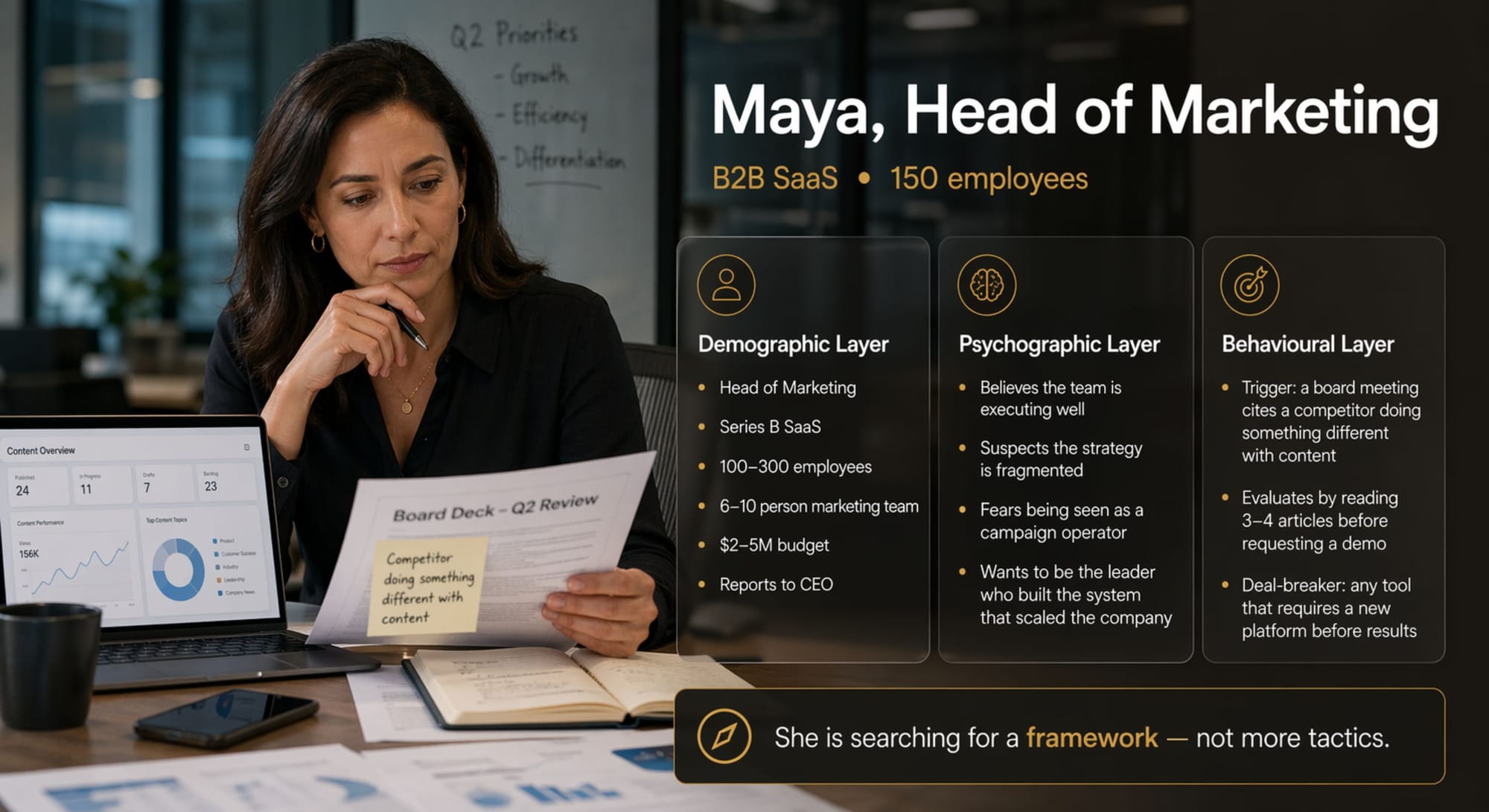
To make this concrete, here is an example of what a three-layer ICP looks like when it is built properly - for a B2B marketing automation platform targeting mid-market companies. Compare this to the one-paragraph demographic profile most teams are working from.
Maya, Head of Marketing · 41 · B2B SaaS · 150 employees
Demographic Layer
Head of Marketing, B2B SaaS, Series B, 100-300 employees, 6-10 person marketing team, $2-5M marketing budget, reporting to CEO.
Psychographic Layer
Believes her team is executing well but suspects the strategy is fragmented. Fears being seen as a "campaign operator" rather than a strategic leader. Wants to be the person who built the marketing system that scaled the company.
Behavioural Layer
Triggered to search after a board meeting where the CMO of a competitor was cited as doing "something different with content". Evaluates by reading 3-4 articles before requesting a demo. Deal-breaker: any tool that requires her team to learn a new platform before seeing results.
In their own words
"I need something that makes us look like we have a bigger team than we do." · "I'm tired of explaining to the CEO why we can't connect content to pipeline." · "Show me something that works in the first 30 days."
Notice what becomes possible when the ICP is built to this depth.
- The hook writes itself: "You're running a 7-person team and being asked to deliver like a team of 20".
- The proof point writes itself: "First results in 30 days - or we work for free."
- The content topics write themselves: pipeline attribution, content-to-revenue reporting, making a small team look resourced.
Every downstream decision is guided by the ICP rather than invented fresh for each brief.
ICP Mistakes That Undermine Every Campaign Built on Them
Mistake #1: Building the ICP from assumptions rather than evidence
The most common ICP failure is building the profile in a workshop room using the internal team's beliefs about the customer rather than the customer's own words. Internal assumptions dressed as customer insights produce content that feels right to the people who made it and lands flat with the people it is meant for. The raw material for a genuine ICP is always external: customer interviews, sales call recordings, support tickets, LinkedIn comments, and review platform language. GenAI can help you synthesise and structure that material rapidly - but it cannot manufacture the insight that the raw material contains.
Mistake #2: Maintaining one ICP for all products, stages, and channels
A company with three products serving three different buyer types at three different stages of company maturity does not have one ICP. It has at least three. Using a single composite ICP across all of them produces content that is generic enough to apply to everyone and specific enough to resonate with no one. The discipline is building separate, specific ICPs for each meaningful audience variation - and then creating separate content strategies for each.
Mistake #3: Using the ICP for targeting, but not for content
The most frustrating version of this mistake: the ICP is used with precision by the media-buying team to define campaign audiences, and then completely ignored by the content team who writes the actual copy those audiences will read. The result is highly targeted distribution of content that does not speak to the person it has just been served to. The ICP must live in the brief, not just in the campaign settings.
Mistake #4: Never updating the ICP
An ICP built when your product was at version 1.0 may describe a completely different buyer than the one your version 3.0 product attracts. Markets mature. Buyer sophistication increases. Competitive alternatives multiply. An ICP that is not reviewed at least annually - and updated whenever the product, the market, or the competitive landscape changes meaningfully – becomes a strategic liability rather than a strategic asset.
How to Use GenAI as Your ICP Deepening Engine
GenAI cannot build your ICP from scratch. But once you have the Demographic Layer defined and a body of real customer evidence gathered, GenAI can dramatically accelerate the process of building the Psychographic and Behavioural Layers, and then help you translate the finished ICP into creative direction your team can use immediately.
Use this two-stage prompt:
Stage 1 – Deepening the ICP
You are a Senior Customer Insights Strategist specialising in B2B and B2C buyer psychology.
I will share:
(a) Our Demographic ICP definition
(b) A selection of real customer quotes, review extracts, or sales call notes
Your task is to build the Psychographic and Behavioural Layers of this ICP:
Psychographical Layer – identify:
1. The core professional fear driving their status quo (what they are afraid of losing or being seen as)
2. The identity they are trying to build or protect
3. The gap between their public confidence and their private diagnosis of the problem
4. The exact language they use when describing their frustration - verbatim phrases where possible
Behavioural Layer – identify:
1. The Inciting Incident: the specific event or accumulation that triggers active search
2. The evaluation behaviour: what evidence they seek, what objections appear, and at what stage
3. The deal-breaker: the specific friction most likely to end the consideration process
Demographic ICP: [Paste definition here]
Customer evidence: [Paste quotes, reviews, call notes here]
Output format: Three clearly labelled sections. Use direct language. No abstractions.
Stage 2 – Translating ICP to creating direction
Using the completed three-layer ICP above, generate the following:
1. THREE hook options for a LinkedIn post - each using a different hook type (Pain Point, Curiosity Gap, Recognition)
2. ONE subject line for a cold email that names the Inciting Incident without selling
3. ONE headline for the landing page that speaks to the identity the ICP is building
4. TWO words or phrases from the customer evidence that should appear verbatim in all content for this ICP
Rules:
- Every output must be traceable to a specific element of the ICP.
- No generic marketing language. Every word must be earnable by this specific ICP.
- The brand is the Guide. The ICP is always the Hero.
Validate the result. The output will be structurally sound. Whether it is emotionally accurate depends entirely on the quality of the customer evidence you fed in. If the psychographic layer feels generic, the input was generic. Return to the source material - customer interviews, real reviews, recorded calls, and extract more specific language before running the prompt again.
Final Thought
An ICP is not a targeting parameter. It is the strategic foundation that makes every piece of content, every campaign brief, and every GenAI prompt more powerful - because it replaces the question "what should we say?" with "what does this specific human need to hear right now, and what words will they recognise as true?".
The demographic layer tells you who to reach. The psychographic and behavioural layers tell you how to move them. Both are necessary. Only one of them is sufficient. And most marketing teams are working with only one.
Is your ICP telling your team who to target or what to say, how to say it, and why it will land?
Recommended Use Cases:
 Diana Socaciu