The Content OS: How to Build a System That Runs Without You
If your content engine stops the day you take a week off, you do not have a system - you have a person doing a system's job. Here is the Content OS that makes great content sustainable when you are not in the room.

Every Head of Content I have ever worked with has had the same private thought at some point in their career. It usually surfaces around three in the morning, the night before they go on holiday: if I disappear next week, what actually breaks?
The honest answer is rarely flattering. The hooks get blander. The brand voice drifts. The brief that should have been written by Tuesday is being written on Friday morning, by someone who has not read the latest persona document. Someone publishes the carousel without checking whether it points to a live article. The calendar keeps moving, but the strategic coherence holding it together starts dissolving the moment the person who carries it in their head walks out of the building.
This is not a leadership failure. It is a systems failure. The strategic thinking exists. The frameworks exist. What does not exist is the operating system that translates those frameworks into repeatable rituals, defined roles, and standard templates so that the work continues at the same quality whether you are in the office or on a flight to somewhere else.
That operating system is the Content OS. It is what closes the Content Architecture chapter of this series, and it is what separates a marketing leader from a marketing operator. The leader builds the system. The operator runs it. Most teams have an operator and call them a leader. The fix is not more discipline. The fix is the OS itself.

What the Content OS Actually Is
A Content OS is not software. It is not a Notion template. It is not the project management tool the team uses to track tasks. Those are the surfaces it lives on. The OS itself is the underlying system that makes content production predictable, repeatable, and resilient - the documented combination of pillars, roles, rituals, and templates that everyone on the team knows, follows, and trusts.
The test is simple. If your most senior content person was unreachable for a month, would the team still produce work that was strategically coherent, brand-correct, and on the calendar? If the answer is yes, you have a Content OS. If the answer is "we would manage" or "we would push deadlines" or "we would skip the harder pieces" — you have a person doing a system's job. The work is happening. The system is not.
The systems test: A Content OS exists when the work survives the absence of any one person, including the leader who built it. Anything less is a fragile workflow held together by a specific human's judgment. Useful. Not durable.

The Four Pillars of the Content OS
The Content OS is built on four pillars. Each pillar answers a different operational question. Together they cover the full content lifecycle, from idea to publication to learning. Skip any pillar and the system has a structural gap that will eventually compound into a strategic one.
Pillar 1 – Roles (Who Does What)
Every piece of content has a named owner at every stage of its lifecycle, not a team, not a function, a specific person. Strategy owner approves the brief. Production owner writes or commissions the piece. Brand owner validates voice and narrative coherence before publication. Distribution owner executes the publication and the derivative cascade. When ownership is shared across "the team," nobody is accountable. When it is named, the work moves.
Pillar 2 – Rituals (When Decisions Get Made)
Strategic decisions never happen "as needed" – they happen on a known cadence that everyone has in their calendar. The weekly brief check, the monthly narrative audit, the quarterly strategic review. Rituals replace meetings-on-demand with meetings-on-rhythm, which means the team stops debating the same questions every week and starts compounding the answers across cycles.
Pillar 3 – Templates (What the Output Looks Like)
Every recurring artefact in the content production process – the brief, the Hero Asset outline, the carousel structure, the publication checklist, the derivative request form – exists as a documented, reusable template. Templates are not creative constraints. They are the encoded judgment of your most senior thinker, made available to every contributor every time the artefact is produced. Without templates, every contributor invents their own version of the artefact, and every version is slightly worse than the one before it.
Pillar 4 – Approval Flows (How Quality Is Protected)
Every piece of content moves through a defined sequence of approvals before it is published - and the sequence is the same every time. Brief approval before production. Voice approval before publication. Distribution approval before the derivative cascade begins. The flow is not a bureaucratic delay. It is the mechanism that prevents the wrong piece from reaching the audience, and that gives every contributor the confidence to ship without anxiety, because the system catches what they miss.

The Four Roles That Make the System Work
Inside the Roles pillar, four named roles cover every accountability in the content lifecycle. In a small team, one person can hold two roles. In a large team, each role can be held by multiple people. What never works is leaving any role unassigned and assuming the team will figure it out.
The Strategist (Owns the why)
Approves the brief. Connects every Hero Asset to the Narrative Spine and the funnel stage. Says no when an idea fails the governance rules. The Strategist's signature on a brief is the green light for production.
The Producer (Owns the what)
Turns the brief into the published piece. Writes, commissions, or directs. Responsible for the depth of the framework and the quality of the prose. The Producer never starts work without an approved brief.
The Brand Guardian (Owns the voice)
Validates that the published piece sounds like the brand. Checks against the Brand Manual. Catches drift before it reaches the audience. The Brand Guardian's veto is final on voice questions, regardless of seniority.
The Distributor (Owns the where and when)
Executes publication. Runs the derivative cascade. Owns the channel-specific adaptations. Reports performance against the funnel-stage metrics defined in the brief. The Distributor closes the loop between strategy and signal.
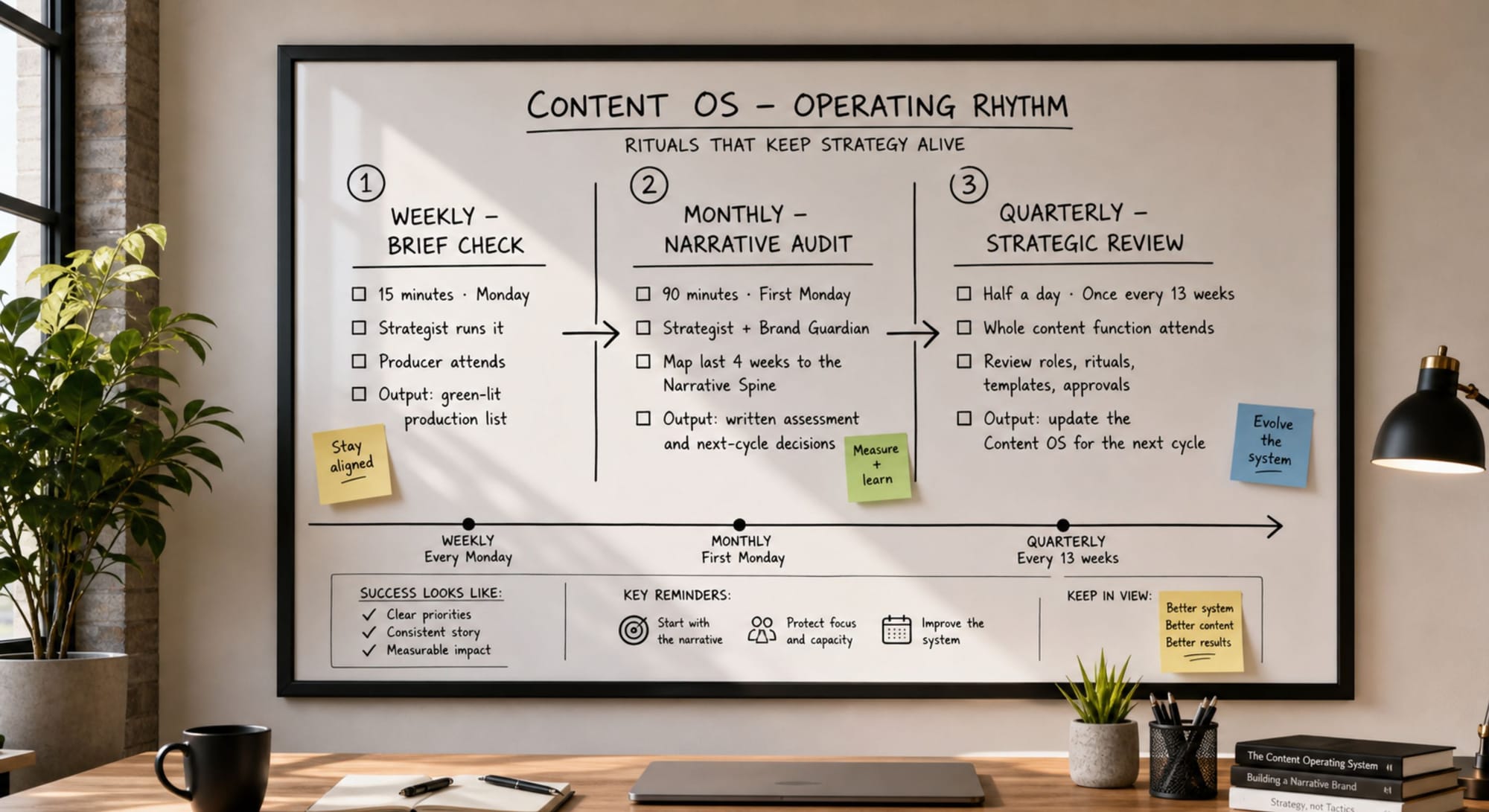
The Three Rituals That Keep the System Honest
Rituals are the difference between a system that exists and a system that runs. Three rituals cover the full operational rhythm. Each has a fixed cadence, a defined attendance, a clear input, and a clear output. None of them are optional.
Weekly - The Brief Check
15 minutes · Monday
Every calendar entry for the upcoming week is checked against the five governance rules from the Strategy-to-Calendar framework. Missing brief, unclear persona, undefined stage - any gap stops production until it is closed. The Strategist runs it. The Producer attends. The output is a green-lit production list for the week ahead.
Monthly - The Narrative Audit
90 minutes · First Monday of the month
Every piece of content published in the previous four weeks is mapped against the Narrative Spine. The Strategist and the Brand Guardian co-run it. The output is a written assessment of which pieces strengthened the narrative, which fragmented it, and which decisions to bake into the next cycle. This is not a retrospective punishment exercise. It is the calibration mechanism that keeps the system honest.
Quarterly - The Strategic Review
Half a day · Once every 13 weeks
The four pillars themselves get reviewed against the current strategic inputs, not against the previous quarter's calendar. Has the persona evolved? Has the positioning sharpened? Are the rituals still serving the team or just consuming time? The whole content function attends. The output is a written update to the OS itself, including any role redefinitions, ritual adjustments, or template revisions needed for the next cycle.
Rituals replace heroics. A team that runs the three rituals consistently produces better content than a team of more talented people running on improvisation. Talent without rhythm burns out. Rhythm without talent stays consistent. Rhythm with talent compounds, which is the only sustainable strategy for content at scale.
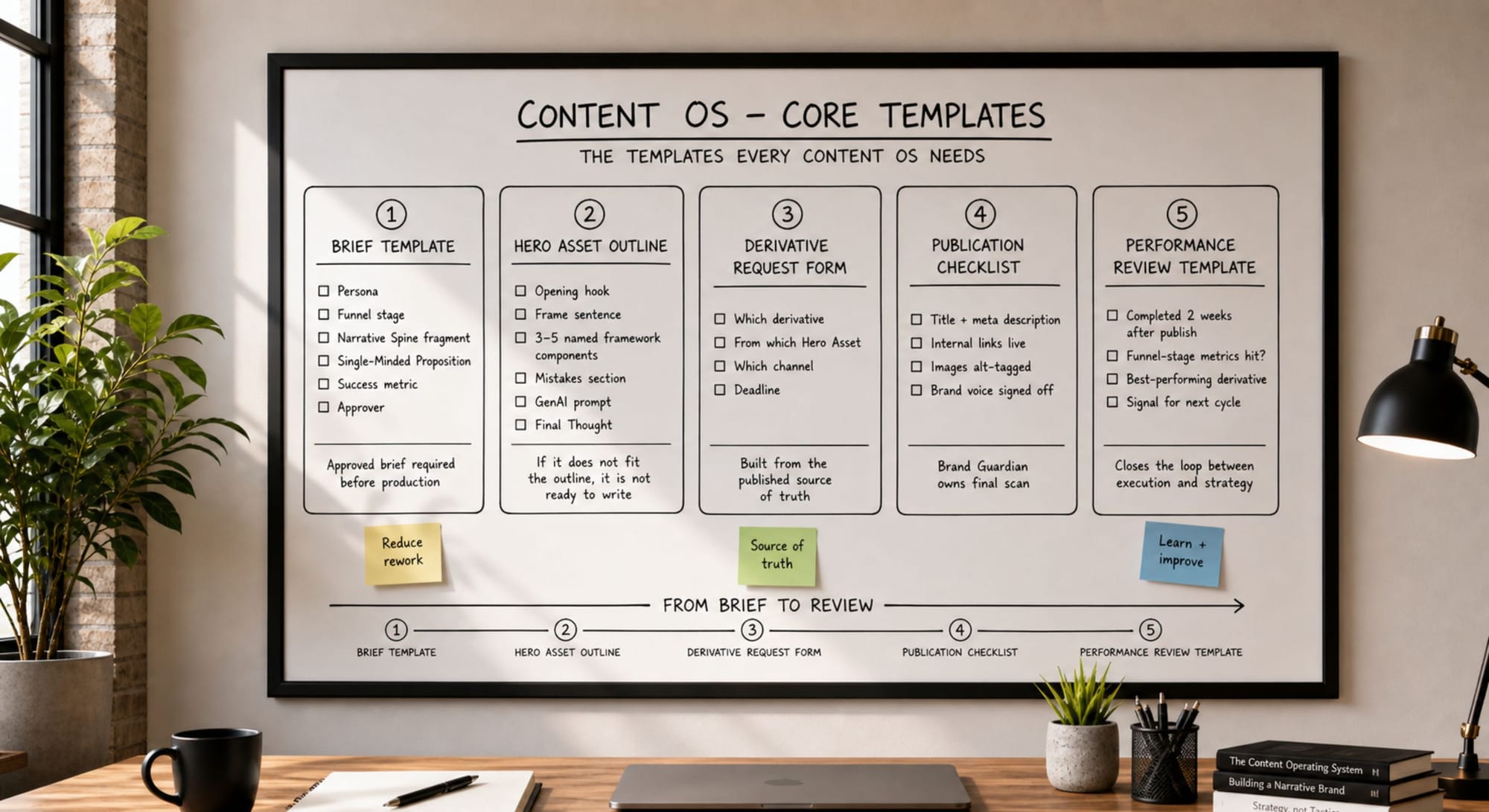
The Templates Every Content OS Needs
Templates are where the OS becomes most visible to the team and most invisible to the audience. Five templates cover every recurring artefact in the production process. Each one encodes the judgment of your most senior thinker so that every contributor produces work at that standard from the first draft, not the third.
The Brief Template
The non-negotiable starting point. Captures the persona, the funnel stage, the Narrative Spine fragment, the Single-Minded Proposition, the success metric, and the approver. No content moves to production without an approved brief on this template. Five fields. One page. Twenty minutes to fill in. Saves weeks of rework downstream.
The Hero Asset Outline
The structural skeleton every long-form piece is built on: opening hook, frame sentence, three to five named framework components, mistakes section, GenAI prompt, Final Thought. The outline ensures every Hero Asset is dense enough to generate the twelve derivatives the model requires. A Hero Asset that does not fit the outline is not yet ready to be written.
The Derivative Request Form
A short form the Distributor fills in for each derivative – which derivative, from which Hero Asset, for which channel, by when. It is the bridge between the published article and the twelve pieces that follow it. Without this template, derivatives get produced from memory or from the brief, both of which drift from the published source of truth.
The Publication Checklist
The final pre-publication scan. Title and meta description in place. Internal links live. Images alt-tagged. Brand voice signed off. The Brand Guardian owns it. It is the difference between a piece that ships clean and a piece that gets edited in production.
The Performance Review Template
One page per Hero Asset, completed two weeks after publication. Did it hit the funnel-stage metrics defined in the brief? Which derivative performed best? What signal does this give the next cycle's planning? This is the template that closes the loop between execution and strategy - and it is the one most teams skip.
Three Mistakes That Quietly Break the System
Mistake #1: Building the OS for the team you have, not the team you are scaling toward
The most common Content OS failure is designing the system around the current contributors' habits and preferences. The OS works beautifully, until someone leaves, the team grows, an agency joins, or a freelancer steps in. Then the system fragments because it was held together by individual context, not documented standards. The OS must be designed for a contributor who has never met you and has no shared history with the team. If a new freelancer cannot produce a brand-correct first draft from the templates and briefs alone, the OS is not yet complete.
Mistake #2: Treating the rituals as meetings rather than decision points
Rituals get diluted into status updates, then into informal check-ins, then into nothing at all. The first sign is when the Brief Check turns into a conversation about workload instead of a governance gate. The second sign is when the Narrative Audit gets postponed because "the team is too busy this month". The third sign is silence. Each ritual exists to make a specific decision. When the decision is not being made, the ritual has already been killed – even if the meeting is still on the calendar.
Mistake #3: Confusing the OS with the tools
Many teams believe they have a Content OS because they have a Notion workspace, an Asana board, or a content calendar in Airtable. Tools are the surfaces the OS runs on, they are not the OS itself. A team can change tools every six months and still operate the same OS. A team can have the most sophisticated tooling in the industry and have no OS at all. The OS lives in the documented pillars, roles, rituals, and templates. The tools just record what the OS produces.
How to Use GenAI as Your Content OS Auditor
Once the four pillars are documented, GenAI can be used to stress-test the OS itself. Not to design it – that is leadership work – but to surface the gaps before the system encounters them in production. Run this prompt at the end of the OS design phase, and again at every quarterly review.
You are a Senior Content Operations Consultant with deep expertise in scaling content functions in marketing organisations.
I will share the four pillars of our Content OS:
1. Roles
2. Rituals
3. Templates
4. Approval Flows
Your task is to audit the system across four dimensions:
The Resilience Test: If the senior content leader was unreachable for one month, which pillar would degrade first, and at what specific point in the lifecycle would the system start to fragment?
The New Joiner Test: A new freelancer joins next Monday with no shared history. Using only the documented templates and briefs, can they produce a brand-correct first draft of a Hero Asset within their first week? If not, what is missing from the OS that would need to be added before they could?
The Ritual Drift Test: Which of our three rituals is most likely to get diluted under deadline pressure? What specific safeguard would prevent the dilution, a forcing function, a documented decision rule, a different attendee structure?
The Compounding Test: Are the templates designed to capture learnings cycle-over-cycle, or do they reset every cycle? If they reset, what change would make the OS compound rather than restart?
After the four tests, deliver:
- One sentence naming the single most fragile element of this OS.
- Three specific, prioritised changes that would make the OS more resilient.
Our four pillars: [Paste documented pillars here]
Rules:
- No generic operations advice. Every finding must reference a specific element of our OS.
- If a pillar passes a test, say so explicitly.
- Treat fragility as a structural problem, not a discipline problem.
Validate the result. Use your own knowledge of the team, the budget, and the strategic context before acting on any output. GenAI applies the audit logic to the documented OS - it does not know your team's actual capacity, your political constraints, or the cultural realities that determine which changes will land and which will be quietly rejected. You provide that judgment. GenAI provides the structured pressure-test.
Final Thought
The marketing leaders who build content operations that outlast them have stopped trying to be the smartest person in the room. They have started trying to build a room that is smart even when they are not in it. That shift – from operator to architect – is what the Content OS makes possible. It is also what makes a content function genuinely scalable, because scale is never about producing more; it is about producing well, consistently, regardless of who is holding the workload that week.
Pillars. Roles. Rituals. Templates. Documented, reviewed, and trusted. The work survives the absence of any one person, including yours.
If you took a month off starting tomorrow, would your content team produce work that strengthened the brand or work that quietly diluted it?
Recommended Use Cases:
 Diana Socaciu