USE CASE: How to Use GenAI to Produce More Content Across Four Brands Without Losing Quality in a Car Dealership
A real-world GenAI marketing use case: how a two-person team at a multi-brand car group kept pace across four brands, using GenAI to multiply production while a human held the quality line.
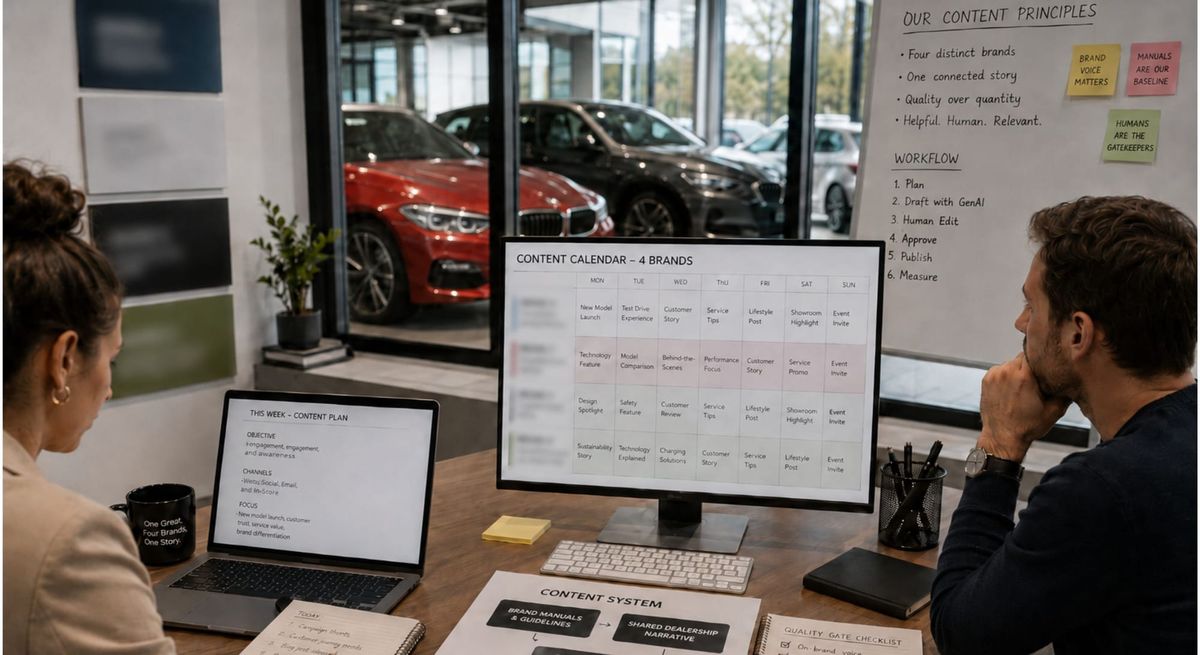
Producing content at scale is easy now; producing more of it without quality collapsing is the actual job. This is what GenAI and a content calendar look like in practice: how a two-person team kept pace across 4 brands, each with its own voice, and held the quality line while doing it.
The Context: 4 brands, 4voices, 2 people
A multi-brand automotive dealership group with 4 brands, each in its own showroom. Every brand has its own manual and its own narratives; the group has a shared dealership narrative that connects them all. And a marketing team of 2. 4 brands’ worth of content to produce, 4 distinct voices to keep straight, 1 shared story to carry through them, and 2 people to do all of it.
The Challenge: a Pace Problem with 2 B Answers
Producing enough content for 4 distinct brands – each governed by its own manual and narratives – while also carrying the shared dealership narrative is more than 2 people can make well. The pace problem has only ever had 2 answers, both bad: produce less, and let a brand go quiet; or produce fast, and watch the 4 voices flatten into one generic dealership tone, the brand manuals shelved to keep up. Neither is acceptable when the whole point is 4 distinct brands. The constraint was capacity against complexity, not just how much content, but how much while keeping four rulebooks straight. And the obvious relief, just publish more and faster, is a trap: producing more was never the goal. Producing more good, on-brand content was. Volume without each brand’s voice held isn’t scale; it’s four brands sounding like none.
GenAI is only as on-brand as the brand you hand it: GenAI doesn’t keep 4 brands distinct on its own – left alone, it flattens them. What keeps volume on-voice is what you hand it: each brand’s manual and narratives, and the shared dealership story that connects them. The bottleneck moves from how much 2 people can write to how well the brand is written down.
The GenAI Workflow: Multiply the Production, Hold the Gate
The fix wasn’t to lower the bar or clone the team; it was to change where 2 people spent their hours, and to feed GenAI the things only the group had. For each brand, GenAI worked from that brand’s own manual and narratives – and from the shared dealership narrative – so its drafts came out in the right voice rather than a generic one. It took on the volume work: drafting across the calendar, adapting one idea into brand-appropriate versions for each brand, repurposing what already existed – multiplying what 2 people could put out each week. The 2 marketers stopped being the producers of every piece and became the editors of all of them: the quality gate every GenAI draft had to clear before it published. More across 4 brands, because the production was multiplied and each brand had a manual to hand the model; still good, because each draft was built against the right brand’s voice, and nothing reached a brand without a human saying so.
You are a content-production engine for a dealership group with 4 brands, each with its own showroom, manual and narratives, plus a shared dealership narrative. Here is the brand I’m working on now – its manual and narratives – and the shared narrative: [paste]. Here are this week’s slots to fill for it: [slots].
Draft content for the slots at volume, in THIS brand’s voice as defined by its manual and narratives – not a generic dealership tone – and carry the shared narrative where it fits. Where one idea suits several slots, produce variants, not the same text pasted across them.
Everything you produce is a draft for human approval, not a finished post. Flag any piece that is thin, generic, off-manual, or padded to fill a slot, as REVIEW – better an empty slot than a weak post. Mark anything not covered by the manual as CONFIRM WITH ME.
The caveat that decides whether this works: GenAI makes the thing you used to ration – volume – almost free, and that is exactly the risk. When producing one more post costs nothing, the temptation is to fill every slot regardless of whether the piece deserves to exist, and a calendar full of competent-but-empty content quietly erodes every brand it touches. GenAI is also a natural flattener: ask it to write for 4brands and it drifts toward one generic voice unless it is handed each brand’s manual and held to it. And it will pad – generate filler to complete a slot – because finishing the task is its instinct, not protecting your brand. The controllable variables: feed it the right brand’s manual and narratives every time, keep a human quality gate that each draft clears, and accept an empty slot over a weak one. A manual GenAI doesn’t have is a brand it can’t protect, and the standard that decides what is good enough to publish stays human.
The Result: 2 People, Keeping Pace
2 people started keeping pace across 4 brands. GenAI multiplied what they could put out – drafting, adapting, varying – using each brand’s manual and narratives so the volume came out on-voice rather than generic, with the shared dealership narrative running through it. No brand went quiet for lack of hands. But the thing that made it work was the gate: every piece still passed a human before it published, so more never meant worse. The team’s week shifted from making each post to deciding which were good enough, which is where 2 skilled people add the most value anyway. And because each draft was built against the right brand’s manual, more volume didn’t collapse 4 brands into one flattened voice. No invented figures here: the change is that the constraint moved from how much 2 people could make to how much they could approve, and the 4 voices held.
Recommended KPIs to Follow
This work is judged on a balance: more output, without quality or brand voice slipping. Watch the throughput and the quality gate together, one without the other is the failure mode. Here’s where the evidence sits and the direction this should push things. The point is the direction of travel, not a promised number.
Production Throughput Across the 4 Brands
The volume 2 people can put through the calendar, across all 4 brands. With GenAI carrying the drafting from each brand’s manual, this should rise sharply, the whole point is no brand going quiet for lack of hands.
Benchmark: Businesses using GenAI report markedly faster content production – on the order of ~60% faster, with several times the output – and most marketers say it saves them more than an hour a day on creative tasks (HubSpot; Typeface). Set your own baseline.
Quality-Gate Pass Rate
The guardrail: the share of GenAI drafts that clear the human bar and reach a brand. The point is that more never means worse, keep this high, and read a falling rate as a signal to improve the brief or the manual you’re feeding it, not to lower the bar.
Benchmark: The risk is real and measured: while ~71% of marketers say GenAI helps them make significantly more content, ~53% struggle to stand out in an AI-saturated market and ~52% say it has made content so easy to produce that it’s become less effective, volume is easy; quality is the new constraint (HubSpot).
On-Brand Consistency, Brand by Brand
Does each brand stay on its own manual at volume, without the 4 flattening into one voice, and does the shared dealership narrative still come through? Track an on-brand rate per brand; scale shouldn’t cost you the differences between the brands you run.
Benchmark: No clean public figure, an internal metric; general-purpose GenAI output tends to need editing to reflect a specific brand’s voice, so baseline an on-brand rate per brand (against its manual) and hold it as volume climbs (Databricks).
GenAI makes volume cheap, which is the danger, so the pass rate and the per-brand on-brand rate are the metrics that keep scale from becoming slop. Better an empty slot than a weak post. Track your own trend; the benchmarks are context.
Why this Transfers
Any small team running more brands than it can comfortably feed will reach the same fork: do less, do worse, or find leverage. The transferable move is to write each brand down – a manual and narratives GenAI can work from – then let it carry the volume while your scarce human hours move to the quality gate. Once producing more is nearly free, the only things protecting your brands are the manuals you hand the model and the standard you’re willing to enforce.
Recommended Articles:
 Diana Socaciu