Experimenting Without a Data Science Team: A Marketer's Guide to Testing
Testing has a reputation as a data science discipline requiring statisticians and enormous sample sizes. Most of what a lean marketing team actually needs is judgment, not statistics. Here is how to run trustworthy experiments without a data scientist in the room.

Most lean marketing teams have a complicated relationship with testing. They know they should be doing it. They have read that the best growth teams run experiments constantly. And then they look at their own situation – no data scientist, modest traffic, a team already stretched across ten priorities – and quietly conclude that rigorous testing is a luxury for companies with more resources. So they either do not test at all, or they run casual A/B tests, glance at whichever version has the higher number after a few days, and declare a winner with a confidence the data does not remotely support.
Both responses come from the same misunderstanding: that good testing is fundamentally a statistical discipline requiring specialist expertise, which is not the case. My master's at the University of Nebraska included a minor in statistics, and the most useful thing it taught me about experiments was the opposite of what people expect, namely that the maths is the small part. The hard part of testing is not the statistics; most of that can be handled by a calculator or the testing tool itself. The hard part is the judgment: choosing what is worth testing, forming a real hypothesis, and reading the result honestly. Those are marketing skills, not data science skills. A lean team that develops them will out-learn a resourced team running sophisticated tests on trivial questions.
This article closes the Measurement chapter by turning everything before it into action. You have chosen the right metrics, learned to present them, and made peace with the limits of attribution. Testing is how you actually improve those metrics, deliberately, one honest experiment at a time.
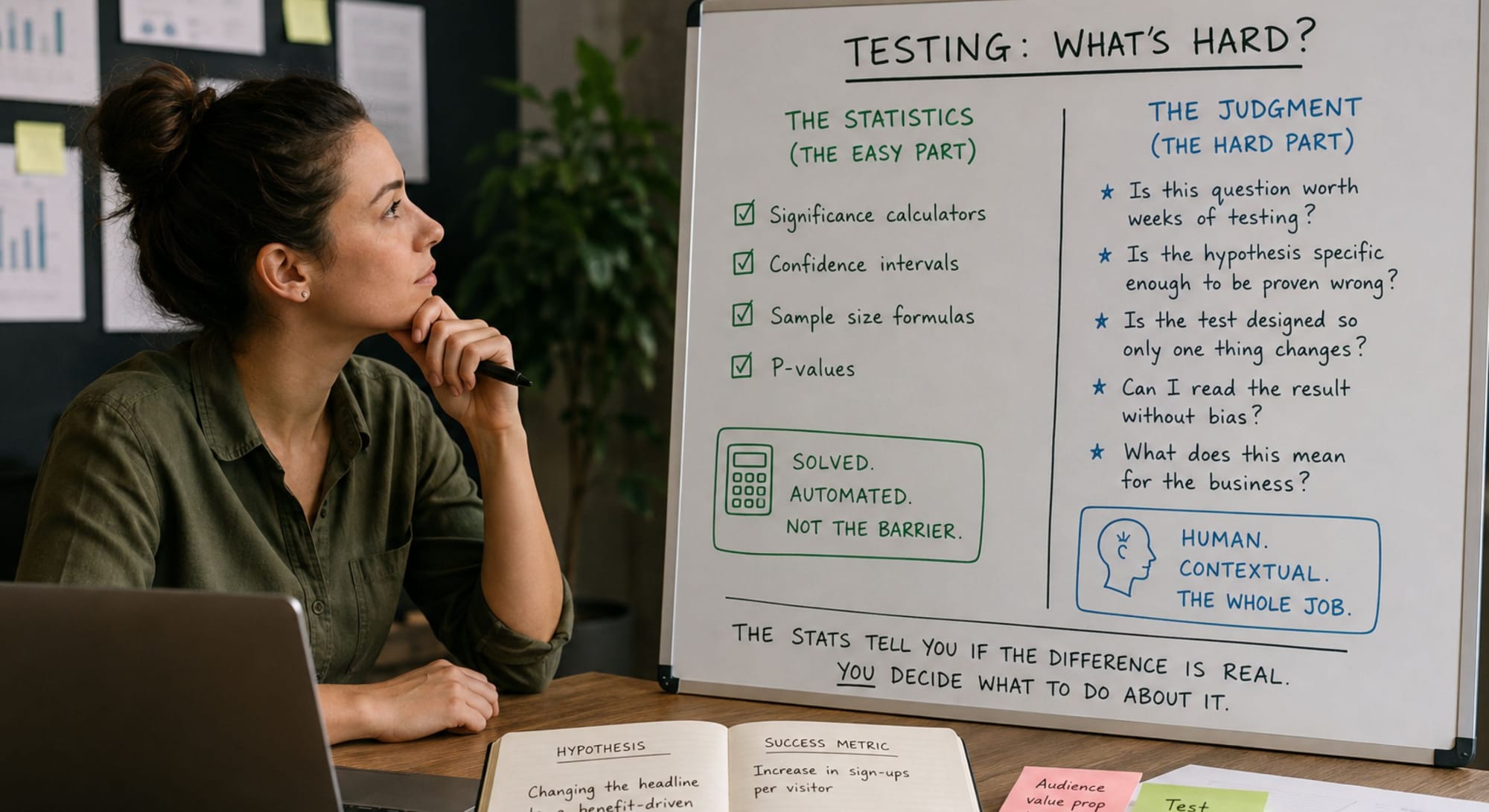
Why the Statistics Are Not the Hard Part
The intimidation around testing comes from the statistics: significance thresholds, confidence intervals, sample size calculations. These sound like the barrier, and for a team without a data scientist they feel insurmountable. But here is the reframe that changes everything: the statistics are the most solved part of testing. A free significance calculator handles the maths. Most testing tools compute significance automatically. You do not need to derive the formula, you need to know what it is telling you and when to trust it.
The genuinely hard parts – the parts no calculator solves – are entirely within a marketer's existing skill set. Deciding which question is worth the weeks a test will take. Forming a hypothesis specific enough to be proven wrong. Designing a clean test where only one thing changes. Reading an ambiguous result without talking yourself into the answer you wanted. Every one of these is judgment, and judgment is what marketers are for.
The testing principle: The statistics tell you whether a difference is real. They cannot tell you whether the question was worth asking, whether the hypothesis made sense, or what the result means for the business. The maths is the easy, solved, outsourceable part. The judgment around it is the whole job, and it is a job marketers are already equipped to do.
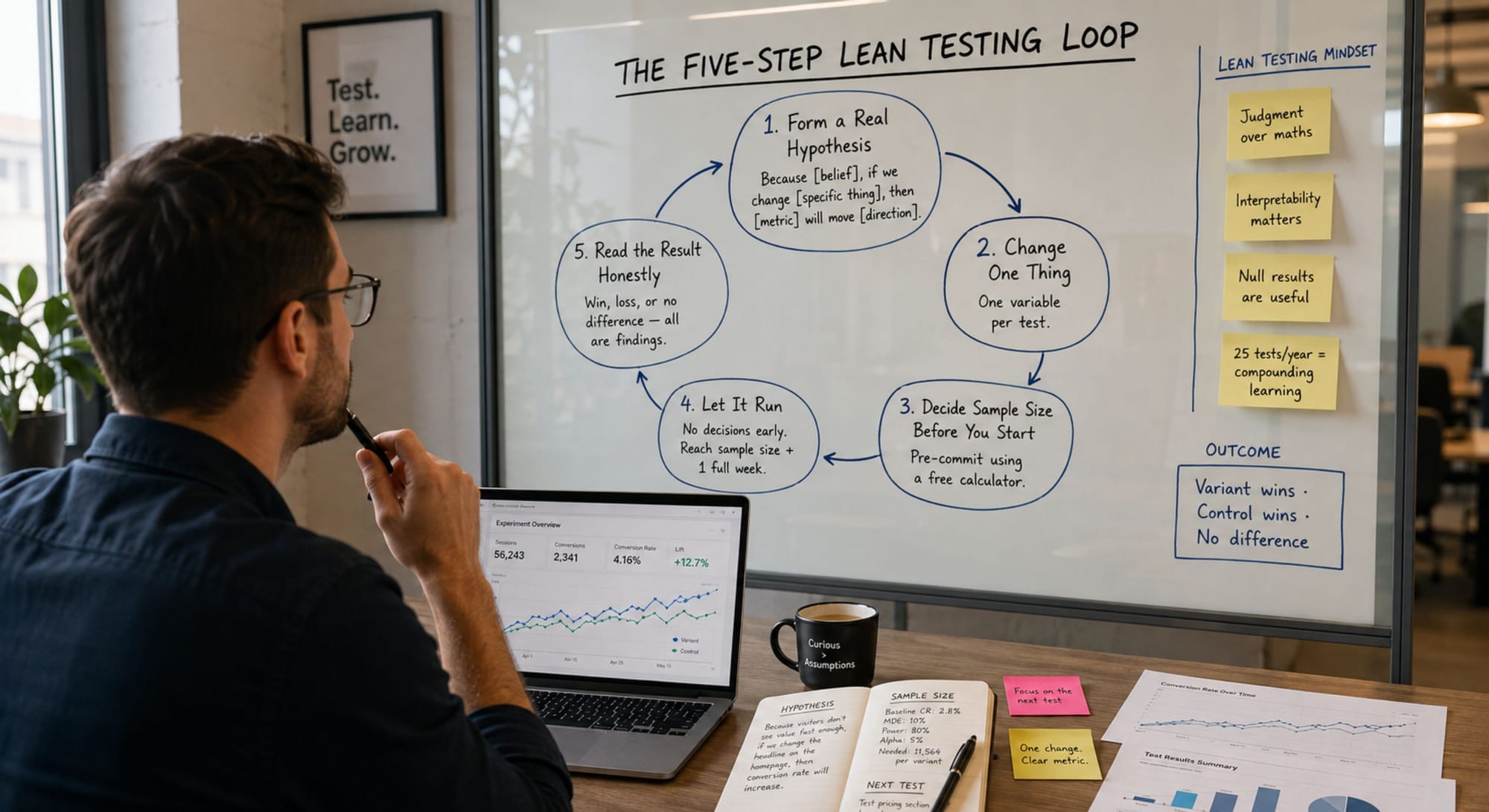
The Five-Step Lean Testing Loop
Trustworthy testing without a data science team runs on a simple, repeatable loop. Five steps, each within reach of a lean team, none requiring a statistician. The discipline is in following all five; most failed marketing tests skip step one or step five, which are the two that require the most judgment and the least maths.
Step 1 – Form a Real Hypothesis, Not a Vague Curiosity
The step most teams skip
A test begins with a hypothesis that can be proven wrong; a specific, falsifiable prediction, not a vague "let's see if green converts better". A real hypothesis has a shape: because we believe something about the audience, if we change this specific thing, then this specific metric will move in this direction. The "because" is what separates a test that teaches you something from a test that just produces a number. A hypothesis with a reason behind it means that whether it wins or loses, you learn something about your audience. A test without one teaches you nothing except which pixel won this time.
The format: "Because [belief about the audience], if we [specific change], then [specific metric] will [direction] – because [the reason we expect it]".
Step 2 – Change One Thing: Isolate the Variable
The discipline step
A clean test changes exactly one thing between the control and the variant. Change the headline and the button colour and the image at once, and a winning result tells you nothing about which change caused it. The single-variable rule is what makes a result interpretable, and interpretability is the entire point of testing. The exception is multivariate testing, which deliberately tests combinations, but that requires far more traffic to read cleanly, which is exactly what lean teams do not have. For most lean teams, the honest answer is: change one thing, learn one thing, repeat.
The rule: One variable per test. If you must test several elements, run them sequentially – not simultaneously – unless your traffic genuinely supports a multivariate design.
Step 3 – Decide the Sample Size Before You Start
The pre-commitment step
Before the test launches, use a free sample size calculator to determine how many visitors or conversions each version needs before the result can be trusted, and commit to running until you reach it. This single act of pre-commitment prevents the most common testing error: stopping the moment the numbers look good. The calculator needs only your current conversion rate and the size of improvement worth detecting. It returns the sample size. You write it down before launch, and you do not look at the result, or at least do not act on it, until you reach it.
The tool: Any free A/B test sample size calculator. Input current rate and minimum detectable effect. Output is the number to reach before deciding. Decide it before you start.
Step 4 – Let It Run, Resist the Early Peek
The patience step
Once the test is live, it runs to the pre-committed sample size before any decision is made. Early results swing wildly: a variant can look like a clear winner on day two and be dead even by day ten, simply because small samples are noisy. Acting on an early lead is how teams "prove" changes that do not actually work, then wonder why the win never showed up in the real numbers. Run the test for at least one full business cycle, too (a week minimum for most businesses) so that a Tuesday audience and a Saturday audience are both represented.
The guardrail: No decisions before the sample size is reached AND at least one full week has passed. Early peeks are fine for reassurance. Early decisions are how tests lie to you.
Step 5 – Read the Result Honestly, Including the Null
The judgment step
When the test reaches its sample size, the significance calculation tells you whether the difference is real. But the honest read goes further: a result that shows no significant difference is not a failed test; it is a real finding. It tells you that the thing you changed does not matter to this audience, which is genuinely useful. The teams that learn fastest treat a null result as information, not disappointment. Most changes you test will not produce a winner, which is not failure. That is the test doing its job, saving you from rolling out a change that would have done nothing. There are three outcomes: Variant wins (roll it out); Control wins (keep it, and you have learned what not to do); No difference (the change does not matter to this audience, also a finding worth having).
The compounding effect: A lean team that runs one clean, honest test per fortnight (real hypothesis, single variable, pre-committed sample size, honest read) runs about 25 experiments a year. Even if only a third produce a clear winner, that is roughly 8 validated improvements annually, plus 17 genuine findings about what does not move the audience. That accumulated, evidence-based understanding of the audience is worth more than any single sophisticated test a data science team could run.
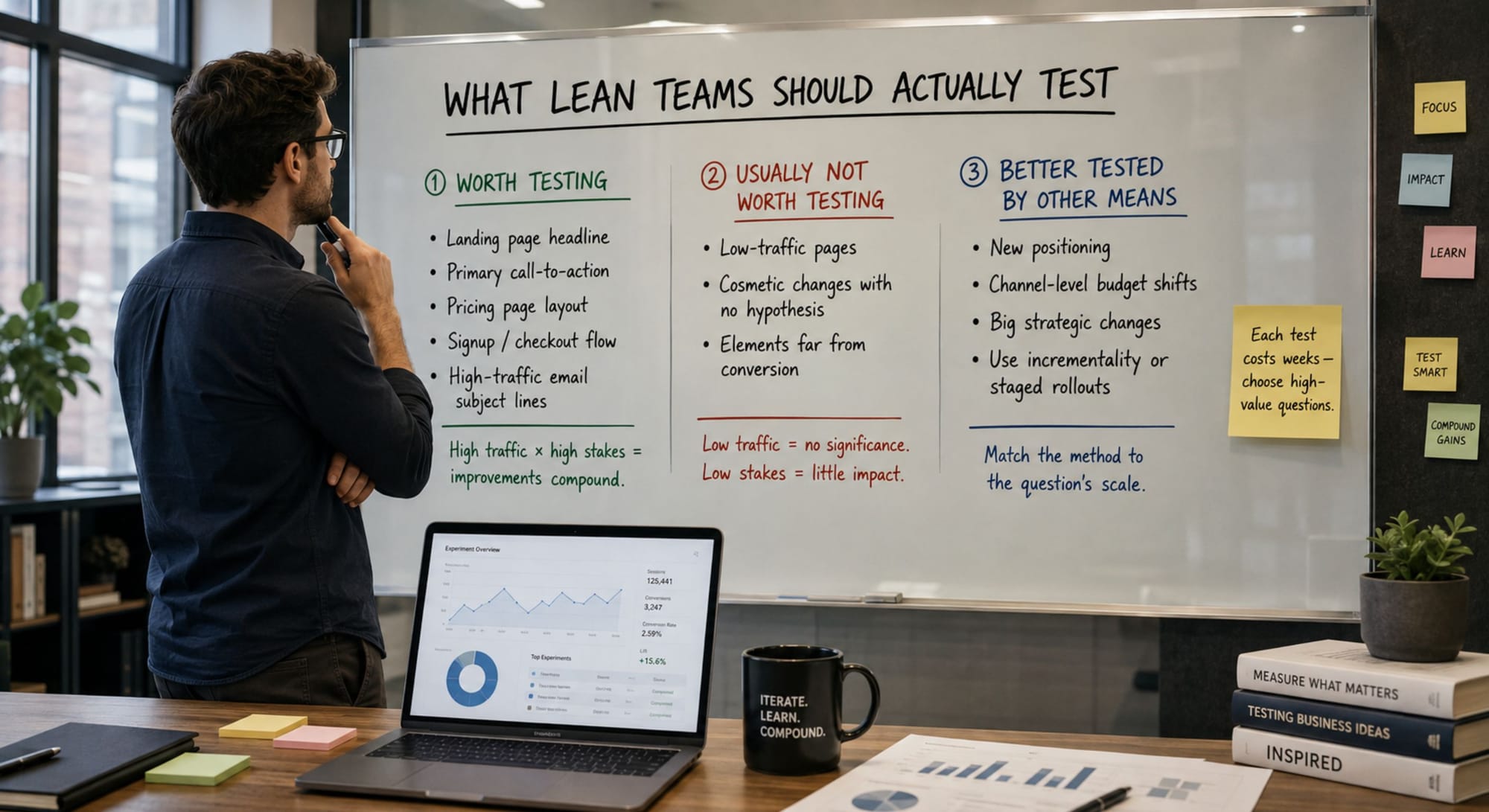
What Lean Teams Should Actually Test
The other half of testing judgment is choosing what to test. Lean teams have limited capacity – each test costs weeks – so what deserves a test matters as much as how the test is run. The principle is simple: test the things that are high-traffic and high-stakes, where a real improvement compounds, and skip the things that are low-traffic or low-consequence, where even a winning result changes little.
Worth testing: The elements that many people encounter and that sit close to a conversion: the primary landing page headline, the main call-to-action, the pricing page layout, the checkout or signup flow, the highest-traffic email subject lines. High traffic × high stakes = a real improvement compounds across thousands of interactions.
Usually not worth testing: Low-traffic pages where you will never reach a trustworthy sample size, cosmetic changes with no hypothesis behind them, and elements so far from conversion that even a win would not move a metric that matters. Low traffic means no significance; low stakes means a win changes nothing. Both waste scarce testing capacity.
Better tested by other means: Big strategic questions (a whole new positioning, a channel-level budget shift) that an A/B test cannot cleanly answer. These belong to the incrementality approach from the attribution article, or to staged rollouts, not to a button test. Some questions are too big for A/B testing. Match the method to the question's scale.
Three Mistakes That Produce Confident, Wrong Conclusions
Mistake #1: Stopping the test when the numbers look good
This is the single most common and most damaging testing error, and it is entirely a discipline failure, not a knowledge one. A variant jumps ahead early, the team gets excited, they call the winner and roll it out, and the "win" evaporates in the real numbers, because it was noise the small sample had not yet averaged out. The pre-committed sample size from step three exists precisely to prevent this. The rule is absolute: the sample size is decided before launch, and the test runs until it is reached, no matter how good the early numbers look. A test you stopped early is not a test. It is a guess with a chart.
Mistake #2: Testing without a hypothesis
Running a test just to "see what happens" produces a number, but no understanding. When green beats blue with no reason behind the prediction, you have learned that green won this once, not why, not whether it will replicate, not anything you can apply to the next decision. A test built on a real hypothesis teaches you about the audience whether it wins or loses. A test without one, even when it produces a winner, leaves you exactly as ignorant about your audience as you were before, just with one more pixel decided.
Mistake #3: Treating a null result as a failed test
When a test shows no significant difference, lean teams often feel they wasted the effort, and quietly stop testing, concluding it does not work for them. But a null result is a genuine finding: it tells you the thing you changed does not matter to this audience, which saves you from investing further in it and points you toward the changes that might. The teams that give up on testing usually do so after a run of null results, having misread "this change does not matter" as "testing does not work". Most changes do not move the needle. Learning which ones do not is exactly what testing is for.
How to Use GenAI as Your Testing Design Partner
The judgment-heavy parts of testing (sharpening a hypothesis, checking that a test is clean, reading a result honestly) are exactly where GenAI helps a team without a data scientist. Not by running the statistics, but by pressure-testing the thinking around them before and after the test.
Use this GenAI prompt:
I am designing (or reading) a marketing test. Help me get it right.
WHAT I WANT TO TEST (or the result I am reading):
[Describe the element, the change, and the metric or paste the result]
MY CURRENT SITUATION:
- Approximate traffic or conversions on this element per week: [Number]
- Current conversion rate (if known): [Number]
- What I believe about the audience that motivates this test: [Describe]
IF I AM DESIGNING THE TEST:
1. HYPOTHESIS CHECK: Restate my idea as a proper hypothesis: "because [belief], if [change], then [metric] will [direction] because [reason]". If my idea has no "because", flag that it is a curiosity, not a hypothesis.
2. SINGLE-VARIABLE CHECK: Confirm I am changing only one thing. If I am changing several, tell me to isolate or sequence them.
3. FEASIBILITY CHECK: Given my traffic, is this element testable in a reasonable timeframe? If the traffic is too low to ever reach significance, tell me honestly, and suggest a better-suited element or method.
4. WHAT TO PRE-COMMIT: Remind me what to decide and write down before launch.
IF I AM READING A RESULT:
1. Is the difference likely to be real, or within the noise of this sample size?
2. If there is no significant difference, frame the null as the finding it is, what does it tell me about the audience?
3. What is the honest one-sentence conclusion, stated with the confidence the data supports, not more?
Rules:
- Never manufacture confidence a small sample cannot support. "Not enough data to conclude" is a valid, often correct answer.
- If the test is not worth running (low traffic or low stakes) say so and protect my testing capacity.
- Treat a null result as information, never as failure.
Validate the guidance against your own knowledge of the audience and the business. GenAI can sharpen the hypothesis, check the design, and keep you honest about what a result supports, but it does not know your customers, your seasonality, or the qualitative signals behind the numbers. Use it as the experimentation partner a lean team does not have on staff. The decision about what to test, and what a result means for the business, stays with you.
Final Thought
You do not need a data science team to test well. You need the discipline to form a real hypothesis, change one thing at a time, decide your sample size before you start, wait for it, and read the result honestly, including the null results that are quietly the most useful findings of all. The statistics are the solved, outsourceable part. The judgment is the job, and it is a job you already know how to do.
This closes the Measurement chapter, and it closes it on purpose with action. Measuring the right things, presenting them clearly, and accepting the limits of attribution all lead here: to the disciplined, repeatable practice of testing your way to genuine, evidence-based improvement. Not sophisticated. Not resourced. Just honest, one experiment at a time.
Are you testing to learn something about your audience or just to feel busy while confirming what you already hoped was true?
Recommended Use Cases:
 Diana Socaciu