Attribution Is Broken. Here's How to Think About It Anyway.
Attribution promised a clean answer to which touchpoint earned the conversion. It never quite delivered, and in a cookieless, multi-touch reality it delivers less. The answer is not a better model. It is a more honest relationship with what measurement can and cannot tell you.

Somewhere in your reporting, there is a number that claims to know exactly which touchpoint earned each conversion. It says paid search drove this many sales, social drove that many, email drove the rest; each one tidily assigned, adding up to a clean total. That number has a confidence about it that the underlying reality does not support. And most marketing teams have quietly built budgets, bonuses, and strategic decisions on top of it, treating a best-guess as a fact because the alternative – admitting they cannot fully trace cause to effect – felt like a failure of rigour.
What felt like a failure of rigour is more likely the honest starting point. Attribution – the attempt to assign credit for a conversion across the touchpoints that preceded it – was always an approximation dressed as a measurement. The buyer's journey has never been fully visible. People research on one device and buy on another, see an ad and search a week later, hear about a brand from a colleague whose recommendation appears in no analytics platform anywhere. The map was always missing territory. What has changed is that the map is now visibly missing territory, because the tracking that used to paper over the gaps has been withdrawn.
This article will not sell you a model that fixes attribution, because none does. It will give you something more useful: a way to think about attribution that is honest about its limits and still makes better decisions than the false precision it replaces.
Why Attribution Was Always a Useful Fiction
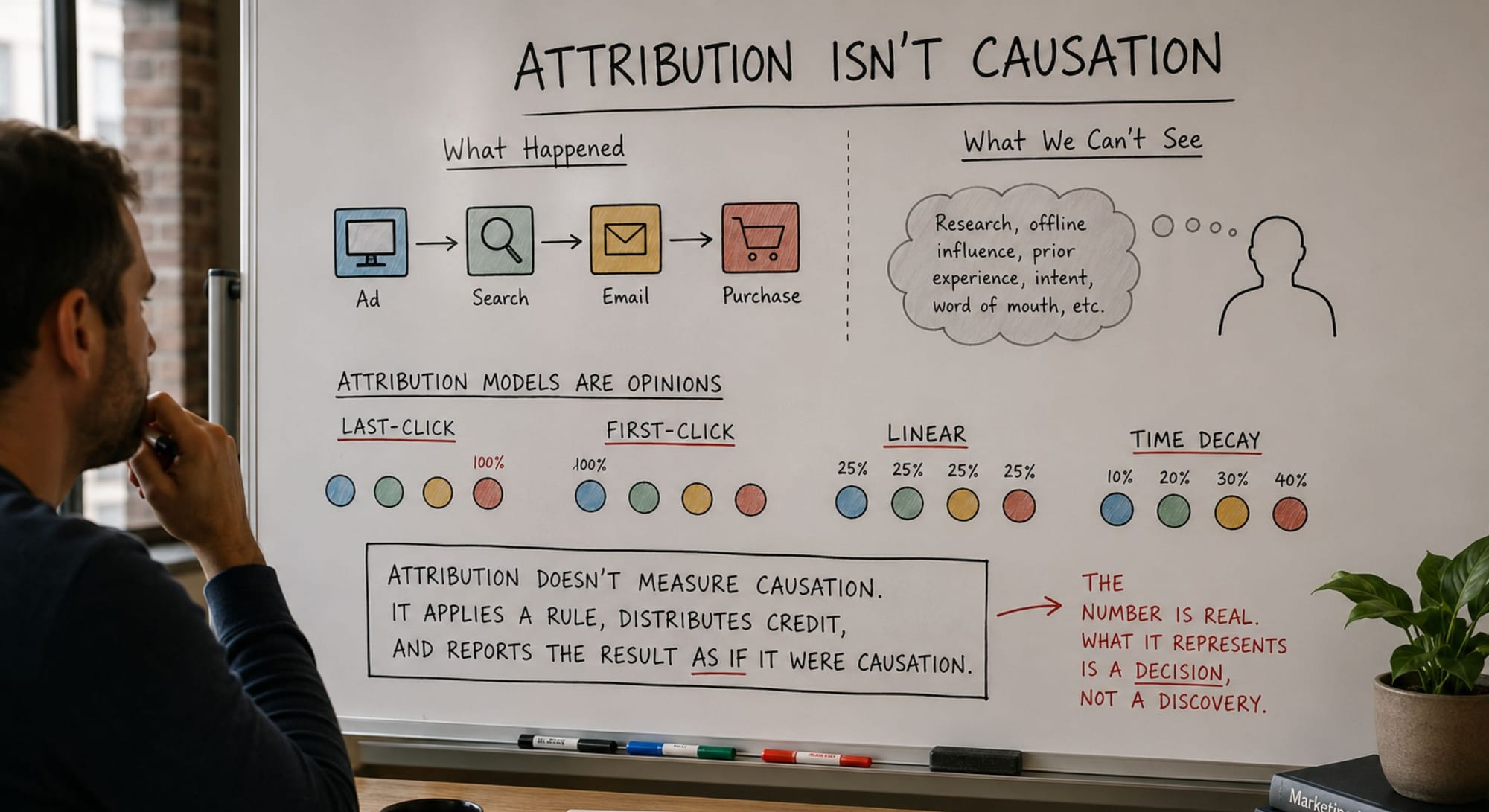
The core problem with attribution is not technical. It is philosophical, and it was there long before cookies started disappearing. Attribution tries to answer a causal question – which touchpoint caused the conversion – using correlational data, which records only what happened before the conversion, not what caused it. The fact that someone clicked a paid ad before buying does not prove the ad caused the purchase. They may have already decided. The ad may have been the last visible step in a decision made weeks earlier, for reasons no platform recorded.
Every attribution model is an opinion about how to resolve this unknowable question, expressed as if it were a fact. Last-click holds an opinion: the final touchpoint deserves all the credit. First-click holds the opposite. Linear attribution holds that every touchpoint deserves equal credit; also an opinion, and a convenient one, since equality requires no judgment. Each model takes an unanswerable causal question and answers it with a rule, then presents the rule's output as a measurement. The number looks precise. The precision is manufactured.
The honest principle: Attribution does not measure which touchpoint caused the conversion. It applies a rule for distributing credit and reports the result as if it were causation. The number is real. What it represents is a decision about how to assign credit, not a discovery about what actually drove the buyer. Treating the model's opinion as a fact is where attribution stops being useful and starts being misleading.
This matters because the choice of model is not neutral. A team on last-click attribution will systematically over-credit bottom-of-funnel channels and under-credit the awareness and consideration work that made the conversion possible – the exact distortion covered in the paid media article. The model does not just measure. It shapes where the budget goes, and it shapes it toward whatever the model happens to credit.

What Changed and What Did Not
The cookieless shift did not break attribution since attribution was already a useful fiction. What the shift did was remove the tracking that let teams pretend the fiction was fact. Cross-site tracking, third-party cookies, and device-level identity resolution were the machinery that produced the confident, granular attribution reports, and as that machinery is withdrawn by regulation and platform policy, the reports lose the false precision that made them feel authoritative.
This is genuinely destabilising for teams that built their decision-making on that precision. But it is worth being clear about what changed and what did not. What changed: the granular, user-level tracking that produced touchpoint-by-touchpoint credit assignment. What did not: the underlying causal question was always unanswerable, and the confident reports were always approximations. The shift did not take away a capability marketers genuinely had. It took away the illusion that they had it.
The reframe that helps: Stop thinking of the cookieless shift as the loss of attribution accuracy you used to have. You never had it. Think of it instead as the removal of a false confidence that was quietly distorting your decisions: over-crediting the trackable, under-crediting the untrackable. What replaces it is not worse. It is more honest, and honesty about uncertainty makes better decisions than confidence about a fiction.
Three Honest Approaches that Work Anyway
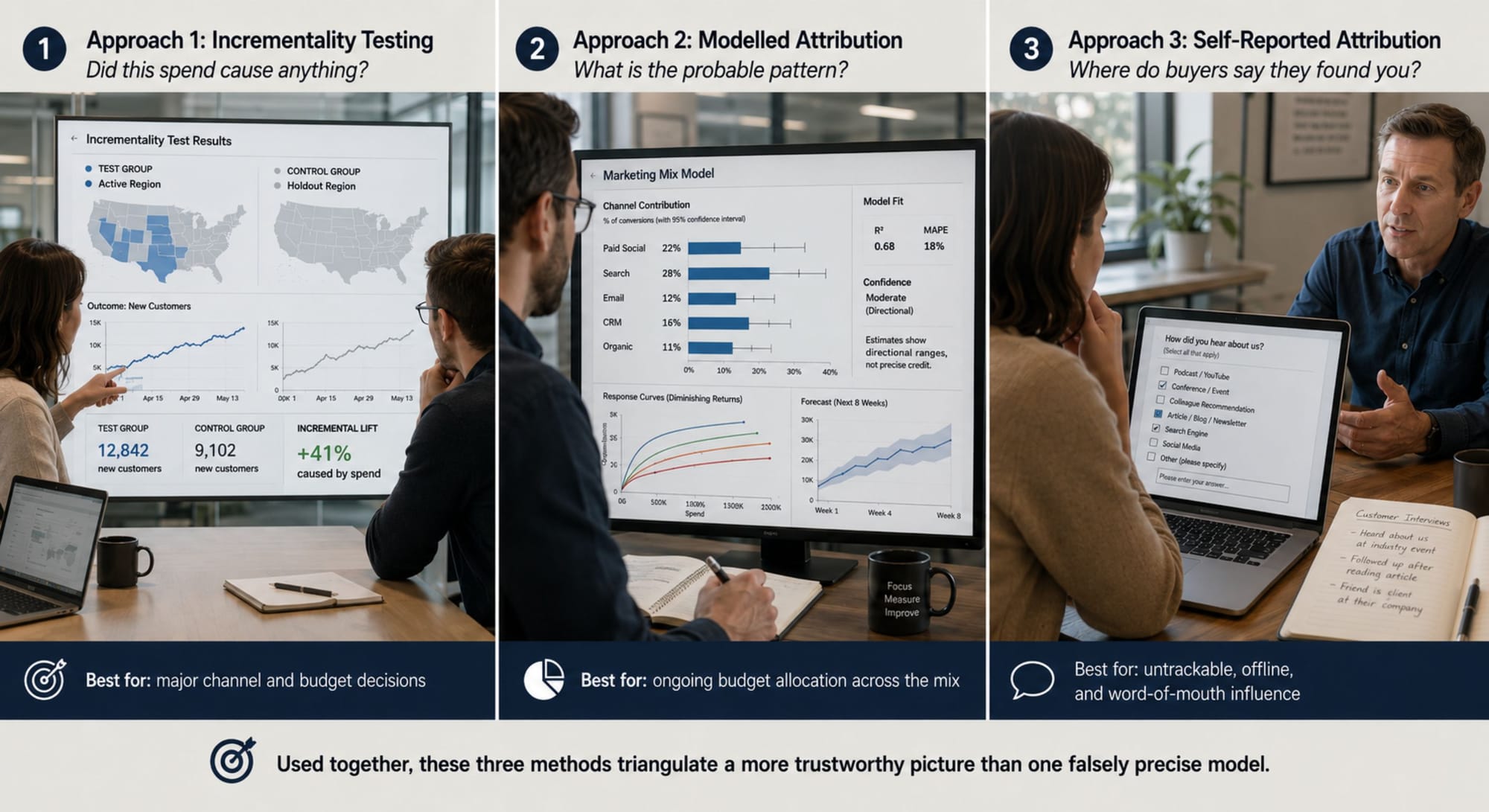
If perfect attribution is impossible, the useful question becomes: how do you make good budget and channel decisions without it? Three approaches, used together, give a more reliable picture than any single-touch model ever did, precisely because they stop pretending to a precision that was never real.
Approach 1: Incrementality Testing
Ask What Actually Changed
Did this spend cause anything?
Incrementality testing sidesteps the credit-assignment problem entirely by asking a cleaner question: "if we turned this channel off, or on, what would change?". Instead of trying to trace credit backward through an invisible journey, it runs a controlled comparison (a holdout region, a paused campaign, a matched-market test) and measures the difference.
Incrementality testing is the closest marketing gets to genuine causation, because it tests the counterfactual rather than assuming it. It cannot be run on everything at once, and it takes discipline to design cleanly, but for the biggest budget lines it answers the question attribution only pretends to.
Best for: Major channel and budget decisions where the spend is large enough to justify a proper test, the questions where being wrong is expensive.
Approach 2: Modelled Attribution
Accept the Estimate, Name the Confidence
What is the probable pattern?
Modelled approaches, including media mix modelling and the aggregate, privacy-safe methods replacing user-level tracking, estimate channel contribution from patterns in aggregate data rather than individual journeys. They do not deliver a precise per-conversion credit, and they should not claim to.
Modelled attribution produce a directional estimate with a stated confidence range, not a false decimal. Used well, a model says "paid social probably contributes within this range", which is a more useful input to a budget decision than a last-click figure that says "exactly this", precisely and wrongly.
Best for: Ongoing budget allocation across the mix, where a directional estimate with honest error bars beats a precise number built on a fiction.
Approach 3: Self-Reported Attribution
Just Ask the Buyer
Where do buyers say they found you?
The most under-used approach is also the simplest: ask. A single "how did you hear about us?" field on a form, a post-purchase survey, a question in the sales conversation.
Self-reported data is imperfect, people misremember, they name the last thing rather than the first, they under-report word of mouth. But it captures exactly the touchpoints that tracking cannot see: the podcast, the conference, the colleague's recommendation, the article read on a device that never converted. It is the only method that can measure the influence that leaves no digital trace, which, increasingly, is much of the influence that matters.
Best for: Capturing untrackable, offline, and word-of-mouth influence, and as a sanity check against what the digital models claim.
None of these three is precise. Used together, they triangulate, and triangulation from three honest, imperfect methods produces a more trustworthy picture than one falsely precise model. When incrementality, modelling, and self-report agree, you can act with real confidence. When they disagree, the disagreement itself is information: it tells you exactly where your understanding is weakest, which is precisely where a single model would have given you unwarranted confidence.
How to Decide Without Perfect Attribution
The fear underneath the attribution anxiety is that without precise credit assignment, budget decisions become guesswork. However, they are not; instead, they become judgment supported by triangulated evidence, which is what every other executive function already runs on. No CFO has perfect attribution for which cost saving drove which margin improvement. No product leader has perfect attribution for which feature drove which retention gain. They decide with directional evidence and sound judgment, and marketing can, too.
The practical shift is to match the method to the stakes. For the largest budget lines, run incrementality tests, because the cost of being wrong justifies the effort. For ongoing allocation, use modelled estimates with honest confidence ranges. Across everything, run self-reported capture to see the influence the models miss. And hold all of it loosely, as evidence that informs judgment, not a formula that replaces it. The team that decides well without perfect attribution beats the team that decides precisely on a model that was quietly wrong.
Three Mistakes That Keep Teams Trapped in False Precision
Mistake #1: Trusting the model that agrees with what you already do
When several attribution models disagree, teams tend to trust the one that validates the channels they already favour. A team heavy on paid search finds last-click congenial, because last-click flatters paid search. This is confirmation bias wearing an analytics costume. The honest move is the opposite: when models disagree, treat the disagreement as the finding, and look hardest at the model whose answer you like least. The comfortable model is the one most likely to be reinforcing a distortion you have not noticed.
Mistake #2: Waiting for attribution to be solved before deciding
Some teams respond to broken attribution by deferring decisions until the measurement is fixed; evaluating new tools, commissioning new models, waiting for certainty that is not coming. Attribution is not going to be solved. The causal question is permanently unanswerable, and the tracking is not returning. A team that waits for perfect measurement waits forever, while a competitor that decides well on imperfect evidence takes the ground. The honest acceptance that attribution is broken is not a reason to stop deciding. It is the precondition for deciding sanely.
Mistake #3: Reporting attribution to the board as if it were fact
The most consequential mistake is presenting attribution figures to leadership without their uncertainty attached, a clean pie chart of channel credit that implies a precision the data cannot support. It makes the marketing director look authoritative in the moment and exposed later, when a decision built on the false precision underperforms. The decision-support principles apply directly: present attribution as a directional estimate with a stated confidence, not a fact. A board that understands the number is an estimate makes better decisions than one that was allowed to believe it was a measurement.
How to Use GenAI as Your Attribution Triangulator
Reconciling three imperfect attribution methods into a single decision is a structured reasoning task, and GenAI is useful for holding the three views side by side, surfacing where they agree and disagree, and flagging where false precision may be creeping back in. It does not produce the data. It helps you reason honestly about the data you have.
Use this prompt:
I will share what my different measurement methods are telling me about channel performance. Help me triangulate them into a decision, without manufacturing false precision.
THE DECISION AT STAKE:
[e.g. "whether to shift budget from paid social to content", "which channel to cut"]
THE EVIDENCE I HAVE (include whichever exist):
- Incrementality test results: [Paste, or note none]
- Modelled / media-mix estimates (with confidence ranges if available): [Paste, or note none]
- Self-reported attribution ("how did you hear about us"): [Paste, or note none]
- Platform / last-click reporting: [Paste, or note none]
TRIANGULATE:
1. AGREEMENT: Where do the methods agree? Agreement across independent methods is the strongest signal available, name it.
2. DISAGREEMENT: Where do they conflict? Treat each conflict as information about where understanding is weakest, not a problem to average away.
3. FALSE-PRECISION CHECK: Flag any figure being treated as more certain than its method can support. Last-click and single-touch numbers especially.
4. THE UNTRACKABLE GAP: Based on the self-reported data, what influence is likely happening that the digital methods cannot see? What might be systematically under-credited?
5. THE HONEST RECOMMENDATION: Given the triangulated evidence, what does the balance of evidence suggest for the decision, stated with the appropriate confidence, not more?
Rules:
- Never manufacture precision the evidence does not support. "Directionally, probably X" is a valid and often correct answer.
- If the evidence is genuinely insufficient to decide, say what test or data would resolve it; do not guess to seem helpful.
- Treat disagreement between methods as a finding, not a failure.
Validate the triangulation against your own knowledge of the business and the market. GenAI can hold the three views side by side and reason about their agreement and conflict, but it does not know the strategic context, the competitive timing, or the qualitative signals your sales team is picking up. Use it to structure the honest reasoning and resist the pull back toward false precision. The decision, made under genuine and irreducible uncertainty, remains a matter of judgment: yours.
Final Thought
Attribution is broken, and it was never as whole as the reports implied. That is not a crisis to be solved by a better model, it is a reality to be accepted, and the acceptance is liberating. Once you stop demanding that measurement deliver a certainty it never could, you can start using it for what it is genuinely good at: giving you directional, triangulated, honestly-uncertain evidence that supports better judgment than false precision ever did.
The best marketing leaders are not the ones comfortable deciding well under irreducible uncertainty: matching the method to the stakes, triangulating imperfect signals, and holding every number with the honesty it deserves. Perfect attribution is not coming. Better decisions do not require it.
Are you making decisions from evidence you have honestly weighed or from a number that looks precise because admitting the uncertainty felt like weakness?
Recommended Use Cases:
 Diana Socaciu