The Long Game in B2B: How to Build a Content Strategy for a Six-Month Sales Cycle
B2C content optimises for the moment. A six-month B2B sales cycle needs something else: a narrative that sustains presence and deepens conviction across months, through a buyer who researches quietly, goes silent for weeks, and returns. Here is the content architecture for the long game.

A B2B buyer does not decide in an afternoon. They notice a problem in March, read a little, get pulled onto something else, come back in April, quietly build a shortlist, disappear for three weeks, resurface to loop in a colleague, go quiet again through a budget cycle, and finally, in September, book the call. Six months from first spark to real conversation, much of it invisible to you, most of it spent not talking to anyone. This is the normal shape of a B2B purchase, and it makes a specific demand on content strategy that most content strategy is not built to meet.
Most content planning is built for the short game. It optimises for the moment of publication: the launch, the campaign burst, the spike of attention that converts soon or not at all. That works when the decision is fast, but it falls apart across a six-month cycle, because the buyer you captured in March is not deciding in March. They are deciding in September, and the question that determines the outcome is not "did we capture their attention?" but "were we still there, still relevant, still deepening their conviction, across all the months in between?".
This article is about building content for that reality. It takes the content calendar governance from earlier in the series and applies it to the B2B long cycle, where the job is not to plan a volume of content but to architect a narrative that sustains attention, and moves conviction forward, across months rather than days.

Why the Short-Game Playbook Fails Over Six Months
The short-game content playbook plans by volume and burst. It asks "how many pieces will we publish this month, and when is the big campaign?" and it measures success by the attention each publication captures. Across a fast decision, that is enough: capture attention, convert while it is hot. But a six-month cycle exposes the flaw hidden in that logic: it treats content as a series of disconnected spikes rather than a continuous narrative, and a buyer moving through months of quiet evaluation does not experience spikes. They experience a relationship that is either sustained or absent.
The specific failure is the gap. A team publishes a strong campaign in March, captures the buyer's attention, and then – its campaign complete – goes quiet while it builds the next burst. The buyer, still months from deciding, hears nothing for six weeks, and the conviction the March campaign built slowly cools. By the time the next burst arrives, it lands as if for the first time, because the relationship lapsed in between. The short game keeps re-capturing the same buyer instead of continuously advancing them, and re-capturing is far more expensive than sustaining. What the long cycle punishes is not weak content. It is discontinuous content.
The long-game principle: Over a six-month cycle, continuity beats intensity. A steady, connected narrative that stays present and keeps deepening conviction outperforms a series of brilliant, disconnected bursts with silence in between, because the buyer decides at the end of the cycle, not at the moment of any single campaign. The question is not "how strong was the campaign?" but "were we continuously present and progressing across all six months?". Plan for the whole cycle, not the launch.
Plan by Narrative Progression, Not Content Volume
The core shift is from planning content by volume to planning it by narrative progression. A volume plan answers "what will we publish, and how often?". A progression plan answers a better question: "where should the buyer's understanding be at each stage of the cycle, and what content moves it there?". The unit of planning stops being the piece and becomes the shift in conviction: from unaware, to problem-aware, to solution-aware, to convinced, to ready. Content is chosen not to fill a slot but to move the buyer from one state to the next.
This reframes the content calendar itself. It is no longer a schedule of what publishes when; it is a map of where the buyer's conviction should be over time, with content chosen to close the gap between where they are and where the next stage requires them to be. The calendar becomes a narrative arc with dates attached, which is exactly what a six-month cycle needs and a volume plan can never be.
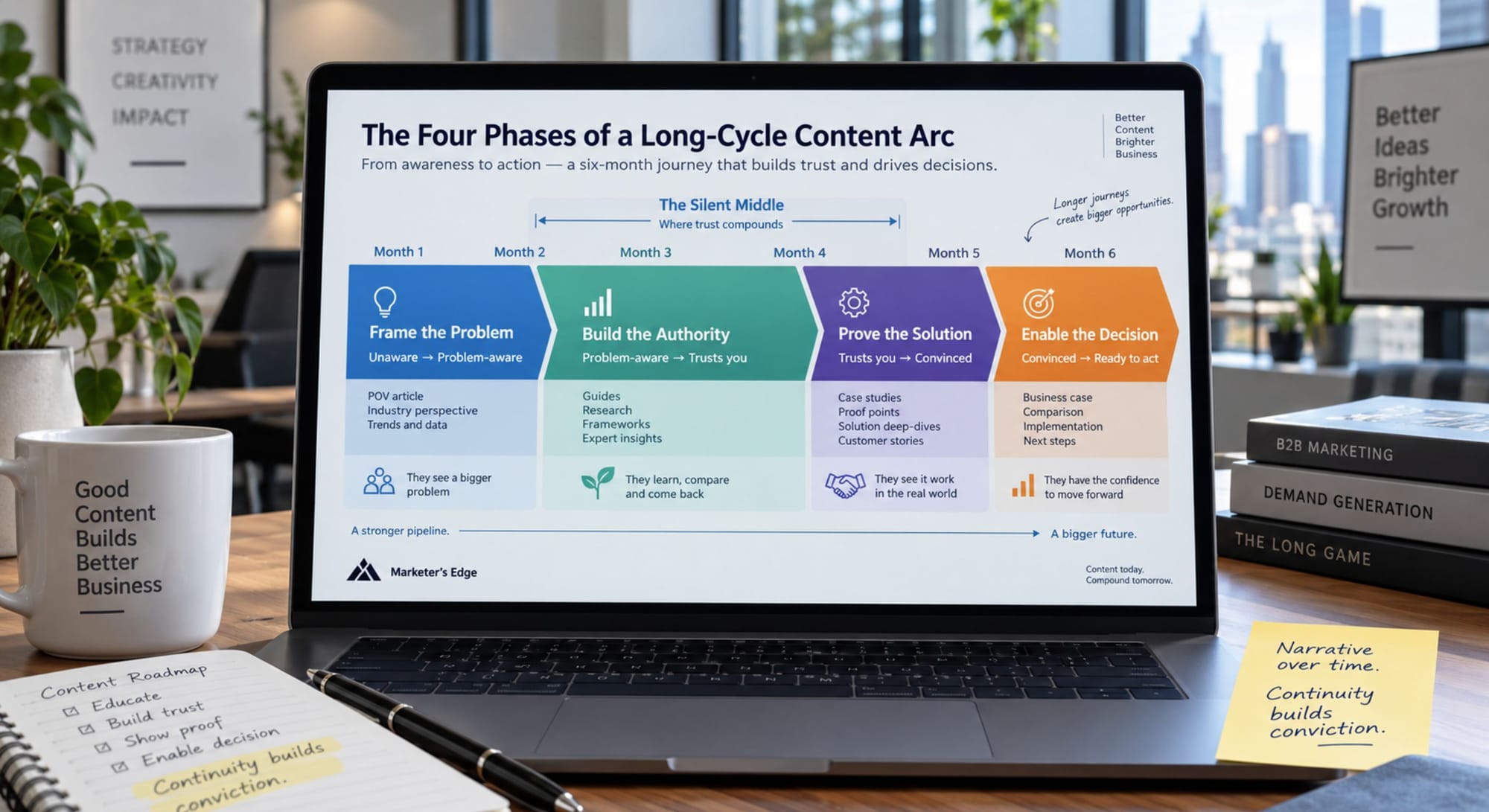
The Four Phases of a Long-Cycle Content Arc
A six-month narrative arc has a recognisable structure: four phases, each with a different job, mapped onto the months of the cycle. The durations are illustrative, not fixed; what matters is the sequence and the shift each phase is responsible for. Together they carry the buyer from first awareness to a readiness the sales conversation can close.
Months 1–2: Frame the Problem
Unaware → Problem-aware
The arc opens by establishing the problem and the point of view on it, before any talk of solutions. The job of the first phase is to make the buyer see their situation the way your narrative frames it, so that every later stage is understood on your terms. This is the foundation the whole cycle rests on: a buyer who adopts your framing of the problem evaluates every solution, including yours, through the lens you gave them. Rush past this to the pitch and the rest of the arc has nothing to stand on.
Content that fits: Point-of-view pieces, problem-framing articles, the industry perspective that reframes how the buyer sees their situation.
Months 2–4: Build the Authority
Problem-aware → Trusts you
Once the buyer holds the problem the way you framed it, the middle phase earns the trust that makes your eventual solution credible. This is the long, quiet centre of the cycle, the stretch where most content strategies go silent and lose the buyer. Sustained, genuinely useful depth here is what separates the brand that wins from the one that merely launched well. The buyer is doing their invisible research now; the brand that keeps showing up with real insight becomes the trusted authority, while the one that went quiet after its launch campaign quietly falls off the shortlist.
Content that fits: Depth pieces, frameworks, guides, research, the substantive material that compounds trust over the silent middle months
Months 4–5: Prove the Solution
Trusts you → Convinced
Only after trust is built does the arc turn to the solution, and now it lands on prepared ground. The buyer already holds your framing and already trusts your authority, so proof of your specific solution is received as the natural answer to a problem you taught them to see. Proof offered here converts; the same proof offered in month one would have been dismissed as a pitch from a stranger. This is the phase that also arms the committee: the specific evidence each role needs to move toward a shared yes.
Content that fits: Case studies, proof points, solution deep-dives, the role-specific evidence the buying committee needs to reach consensus
Months 5–6: Enable the Decision
Convinced → Ready to act
The final phase removes the friction between conviction and action. The buyer is convinced; now the content helps them build the internal case, answer the last objections, and justify the decision to everyone who must sign off. This is where content stops persuading the buyer and starts equipping them to persuade their own organisation. The champion needs the business case, the comparison, the implementation picture; the material that turns private conviction into a committee decision the buyer can carry across the line.
Content that fits: Business-case templates, comparison guides, implementation and onboarding detail, the material that helps the champion close internally
The arc, sequenced: Frame the problem, build the authority, prove the solution, enable the decision. The order is not optional; each phase prepares the ground for the next, and proof offered before trust, or a pitch offered before framing, lands wrong and wastes the attention it spent. The silent middle – building authority across months two to four – is where cycles are won and lost, because it is where most brands go quiet and the disciplined few keep showing up.
Sustaining Presence Through the Silent Middle
The hardest part of the long game is not the launch or the close. It is rather the middle: the months when the buyer is researching quietly, giving you almost no signal, and it feels like nothing is happening. This is exactly where the discipline of a governed content system earns its keep, because sustaining presence across a silent stretch cannot rely on the motivation of visible results. It has to run on a cadence that continues whether or not this week showed a spike.
The practical answer is a sustaining cadence: a steady, planned rhythm of genuinely useful content that keeps the brand present and the narrative advancing through the quiet months, independent of campaign bursts. Not the high-effort launch pieces, which are unsustainable weekly, but a reliable drumbeat of depth – the article, the insight, the framework – that a buyer in silent evaluation keeps encountering. The content governance system exists precisely to make this rhythm survivable: rituals and templates that let a lean team sustain presence for months without burning out, because the long game is lost far more often to exhaustion in the middle than to weakness at the start.
Three Mistakes in Long-Cycle Content Strategy
Mistake #1: Front-loading the cycle and going quiet
The most common long-cycle failure is pouring the entire content effort into a strong opening campaign and then falling silent while the buyer is still months from deciding. It feels productive, a big launch, a spike of attention, but it spends the whole budget at the one moment the buyer is least ready to act, and abandons them through the months when conviction actually forms. The buyer captured in the launch cools in the silence and is gone by the time the next burst arrives. Spread the effort across the cycle. A smaller, sustained presence beats a large one that ends in month two.
Mistake #2: Planning volume instead of progression
A calendar built around "publish twelve pieces this quarter" can hit its number completely and still fail, because volume is not progression. Twelve disconnected pieces that do not move the buyer from one conviction state to the next are twelve slots filled and nothing advanced. The buyer does not need more content; they need their understanding moved forward, and a plan that measures output rather than movement will happily produce a full calendar that leaves the buyer exactly where they started. Plan the shifts in conviction first, then choose the content that produces them, not the other way round.
Mistake #3: Pitching before the ground is prepared
Under pressure to show pipeline, teams pull the solution-proof content forward: running case studies and product deep-dives in month one, before the problem is framed or trust is built. Offered to a buyer who does not yet hold your framing or trust your authority, that proof reads as a pitch from a stranger and is dismissed. The same content, offered in month four on prepared ground, converts. Sequence is not a nicety in the long game; it is the mechanism. Proof works only after framing and trust have made the buyer ready to receive it, and moving it earlier does not accelerate the cycle; it wastes the asset.
How to Use GenAI to Architect the Long-Cycle Arc
Designing a six-month content arc – mapping conviction stages to phases, choosing content for each, and planning a sustaining cadence through the middle – is a structured planning task GenAI supports well. Not to churn out a content calendar by volume, but to architect the narrative progression the long cycle actually requires.
Use this GenAI Prompt:
Help me architect a long-cycle content arc.
MY SITUATION:
- What I sell and to whom: [Describe]
- Typical sales cycle length: [e.g. six months]
- The buyer's starting state (what they know / believe at the start): [Describe]
- My content capacity (realistic output per month): [Describe]
ARCHITECT THE ARC:
1. THE PROGRESSION: Map the conviction journey for my buyer (from their starting state to ready-to-act) as a sequence of stages, not a list of topics. Name each state shift the content must produce.
2. THE FOUR PHASES: Lay the arc across the cycle in phases (frame the problem / build authority / prove the solution / enable the decision; adjust to my cycle). For each, state its goal, the conviction shift it owns, and the content types that fit.
3. THE SILENT MIDDLE: Design a sustaining cadence for the long authority-building middle: a realistic, repeatable rhythm my stated capacity can actually maintain for months without burning out. Distinguish this steady drumbeat from occasional higher-effort pieces.
4. THE SEQUENCE CHECK: Flag anything I might be tempted to pull forward, especially solution proof before trust is built, and explain why it must wait.
5. THE CONTINUITY RISK: Identify where in my cycle a gap is most likely to open (where a team usually goes quiet) and what to place there to stay present.
OUTPUT:
- A phase-by-phase arc mapping conviction shifts to content.
- A sustaining-cadence plan for the silent middle, sized to my real capacity.
Rules:
- Plan progression, never volume. If I ask for "X pieces a month", convert it into conviction shifts.
- Respect my stated capacity: an arc I cannot sustain is worse than a smaller one I can.
- Protect the sequence: framing before trust, trust before proof, proof before the ask.
Validate the arc against your real cycle and your buyers' actual behaviour. GenAI can architect the progression and design a sustaining cadence sized to your capacity, but it does not know the real rhythm of your buyers' silent months, the seasonality of your market, or where your last long deal actually stalled. Use it to build the phased arc and the drumbeat that carries the silent middle. The judgment about pacing to your real capacity, and staying disciplined about sequence under pipeline pressure, remains yours.
Final Thought
The long game is not won by the brand with the best launch. It is won by the brand that was still there in month four, still useful, still deepening the buyer's conviction, while its competitors spent their budgets on a spike in month one and went quiet. A six-month cycle rewards continuity over intensity, progression over volume, and sequence over urgency, and punishes the front-loaded campaign that treats a months-long decision as if it could be captured in a single burst.
Build the arc, not the calendar of slots. Plan where the buyer's conviction should be at each stage and choose the content that moves it there. Protect the sequence – framing, trust, proof, enablement – and above all, do not go silent through the middle, because the middle is where the decision is quietly made. The buyer is playing a long game whether or not you are. Play it with them, or lose to whoever does.
When your buyer goes quiet for six weeks in month three, are you still showing up or did your strategy end at the launch?
Recommended Use Cases:
 Diana Socaciu