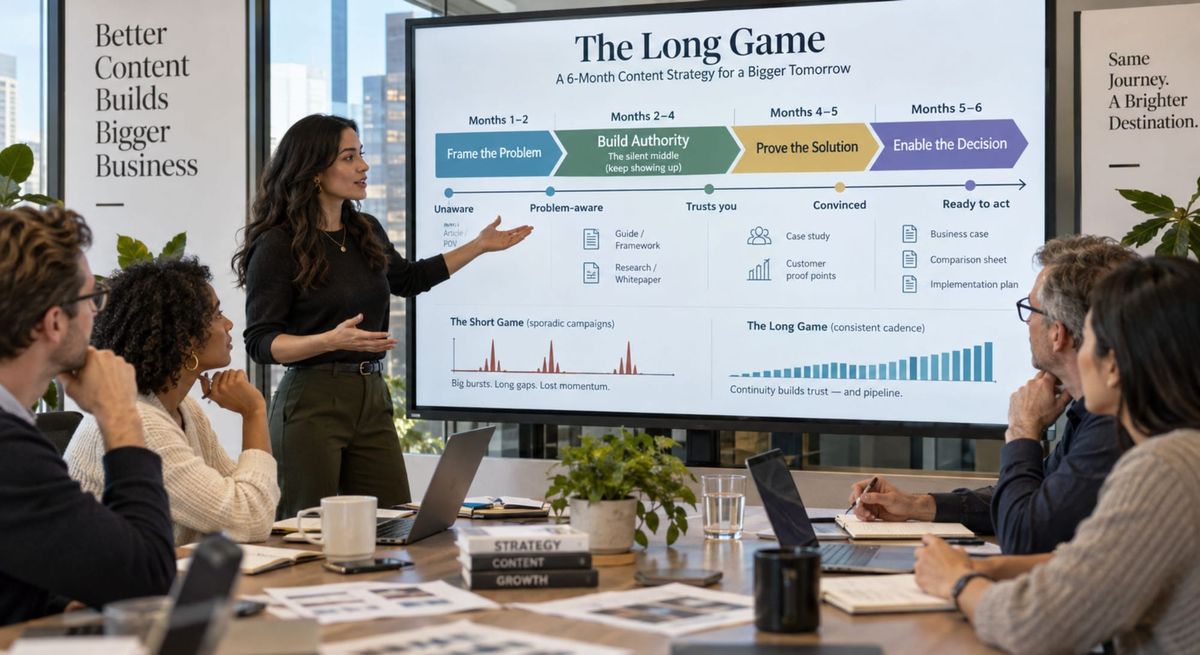
USE CASE: The Long Game Content That Holds a Buyer’s Attention Across a 6-Month Cycle in an Industrial Automation Company
A real-world GenAI marketing use case: how an industrial automation firm serving food & beverage manufacturers stopped losing buyers’ attention in the middle of a months-long cycle, building content for the long game that stayed usefully present from first interest to final decision.
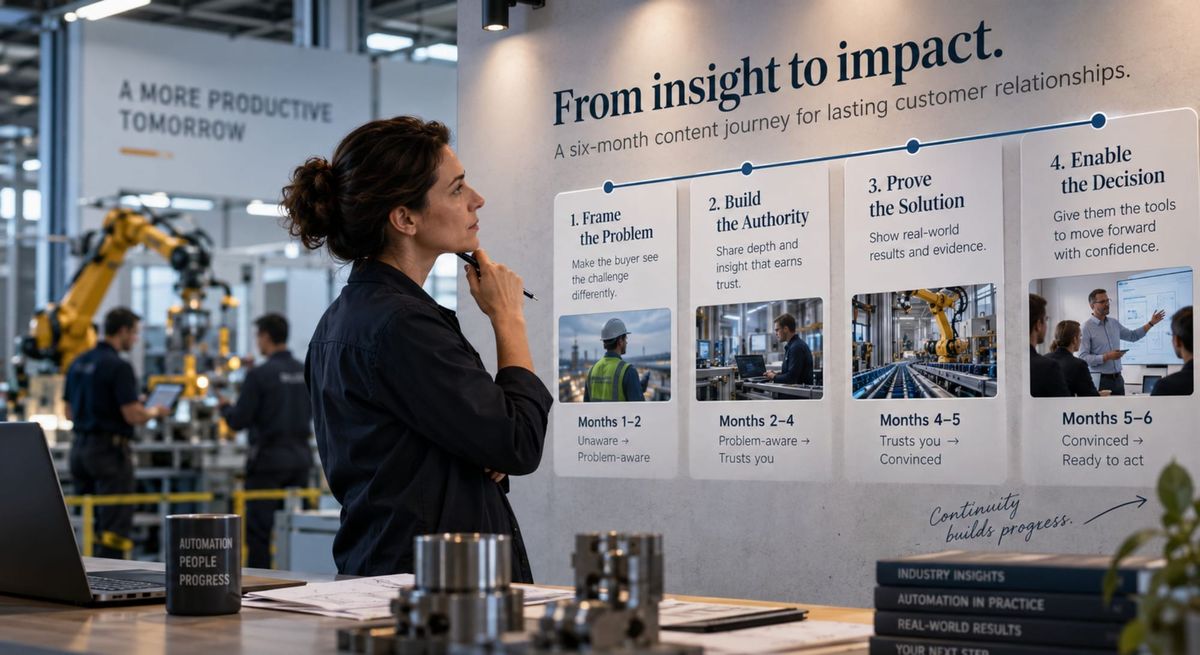
Content for a long sales cycle has a different job from content for a quick one: not to win attention, but to hold it, across months in which the buyer is mostly researching alone and the firm is mostly not in the room. This is what playing the long game looks like in practice: how a food & beverage automation firm stayed usefully present across a six-month cycle.
The Context: a Six-Month Decision, Not a Six-Minute One
An industrial automation and process-engineering firm serving food & beverage manufacturers, running growth marketing for a pipeline of considered, high-value engagements. A new production line isn’t an impulse buy; it’s months of deliberation, budgeting and internal debate. The firm’s content, though, was built for a much shorter game.
The Challenge: Buyer Attention Lost Over a Months-Long Cycle
Between the first flicker of interest and a signed contract sit months of deliberation, and over that span, the firm kept losing the buyer’s attention. Its content was built the way most content is: to grab attention and drive toward a conversion. That works when the buyer is ready now. It fails over a long cycle, because the buyer isn’t ready for months; most of that time is spent researching independently, with the firm not in the room at all, so the early push is premature, and content that fired once and then went quiet left a silence that whoever stayed present quietly filled. Attention, in a long cycle, isn’t a thing you win at the start; it’s a thing you lose in the middle, and the firm was losing it in exactly the stretch where the decision was actually being shaped. The problem wasn’t that the content was bad. It was that it was built for a moment, when the sale was a marathon.
Attention isn’t won, it’s held: In a six-month cycle, attention isn’t won once, it’s held. Content built to grab it, the great first impression and the burst that fades, loses the buyer by month two to whoever stays usefully present. The firm still worth reading in month five, not the one with the best month one, is the one in the room when the decision is finally made.
The GenAI Workflow: Build Content for the Whole Cycle
The fix was to stop making content for a moment and build it for the marathon, a paced programme that stayed useful across the whole six months, matched to where the buyer actually was in their deliberation rather than where the firm wanted them to be. Working from the real shape of its long cycle, the team used GenAI to map the journey into the phases a buyer moves through over the months, and to plan content that met them at each:
Understanding the Problem
Early – Months 1-2
The buyer is framing the issue, not shopping.
Content: a plain-English guide to a pressure they’re feeling (changeover time, a new food-safety rule, line downtime), a short trend report, an explainer article.
Used as: the “thought this was useful” a rep opens a first outreach with, a LinkedIn post, a newsletter piece, never a pitch.
Building the Case & Evaluating
Middle – Months 3-4
The buyer is weighing options and making the internal argument.
Content: a buyer’s guide to choosing an automation partner, a like-for-like case study from another food or drink manufacturer, an ROI or business-case template they can drop into their internal deck.
Used as: what a rep sends as a post-meeting follow-up, and what the champion forwards up the chain.
De-risking the Decision
Late – Months 5-6
The buyer is narrowing and looking for reasons to be sure.
Content: a detailed reference story with real results, an implementation and commissioning plan, a straight FAQ on downtime, food-safety compliance and support, references to call.
Used as: late-stage sales outreach and the material that sits alongside the proposal.
The point was that none of this was content that simply sat on the website waiting to be found. Each piece was built to be used: dropped into a rep’s outreach at the right moment, forwarded by the champion internally, attached to a follow-up after a site visit, folded into the newsletter that kept the firm in view between conversations. The same explainer that educated the problem early became a rep’s honest reason to reach out; the case study that helped the committee evaluate became the champion’s ammunition; the implementation plan that de-risked the decision travelled with the proposal. Marketing content and sales material stopped being two separate piles and became one library, phased across the cycle.
GenAI helped produce the volume that staying present across months requires – something a lean team could never hand-make – but under a strict rule: every touch had to earn its place by being genuinely useful for that phase, because over a long cycle the fastest way to lose attention isn’t silence, it’s noise. The firm stopped making a brilliant first impression and going quiet, and started being the one still worth reading in month five.
You are a B2B Marketing Strategist helping an industrial automation firm (food & beverage sector) plan content for a long B2B sales cycle – roughly six months – where the buyer’s attention drifts in the middle. Here is the real shape of our cycle and how buyers move through it: [the phases, the timeline, what happens when].
1. Map the cycle into the phases a buyer moves through over the months, and for each, the content that would be genuinely useful for where they are: early, educate the problem; middle, help build the internal case and evaluate; late, de-risk the decision.
2. Propose a paced programme across the six months that keeps us usefully present without pestering.
Every touch must earn its place by being useful for that phase; do NOT propose “just checking in” filler or volume for its own sake, because noise loses attention faster than silence. Base it on the real cycle I gave you, not a generic drip. Remember a long-cycle decision can’t be attributed to any single touch, so we’ll measure presence and engagement over time, not immediate conversion. Mark assumptions as CONFIRM WITH ME.
The caveat that decides whether this works: The long game tempts you toward exactly the wrong thing: because GenAI makes content cheap to produce, the obvious way to “stay present” for six months is to produce a lot of it, and a lot of it is how you lose a buyer’s attention faster than silence would. Over a long cycle, fatigue is real, and every touch that isn’t genuinely useful is a small withdrawal from a patience you need to last for months, so the discipline is fewer, better, phase-right touches, not more.
Make sure you check these requirements:
- The content has to match where the buyer actually is: GenAI will produce generic “stay in touch” filler unless it’s grounded in the real stages of your cycle, and filler is precisely what gets tuned out.
- Presence is not the relationship: content keeps you usefully in view, but the human relationship – the sales conversations, the responsiveness, the reading of where this buyer actually is – is what content supports, never replaces, and a six-month drip that feels automated will be noticed as one.
- Measure the long game honestly: a decision in month six can’t be cleanly traced to a piece of content from month two, so resist judging each touch by immediate conversion; the payoff is being present and trusted at the end, which shows up in engagement over time, not this week’s numbers.
GenAI sustains the presence; the judgement of what’s worth sending and the relationship underneath it stay human.
The Result: Still There When the Buyer Was Ready
The firm stopped disappearing in the middle. By building content for the whole six-month cycle rather than the first impression, it stayed usefully present through the long stretch where the decision was actually being shaped, meeting the buyer where they were each month, from understanding the problem to de-risking the choice, instead of pushing for a conversion they weren’t ready to make. Because every touch was held to the test of being useful for its phase, presence didn’t curdle into pestering; and because GenAI carried the production, a lean team could sustain a programme across months it could never have hand-made. The firm that used to make a strong first impression and go quiet became the one still worth reading when the buyer, months later, was finally ready to decide. No invented figures here: the change is that the firm stopped treating a six-month marathon like a sprint, and started being present for the part of the race that actually decided it.
Recommended KPIs to Follow
A long-game programme is judged over time, not this week: is the buyer still engaged in the middle, are you still in the set at the end, and are your touches useful rather than noise? Here’s where the evidence sits and the direction this should push things. The point is the direction of travel, not a promised number.
Sustained Engagement Through the Cycle
Whether the buyer keeps engaging through the middle months, not just the first; the direct read on whether attention is being held rather than lost. If engagement cliffs after the opening touch, the long game isn’t being played.
Benchmark: Direction, not a promise: B2B buyers spend only ~17% of the journey meeting suppliers – roughly 80% is self-directed, ~27% independent online research – across an average cycle of ~11.3 months (Gartner; 6sense). Content is what keeps you present through the long stretch when you’re not in the room.
Presence at the Decision (still in the set)
Whether you’re still in the consideration set – ideally the preferred option – when the buyer finally decides. The long game’s payoff is being the firm they remember and trust at the end, not the one with the loudest start.
Benchmark: Direction, not a promise: ~81% of buyers already have a preferred vendor before first sales contact, and ~92% start with a vendor in mind (6sense / Forrester) – while ~86% of B2B purchases stall somewhere mid-journey (Forrester). Presence through the middle is what earns the preference.
Usefulness, Not Volume (the noise guardrail)
Whether the touches are actually useful – engaged with, not ignored or opted out of – rather than volume produced to fill a calendar. This is the metric that stops “staying present” from becoming the pestering that loses the buyer.
Benchmark: Direction, not a promise: ~73% of B2B buyers actively avoid suppliers who send irrelevant outreach, and Gartner is blunt that bad prospecting damages relationships (Gartner). Noise doesn’t just fail to help; it actively costs you the buyer.
Sustained engagement is the point, presence-at-decision is the payoff, usefulness is the guardrail that protects both. The figures are Gartner/Forrester/6sense survey data, treat as direction. And note the through-line to the attribution case: a six-month cycle is exactly where clean attribution fails, so judge the long game on engagement and presence over time, not on tracing month-six decisions to month-two content.
Why this Transfers
Any business with a long, considered sales cycle faces the same trap: content built to win attention up front, then silence through the months when the decision is actually made. The transferable move is to build for the whole cycle; map the phases a buyer moves through over time and stay usefully present at each, letting GenAI carry the production while a strict usefulness test keeps presence from becoming noise. You don’t win a marathon with a fast first hundred metres; you win it by still being there at the end.
Recommended Articles:
 Diana Socaciu