The B2B Creative Brief: Writing for Procurement, Legal, and Six Other Stakeholders Simultaneously
In B2B the audience is a committee whose priorities actively conflict, procurement wants cost justified, legal wants risk gone, the end user wants ease. Here is how the brief has to change to direct creative that serves all of them without collapsing into an incoherent everything-brief.

The creative brief is the most quietly consequential document in marketing. It is where strategy becomes instruction, where everything you know about the audience, the message, and the goal gets compressed into a page that tells a creative team what to make. Get the brief right and the work has a chance of landing. Get it wrong and no amount of craft downstream will save it, because the creative team executed beautifully against the wrong target. The brief is the lever, and in B2B most briefs are pulling in the wrong direction from the first line.
The reason is structural. Almost every creative brief template ever written assumes a single audience and a single desired action: "who are we talking to, and what do we want them to do?". That is the right question for B2C, where the person you persuade is the person who acts. But we have spent this chapter establishing that the B2B buyer is not a person. It is a committee of five to seven people whose priorities do not merely differ but actively conflict, and a brief that names "the audience" as one person hands the creative team an impossible, invisible problem: serve a composite who does not exist, and inevitably serve some real stakeholders while alienating others.
This article rebuilds the creative brief for that reality. It takes the brief framework from earlier in the series and re-engineers each part of it to hold a committee with conflicting priorities, so the creative team receives not an impossible average, but a clear map of who must be served, how their priorities collide, and what the work must do to move all of them.
Why the Single-Audience Brief Breaks in B2B
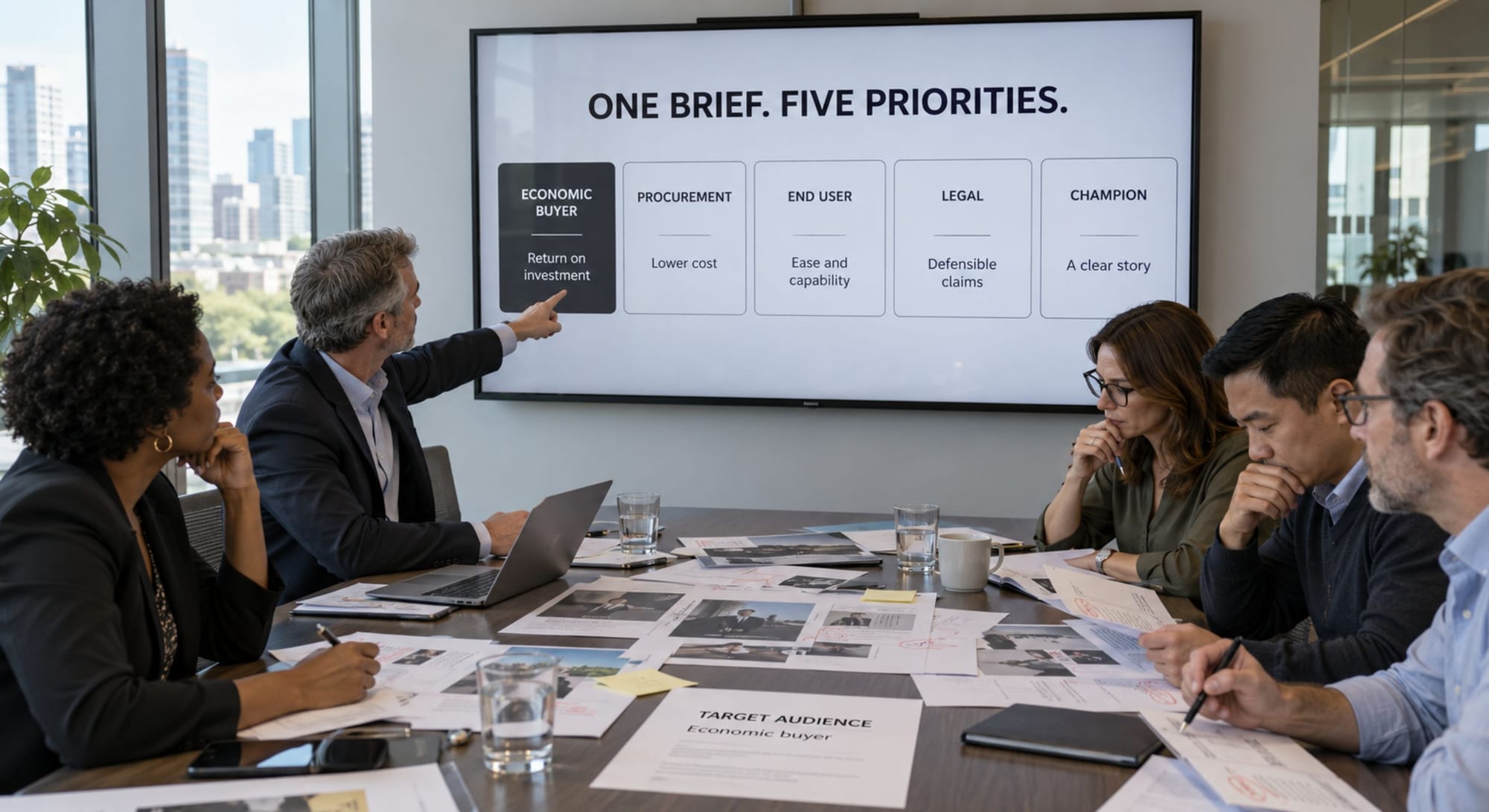
The single-audience brief breaks because it forces a choice the brief-writer usually makes unconsciously: when "the audience" must be one entry, they pick one stakeholder – most often the economic buyer or the champion – and write the brief around that person's priorities. The creative team then produces work optimised for that one stakeholder, and it does its job for them. But the same work, tuned to the economic buyer's obsession with return, may read as slick and untrustworthy to the risk-averse legal reviewer, or as irrelevant to the end user who just wants to know it will not make their day harder. One audience served; several quietly alienated.
What makes this worse in B2B than a simple targeting miss is that the stakeholders' priorities genuinely conflict. This is not one message some people like more than others. It is a set of requirements that pull against each other: procurement wants the lowest defensible cost, which pulls toward a value-and-savings message; the end user wants capability and ease, which pulls toward richness that reads as expensive; legal wants every claim hedged, which pulls against the confident simplicity the champion needs to sell internally. A brief that ignores these conflicts does not resolve them; it hides them, and the creative team collides with them blind, in the work, where they are most expensive to fix.
The core problem: A single-audience brief does not simplify a committee; it suppresses it. The conflicts between stakeholders do not disappear when the brief names only one; they resurface in the creative, in the review round, and in the deal, where they are far harder to resolve than they would have been on the page. A B2B brief's job is not to hide the committee's conflicting priorities behind one composite audience. It is to name them, so the creative work can be designed to hold them on purpose.
The Conflicting Priorities, Named
Before a brief can hold the committee's conflicts, it has to state them plainly. The value of writing them down is immediate: half the tension that would otherwise surface as vague discomfort in a review round becomes a visible, addressable design constraint. Here are the conflicts a B2B creative brief most often has to reconcile.
| Stakeholder | What they want the work to do | What that pulls against |
|---|---|---|
| Economic Buyer | Justify the spend - lead with return and business outcome | The end user's want for capability, which can read as costly |
| Procurement | Show defensible, competitive cost | The premium positioning that signals quality to others |
| Legal / Risk | Hedge every claim, disclaim every risk | The confident simplicity the champion needs to sell inside |
| End User | Prove it is easy and improves their day | The economic buyer's focus on outcome over experience |
| Technical Evaluator | Provide depth, specifics, honest detail | The clarity and brevity a broad audience needs |
| Champion | Give simple, confident ammunition to carry inside | Legal's hedging and technical's caveats |
Read down the right-hand column and the shape of the problem is clear: nearly every stakeholder's priority pulls against another's. This is why the single-audience brief is not just incomplete but actively misleading; it presents as simple a situation defined by its tensions. The brief that serves B2B creative well does the opposite: it surfaces these conflicts as the central design challenge, because they are exactly what the work must be built to navigate.
The B2B Brief, Section by Section
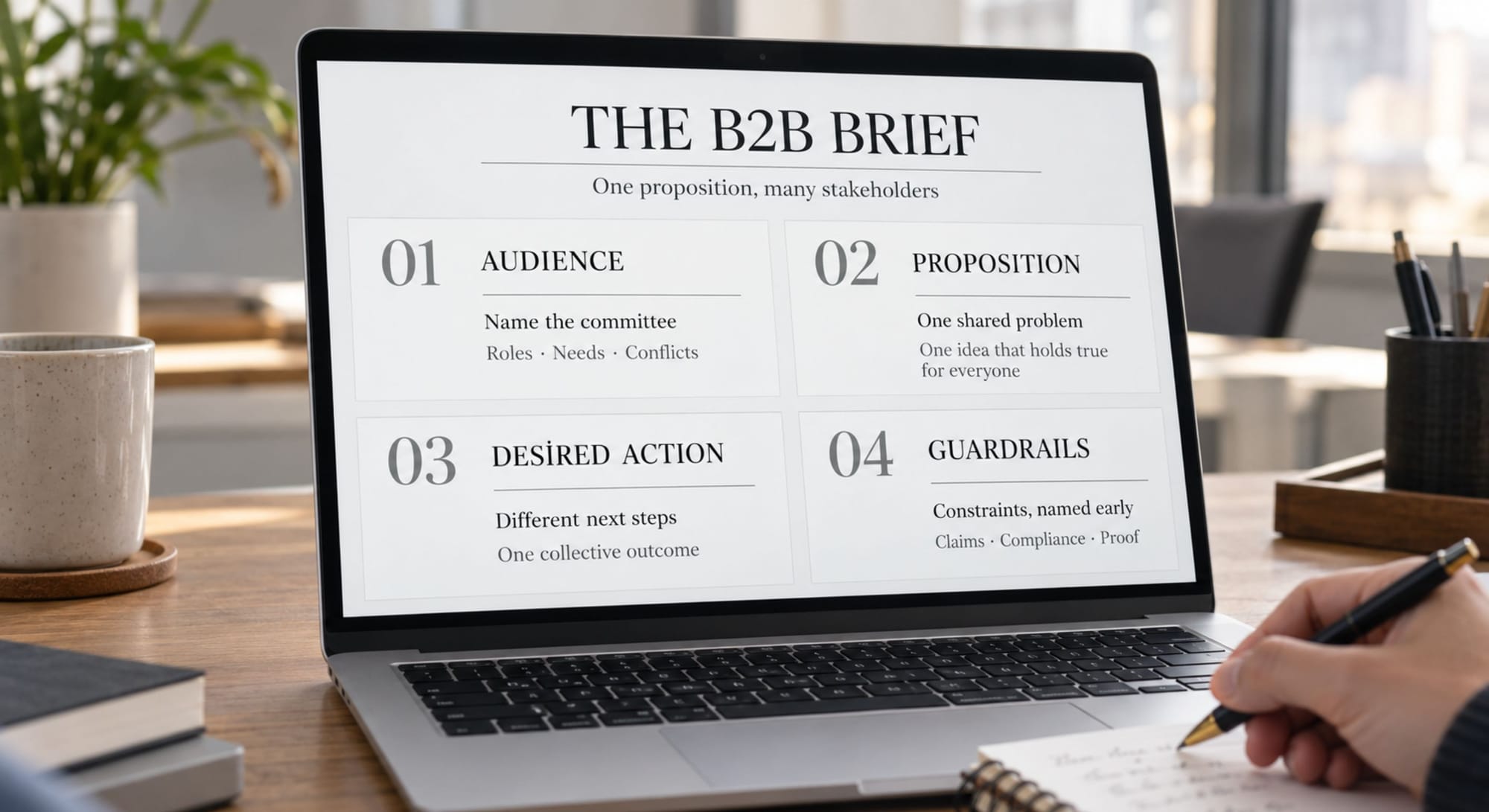
Re-engineering the brief does not mean adding pages. It means changing what four of its core sections ask for, shifting each from a single-audience question to a committee question. The brief stays roughly the same length; it just stops lying about how many people are in the room.
1 – The Audience Section
The single biggest change. Instead of one audience, the brief names the committee: the roles that must be served and, crucially, the priority conflicts between them. It does not need six full personas here; it needs the thin role layers: who is in the room, what each most needs the work to do, and where those needs collide.
Instead of "The audience is the marketing decision-maker", write "The audience is a committee: economic buyer (wants return), end user (wants ease), risk guardian (wants safety). These pull against each other; the work must serve all three".
2 – The Single-Minded Proposition
A brief still needs one core idea: a committee brief does not become a committee of messages. But in B2B the proposition must be the one idea that holds true across every stakeholder, pitched at the level of the shared problem rather than any single role's priority. The proposition is the common ground; the role-specific priorities are served in the execution, not by fracturing the core idea into several.
Instead of "Proposition: the best return on investment in the category", write "Proposition: the confident, low-risk way to solve [shared problem] – a single idea true for the buyer, the user, and the reviewer alike".
3 – The Desired Action
A single-audience brief names one action for one person. A committee brief recognises that different stakeholders take different next steps, and that the ultimate action is collective. The brief names the role-appropriate action for each key stakeholder and the collective outcome they must reach together, so the creative is not built to push one person to convert but to move a group toward consensus.
Instead of "Desired action: book a demo", write "Champion: feels equipped to raise it internally. Economic buyer: sees a defensible case. Collective: the committee agrees to a first conversation".
4 – The Mandatories and Guardrails
In B2B, the mandatories section carries weight it never has in B2C, because it is where the non-negotiable requirements of the risk stakeholders live; the claims legal must approve, the compliance language, the proof points procurement requires. Naming these up front spares the creative team the cruellest kind of rework: producing bold work that a stakeholder nobody briefed them on then guts in review. Brief the guardrails early, and the creative can be bold within them instead of bold and then dismantled.
Instead of "Mandatories: include the logo and URL", write "Legal: no unqualified superiority claims. Procurement: reference the cost-transparency proof. These are known constraints, not review-round surprises".
The re-engineered brief, in one idea: One proposition, many stakeholders. The core idea stays single-minded – pitched at the shared problem every committee member recognises – while the audience, action, and mandatory sections carry the committee's real complexity: who is in the room, what each needs, where they conflict, and which constraints are non-negotiable. The brief does not fracture into six briefs. It holds one idea and an honest map of the room it must win.
Three Mistakes in B2B Creative Briefing
Mistake #1: Naming one audience to keep the brief clean
The tidiest brief names one audience, one proposition, one action, and in B2B, that tidiness is a lie that costs a production cycle. Collapsing the committee to one stakeholder does not make the other stakeholders' priorities go away; it just removes them from the document where they could have shaped the work, so they reappear in the review round as objections nobody anticipated. A brief that looks messier because it names the committee's conflicts is doing its job. A brief that looks clean because it hid them has simply moved the mess downstream to where it is most expensive.
Mistake #2: Turning one proposition into six
Overcorrecting is the opposite failure: having accepted that the audience is a committee, the brief-writer fractures the core message into a separate proposition per stakeholder, and hands the creative team six competing ideas with no centre. The result is work that says different things to different people and coheres for no one, and a committee that compares notes and catches the incoherence. The discipline is to hold one proposition at the level of the shared problem, and serve the role-specific priorities in the execution and the mandatories, not by multiplying the core idea. One idea, many expressions, not many ideas.
Mistake #3: Leaving the risk stakeholders out until review
Legal, compliance, and procurement are rarely in the brief and always in the review, which is the most expensive possible sequence. Creative is developed free of their constraints, presented, and then dismantled when the stakeholders nobody briefed impose requirements that could have shaped the work from the start. The rework is demoralising and the timeline slips, all because the guardrails arrived after the creative instead of before it. Brief the risk stakeholders' non-negotiables at the beginning, as constraints the work is designed within, not as a review gate the finished work has to survive.
How to Use GenAI to Build a Committee Brief
Turning a single-audience brief into a committee brief – naming the stakeholders, surfacing their conflicts, and re-engineering each section – is a structured task GenAI supports well, and it is genuinely useful for spotting the priority conflicts a brief-writer close to the work can miss.
Use this GenAI Prompt:
Help me turn my brief into a committee brief.
MY DRAFT BRIEF (or the project):
- What we're making: [Describe the asset / campaign]
- The single audience currently named (if any): [Describe]
- The current proposition and desired action: [Describe]
- Known constraints (legal, procurement, brand): [List]
RE-ENGINEER THE BRIEF:
1. NAME THE COMMITTEE: List the 5-7 stakeholders this work must serve. For each, one line: what they most need this work to do.
2. SURFACE THE CONFLICTS: Identify where these priorities pull against each other. State each conflict plainly; this is the central design challenge, so do not smooth it over.
3. THE ONE PROPOSITION: Give the single core idea, pitched at the shared problem, that holds true for every stakeholder. If my current proposition is tuned to just one role, rewrite it to the shared level.
4. THE DESIRED ACTIONS: Name the role-appropriate next step for each key stakeholder AND the collective outcome the committee must reach.
5. THE GUARDRAILS: List the non-negotiable mandatories from the risk stakeholders (legal, compliance, procurement) that must be briefed up front, not discovered in review.
OUTPUT:
- A re-engineered brief: one proposition, the committee named, the conflicts surfaced, the actions and guardrails mapped.
- The single sharpest priority conflict the creative team must consciously design around.
Rules:
- One proposition, never six. Hold the core idea single-minded.
- Surface conflicts, never hide them. The messy-but-honest brief beats the clean-but-false one.
- Put the risk stakeholders' constraints in the brief, not in the review round.
Validate the committee brief with the people who actually sit in your review rounds, especially legal and procurement, whose real constraints you cannot fully guess. GenAI can name the likely stakeholders, surface the probable conflicts, and re-engineer the sections, but it does not know your organisation's specific approval requirements or which stakeholder tends to reshape the work late. Use it to build the honest first draft of the committee brief. The knowledge of who really holds a veto in your review, and what they will insist on, comes from you and the colleagues who have been in those rooms.
Final Thought
The creative brief is where B2B's committee reality either gets confronted or gets buried. Bury it – name one audience, one message, one action – and the conflicts you smoothed over on the page come back in the work, the review, and the deal, where they cost far more than a slightly messier brief ever would. Confront it – name the committee, surface the conflicts, hold one proposition while serving many roles – and the creative team can design for the real room instead of an imaginary single buyer.
The best B2B creative is not the work that pleased one stakeholder most. It is the work that left no stakeholder with an unaddressed priority potent enough to block it, and that kind of work can only come from a brief honest enough to name every priority in the room. Write the brief for the committee that actually decides, not the composite that never will.
Does your brief name the one buyer it's easiest to write for or the whole committee that will actually decide?
Recommended Use Cases:
 Diana Socaciu