The Buying Committee Persona: How to Build B2B Audience Profiles When There Are Six Heroes in the Room
Traditional persona work profiles one buyer. B2B contexts have a buyer committee, sharing one account but diverging by role, fear, and definition of success. Here is the two-layer persona architecture that maps the six buyers at once, without producing six documents nobody ever opens.

The previous article established the reframe: in B2B, your buyer is not a person but a committee of Heroes of five to seven people, each with a different fear and a different definition of success, who must cross the threshold together. That reframe raises an immediate, practical problem. If there are six Heroes in the room, how do you build audience profiles for all of them? The persona methods most teams inherited were designed for one buyer. If pointed at a committee, they break.
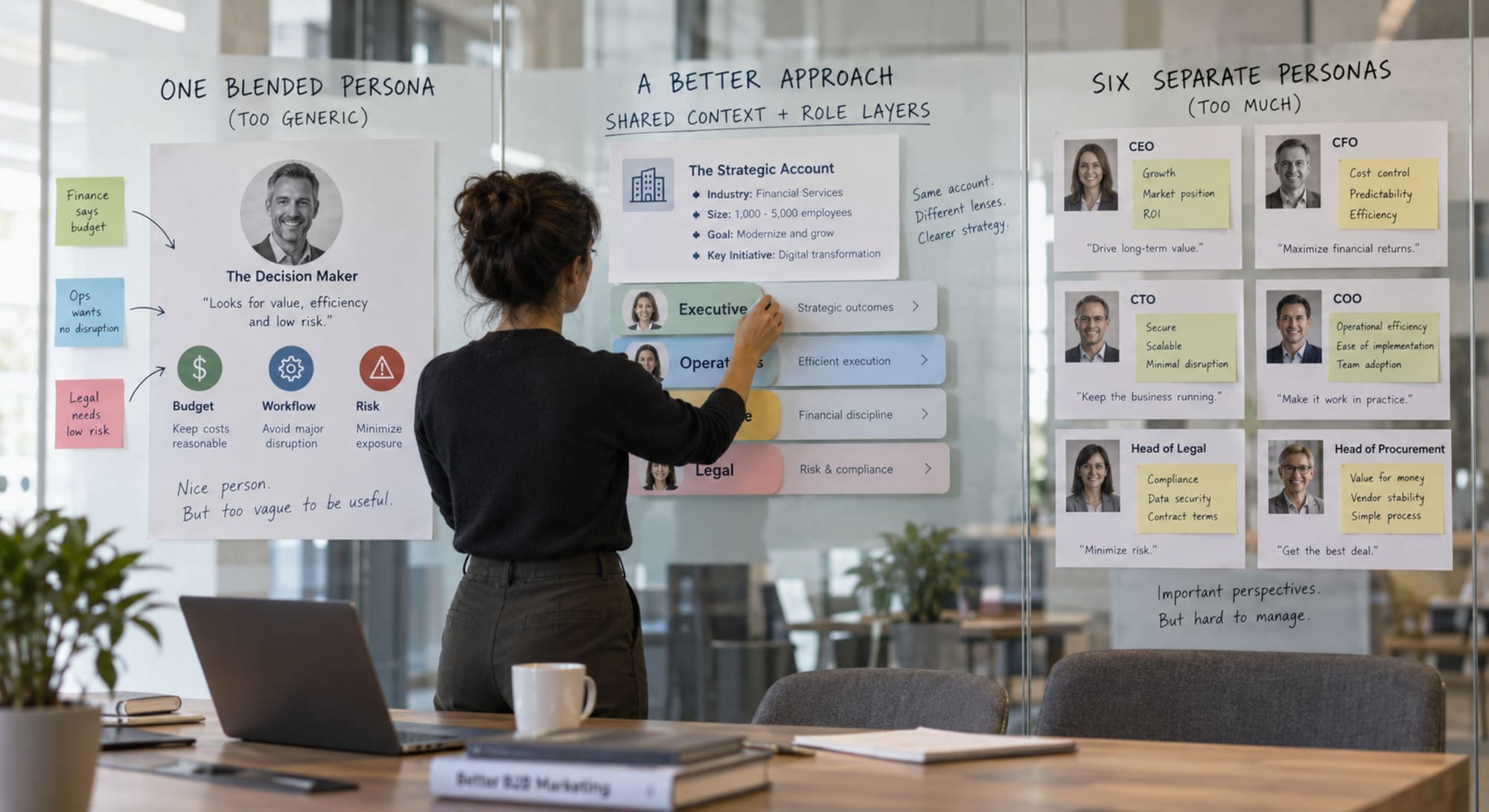
The usual response is one of two failures. Either the team builds a single blended persona – an averaged composite of all six roles that resembles none of them and speaks to no one – or it builds six separate persona documents that sit in a shared drive, disconnected and never used, because nobody can hold six unrelated profiles in their head while writing a single email. The first fails by over-simplifying. The second fails by over-complicating. Both leave the writer with no usable model of who they are writing for.
This article solves that issue with an architecture. Not six documents and not one composite, but a two-layer structure: a shared account-level profile that all six roles have in common, and a set of lightweight role personas that capture only how each Hero diverges from it. It applies the ICP and persona thinking from the strategic foundation chapter to the committee reality, and produces something a writer can actually hold in their head and use.
Why One Persona and Six Personas Both Fail
The single-blended-persona approach fails because averaging destroys the very information that makes a persona useful. The economic buyer fears wasted budget; the end user fears disruption to their day; the risk guardian fears exposure. Average those three fears together and you get a vague "concern about making the right choice" that is true of everyone and useful to no one. A persona's value lives in its specificity – the particular fear, the particular language, the particular definition of success – and averaging is precisely the operation that strips specificity out. The blended persona is smooth, plausible, and inert.
The six-separate-personas approach fails for the opposite reason: it produces more information than anyone can operationalise. Six standalone documents, each with demographics, goals, pain points, and messaging, is a research artefact, not a working tool. The writer drafting a campaign cannot cross-reference six profiles in real time, so they default to writing for the one they remember best – usually the champion – and the other five become expensive shelfware. Completeness that cannot be held in working memory is not completeness. It is paralysis with good documentation.
The architecture problem: One persona loses the differences that matter; six personas produce differences nobody can hold. The answer is neither. It is a structure that separates what the committee shares from what divides it: a common account layer they all inhabit, and thin role layers that capture only the divergence. Build the shared context once, then describe each Hero only by how they differ from it.
The Two-Layer Persona Architecture
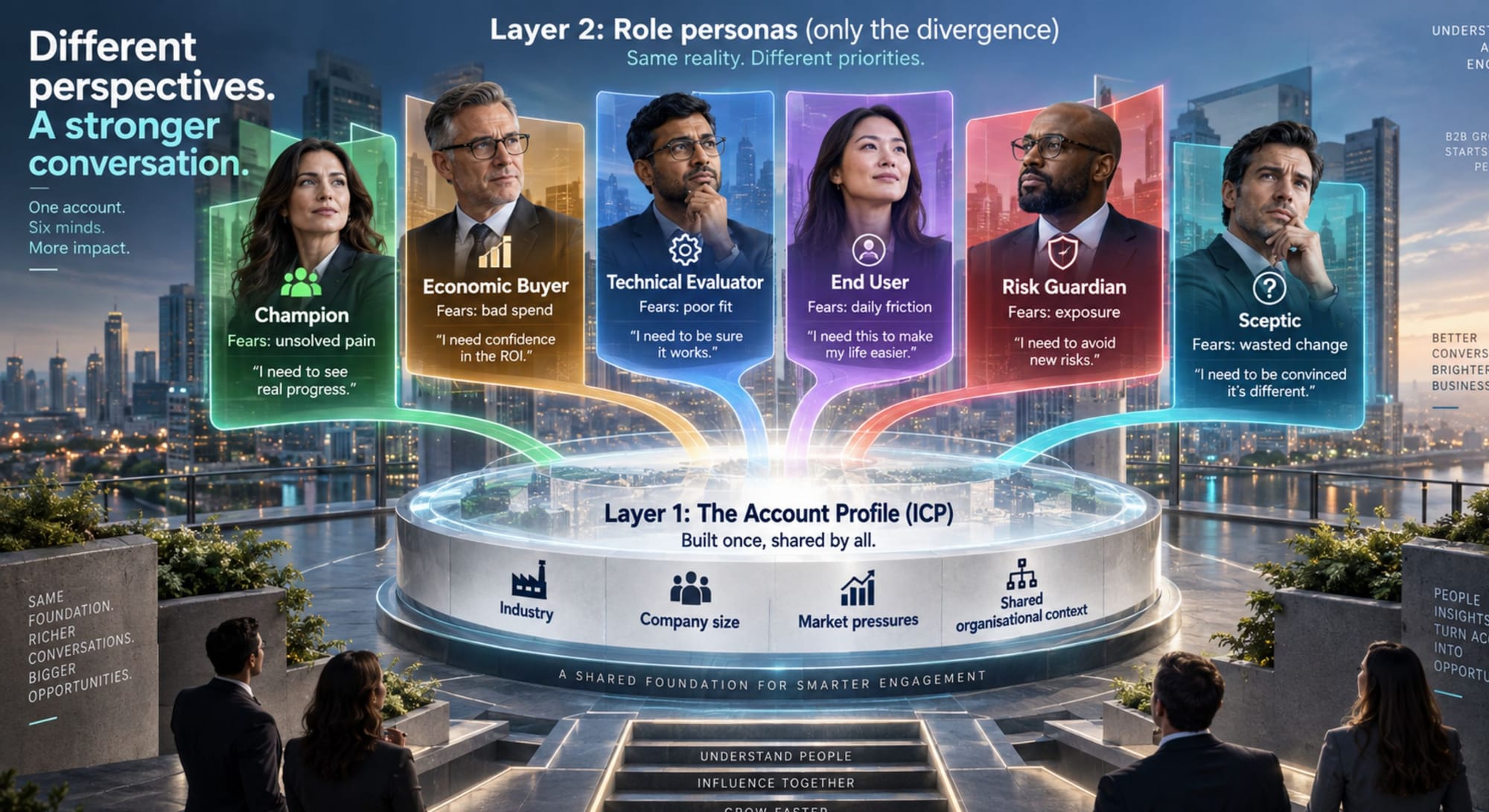
The solution is to stop treating the six roles as six independent personas and start treating them as six variations on one shared account profile. Most of what is true about a buying committee is true of all of them: they work at the same company, face the same market, share the same organisational context. That common ground belongs in one place, built once. What differs (the role, the fear, the success metric, the language) is captured in a thin layer on top. Two layers, not six documents.
Layer 1: Built once, shared by all
The Account Profile (ICP)
Industry · company size · market pressures · shared organisational context· all six roles share this
Layer 2: The role personas (only the divergence)
Champion – Fears: unsolved pain
Economic Buyer– Fears: bad spend
Technical Evaluator – Fears: poor fit
End User – Fears: daily friction
Risk Guardian – Fears: exposure
Sceptic – Fears: wasted change
1 – The Account Profile: The Shared Layer
Built once, for the whole committee
The bottom layer is the account-level profile, essentially your Ideal Customer Profile applied to the specific account type: industry, company size, market pressures, growth stage, the organisational context every committee member shares. This is built once and is true of all six roles simultaneously, because they all work for the same company facing the same situation. It is the ground the whole committee stands on, and getting it right means the six role layers above it can stay thin; they inherit all of this rather than repeating it.
Contains: Firmographics · market and competitive pressures · the organisational problem driving the search · the shared context every committee member operates within
2 – The Role Personas: The Divergence Layer
Thin, one per seat at the table
On top of the shared account profile sit the role personas, but each captures only what makes that role different, not a full standalone profile. Everything shared is inherited from Layer 1; the role persona adds only the divergence: this role's specific fear, its definition of success, the language it uses, the proof it trusts, and the one message it most needs to hear. Because each role persona holds only the differences, it can be a few lines rather than a page, and a writer can actually keep all six in mind at once. The thinness is the point: it is what makes six personas usable instead of paralysing.
Each role persona contains only: The role's core fear · its definition of success · its trusted proof type · its language register · the single message it most needs
Why the architecture works: Separating the shared layer from the divergence layer means you build the hard, research-heavy part (the account context) once, and then describe each Hero in five lines of pure difference. The writer holds one rich account picture plus six thin role overlays, which is cognitively manageable in a way six full personas never are. The structure mirrors the reality: one company, six people who differ only in their seat at the table.
What Goes in a Role Persona and What Doesn't
A traditional persona is a self-contained profile of one buyer: everything about them in a single document. A role persona is different: it is not a whole person, but the thin layer of difference that sets one committee role apart from the others, sitting on top of the shared account profile they all inherit. It describes only what changes the content for that seat at the table, and assumes everything else from the layer below.
The discipline that makes this architecture work is ruthless about what belongs in the thin role layer. The temptation is to rebuild a full persona for each role: demographics, background, a stock photo, a day-in-the-life. Resist it. Everything that is shared lives in the account profile; the role persona carries only what changes the content. Five fields are enough, and more than five is the slide back toward six unusable documents.
Notice what is not on the list: age, tenure, a fictional name, a photo, hobbies, a narrative biography. None of it changes how you write to the person's fear, so none of it belongs in a working persona whose entire job is to guide content. Those details make personas feel richer and work worse, because they pad the profile with information the writer must wade through to reach the five things that actually matter. Strip them out, and the role persona becomes the sharp instrument it was meant to be.
How the Personas Map to Content
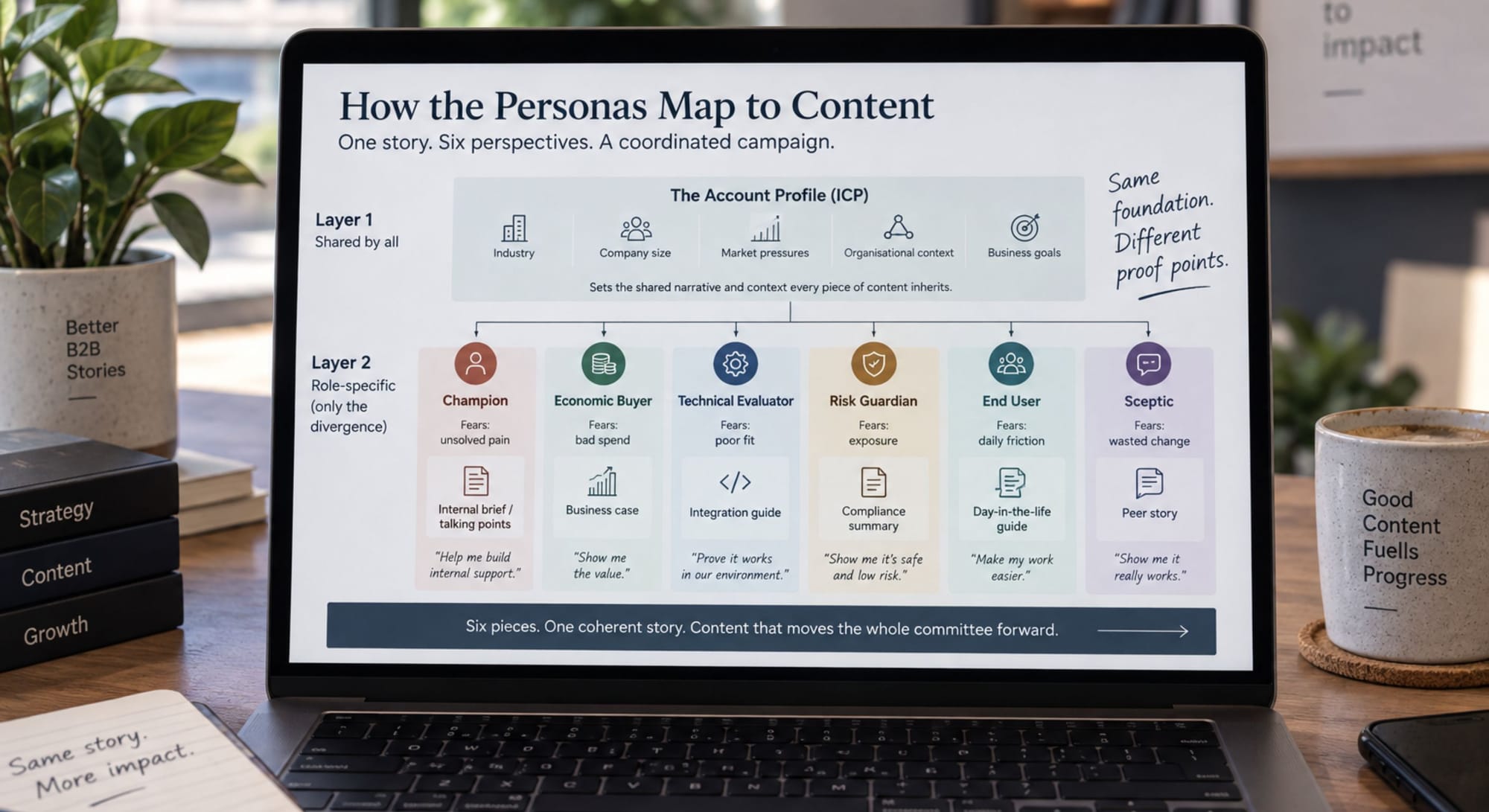
A persona architecture is only worth building if it changes what gets made. The two-layer structure translates directly into a content plan: the account profile sets the shared narrative and context every piece inherits, and each role persona generates the specific pieces that neutralise that role's fear. The result is a content map with two axes: the shared story running through everything, and the role-specific pieces that make sure no seat at the table is left unaddressed.
In practice this means a campaign is not one asset, but a coordinated set. The shared account narrative (the point of view on the problem) runs through all of it, keeping the messages consistent when the committee compares notes. On top of that, each role gets the specific proof it trusts: a business case for the economic buyer, an integration guide for the technical evaluator, a compliance summary for the risk guardian, a day-in-the-life for the end user, a peer story for the sceptic, and ammunition for the champion to carry all of it internally. Same narrative, six proof points, one coherent campaign; exactly what the committee model demands.
The mapping principle: The account profile decides what every piece of content has in common. The role personas decide what specific pieces must additionally exist. Together they answer the two questions a B2B content plan has to answer at once: "what is the one story we are telling, and what are the six fears we must each address inside it?". A plan that answers only the first speaks to a composite nobody is; a plan that answers only the second is six disconnected pitches. You need both axes.
Three Mistakes in Committee Persona Work
Mistake #1: Building the role personas as full standalone profiles
The most common error is treating each of the six roles as a complete persona in its own right: repeating the firmographics, the market context, and the organisational situation in every one. This rebuilds the shared layer six times, bloats each profile into a page nobody reads, and recreates the exact problem the architecture exists to solve. The role persona is a thin overlay, not a standalone document. If the same market-context sentence appears in more than one role persona, it is in the wrong layer, move it down to the account profile and let all six inherit it.
Mistake #2: Inventing divergence that isn't there
The opposite failure is manufacturing differences between roles to justify separate personas: assigning distinct hobbies, personalities, or fabricated backstories to make each feel unique. Real personas differ on the dimensions that change content: fear, success, proof, language, priority. They do not need to differ on personality, and inventing that they do adds noise while implying a precision the profile does not have. If two roles genuinely share a fear and a success definition, they may be one persona for content purposes; do not split them just to reach six. The number of personas is set by genuine divergence, not by the headcount in the room.
Mistake #3: Building personas nobody uses to write
The deepest mistake is building persona documents as a research deliverable rather than a writing tool: polished, comprehensive, filed, and never opened again when the content gets made. A persona that does not sit beside the writer as they draft is decoration. The test of this whole architecture is not whether it is thorough; it is whether a writer producing next week's campaign actually reaches for it and writes differently because of it. Build for the moment of writing, keep the role layers thin enough to hold in mind, or the most rigorous persona work in the world will change nothing about the content.
How to Use GenAI to Build Committee Personas
Building a two-layer committee persona set – the shared account profile plus six thin role overlays – is a structured task GenAI supports well, provided you hold it to the discipline of the architecture. Used carelessly it will happily generate six bloated standalone profiles; directed properly, it produces exactly the thin, usable layers the writer needs.
Use this GenAI Prompt:
Build a committee persona architecture for my offer.
MY OFFER AND ACCOUNT:
- What I sell and to whom: [Describe]
- Typical customer: industry, company size, market pressures: [Describe]
- The organisational problem that drives this purchase: [Describe]
BUILD IN TWO LAYERS:
LAYER 1: THE ACCOUNT PROFILE (built once, shared by all roles):
Produce a single account-level profile: firmographics, market and competitive pressures, the shared organisational context every committee member operates within. This is inherited by all roles; put everything shared HERE.
LAYER 2: THE ROLE PERSONAS (thin, only the divergence):
For each of the 5-7 committee roles (champion, economic buyer, technical evaluator, end user, risk guardian, sceptic; adjust to my offer), give ONLY these five fields:
- Core fear (specific to this role and this purchase)
- Success definition (in this role's own currency)
- Trusted proof (the evidence type this role actually believes)
- Language register (the vocabulary this role speaks in)
- The one message (the single thing this role must remember)
Do NOT repeat any shared context from Layer 1. Do NOT add demographics, names, photos, or backstories. If a sentence would apply to more than one role, it belongs in Layer 1, move it there.
THEN:
1. CONTENT MAP: For each role, name the one specific content piece its fear most demands (e.g. business case, integration guide, compliance summary).
2. THE CONSOLIDATION CHECK: If any two roles share the same fear, success, and proof, tell me they can be one persona; do not split to reach a number.
3. THE BLOCKING FEAR: Which single role's fear, left unaddressed, is most likely to stall the deal? Prioritise it.
Rules:
- Keep every role persona to the five fields. Thinness is the requirement, not a limitation.
- Build the shared layer once. Never duplicate it upward.
- Personas exist to guide writing; if a field would not change the content, leave it out.
Validate the architecture against your real accounts and your sales team's experience of who is actually in the room. GenAI can build the shared profile and the thin role overlays quickly and hold the two-layer discipline you direct it to, but it does not know the specific committees in your pipeline, the roles that vary by deal, or which fear really stalled your last one. Use it to draft the structure and keep the role layers disciplined. The knowledge of who truly sits at your buyers' tables, and which of them tends to say no, comes from you and your sales colleagues.
Final Thought
When there are six Heroes in the room, persona work does not mean six times the documents. It means one shared account profile and six thin overlays of difference: an architecture that separates what the committee has in common from what divides it, so a writer can hold the whole room in mind at once. Neither the blended composite nor the six standalone profiles gives you that. Only the two-layer structure does, because it matches the actual shape of a B2B buyer: one company, several people, differing only in their seat at the table and the fear they bring to it.
Get this architecture right and every downstream decision (what content to make, which fear to address next, how to keep the messages consistent across the committee) becomes tractable. Get it wrong and you are back to writing for a composite nobody is, or drowning in profiles nobody opens. The committee is real. Build the persona system that fits it, and keep it thin enough to actually use.
Could a writer on your team hold all six of your buyers in their head at once or have you built personas so heavy they only ever get filed?
Recommended Use Cases:
 Diana Socaciu