The B2B Brand Voice: How to Sound Like a Human Company in an Industry Full of Jargon
Most B2B companies treat jargon as a writing problem and send the team on a plain-language course. Here is how to apply the Brand Manual to B2B, where six readers and a six-month cycle make every inconsistency more expensive.

Follow one buyer through one deal. Over three months, the people on a buying committee hear from your company four times. Your website promises "end-to-end solutions tailored to your operational needs". Your salesperson's email says, "I'll come to your site on Thursday and show your team how it works". Your proposal talks about "value optimisation across the full lifecycle". Your reply to a question about the contract reads as if it were drafted to be used in court. Four documents, four voices, and only one of them sounds like a person the buyer would trust with the budget.
The usual diagnosis is that the team writes badly, which is not accurate. Each writer made a sensible choice in the absence of a rule: when nobody tells you how the company speaks, you borrow the voice of the industry. Jargon is what a company sounds like when its voice is not governed.
Earlier in this series, the Brand Manual turned brand voice from a vibe into a set of rules. This article applies that framework to B2B, where the buyer is a Committee of Heroes and the same company is heard through many more mouths than a consumer brand ever uses.
Why Jargon Is the Safe Choice
Nobody chooses jargon because they love it. They choose it because it cannot be wrong. "Integrated, best-in-class solutions" has never caused a complaint, never been challenged by legal, never embarrassed anyone in a review. It says nothing, so it risks nothing.
Plain language is riskier. "We answer every support request within four hours" is a promise somebody has to keep. To write it, the writer needs to know that the company stands behind it and that this is how the company talks. Without that permission, the careful writer retreats to the phrase everyone else in the industry uses. Multiply that by every writer in every department and you get a market where ten competitors are indistinguishable with the logo covered.
The voice principle: Jargon is not a vocabulary problem. It is what fills the space where a governed voice should be.

Why Inconsistency Costs More in B2B
A consumer brand speaks mostly through marketing, to one person, for a short decision. B2B changes all three conditions, and each change raises the price of sounding like several different companies.
| B2C voice | B2B voice | |
|---|---|---|
| Who speaks | Mostly marketing | Marketing, sales, bid writers, customer service, finance, legal |
| Who listens | One buyer | A committee that compares notes |
| For how long | Minutes to days | Months, then years of contract |
| What a slip costs | One confused customer | A doubt raised in a meeting you are not in |
More speakers. The buyer reads your website once and your salesperson's emails twenty times. Most of the voice a B2B buyer experiences is produced outside the marketing team, by people who have never seen the brand guidelines.
More listeners. Your contact forwards the proposal to the finance director. The people who will use the product see the onboarding guide. Procurement reads the contract. When they meet, they are comparing impressions of what should be one company.
More time. Over a long cycle, the voice is the evidence. A committee cannot test how you will behave as a supplier before signing. It can only judge whether you sound the same in month four as in month one. Inconsistency reads as disorganisation, and nobody signs a multi-year contract with a supplier that seems disorganised.
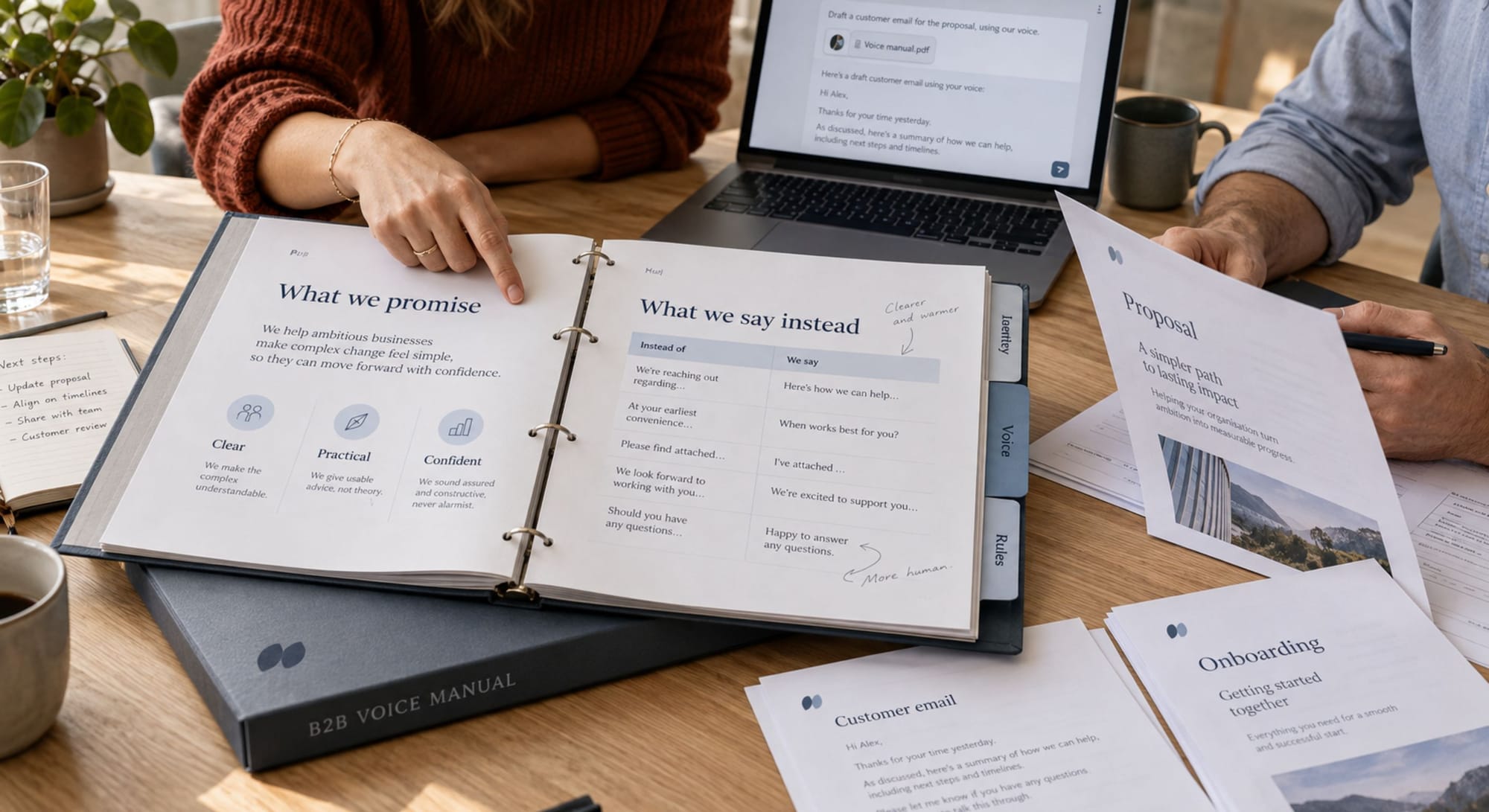
The B2B Voice Manual
The Brand Manual has three layers: Identity Foundation, Verbal Identity and Operational Rules. None of them needs replacing for B2B. Each needs one question answered that a consumer brand can leave alone.
Identity Foundation
"What can a buyer repeat about us to a colleague?"
In B2B your promise travels by retelling. Your Champion has to say it to the Economic Buyer in a corridor, without your slides. "A trusted strategic partner" does not survive that journey. A sentence that names what you do and what the customer can count on does.
Write: A Brand Promise in words a customer would use, and three personality traits, each with one sentence showing what it sounds like in a proposal.
Test: Read the promise aloud to someone in sales. If they would not say it to a customer, rewrite it.
Verbal Identity
"What do we say instead?"
Voice stays constant; tone adapts to the reader. In B2B the tone map is drawn by committee role, not by channel alone. And the Language Rules need a section most consumer manuals skip: the industry phrases you have retired, each paired with what you say in its place.
Write: Voice in three traits with examples. A tone guide per committee role. A Jargon Exchange list of banned phrases and their replacements.
Test: Cover the logo on a page of your copy. Could a customer tell it is yours and not a competitor's?
Operational Rules
"Who else speaks for us, and do they have the manual?"
This is where B2B manuals most often stop short. The rules cover the website and social media, and leave out the documents the committee reads most closely: proposals, tender responses, email templates, contract cover notes, onboarding guides. If GenAI drafts any of these, the manual must be part of what it is given.
Write: A list of every customer-facing document type, who writes it, and who checks its voice. A short version of the manual for sales and customer service. A GenAI Usage Policy that names the manual as required input.
Test: Ask a bid writer where the voice rules are kept. The answer tells you how far the manual reaches.
The Jargon Exchange: Precision Stays, Padding Goes
Sounding human does not mean removing technical language. Every industry has terms its buyers use every week: a service level, a tolerance, a compliance standard. Those are precise words for real things, and replacing them with something friendlier would sound like you do not know the business.
The line runs between precision and padding. A precise term names something the buyer could measure. Padding names nothing and could be deleted without loss. One test separates them: would your buyer say this phrase to a colleague? "Service level" passes. "Value ecosystem" does not.
| The jargon version | What the human version states | |
|---|---|---|
| The offer | End-to-end solutions | What you deliver, named in one sentence |
| The cost case | Value optimisation across the lifecycle | What it costs per month, and what that includes |
| The service | Proactive, world-class support | Who answers, and how fast |
| The relationship | A dedicated partnership approach | A named person the customer can call |
| The contract | Flexible, scalable terms | What the customer can change, and with how much notice |
Notice what the right-hand column has in common. Every line points to a claim someone could check. That is the real work of the exchange: it forces the company to decide what it is prepared to promise. The table shows the shape of each replacement; the specifics have to be the ones your operations team will stand behind.

One Voice, Six Tones
The Buying Committee Persona gave each role its own fears and its own definition of success. Tone follows from that. The voice stays plain, specific and accountable for all six. What changes is emphasis and register.
| Role | What they listen for | Tone that works |
|---|---|---|
| Champion | Arguments they can carry into the room | Practical and collegial. Give them sentences they can reuse. |
| Economic Buyer | The cost, the return and the assumptions | Brief and numerate. Assumptions shown, no adjectives. |
| Technical Evaluator | Proof that it works as described | Exact. Specifications, limits and conditions stated. |
| End User | What changes in their working day | Direct and respectful. What happens on Monday morning. |
| Risk Guardian | Obligations, liabilities and exits | Formal but readable. Obligations in plain sentences. |
| Sceptic | The weak point in your case | Calm and evidenced. Concede what is true, then show proof. |
This is the same discipline as the B2B Creative Brief: several readers, one message. The legal reply from the opening scene does not need to become chatty. It needs to sound like the formal register of the same company whose salesperson offered to come on Thursday.
The manual, in use: A promise the buyer can repeat. A list of what you say instead. A rule that reaches every document the committee reads. Three layers, one company.
Three Mistakes in B2B Brand Voice
Mistake #1: Writing the manual for marketing only
The voice guide lives in the marketing drive, and marketing follows it. Sales, bids and customer service have never opened it, and they produce most of what the committee reads. The result is a polished website and a proposal that sounds like a different firm. A B2B voice manual that does not reach the proposal template has governed the smallest part of the conversation.
Mistake #2: Confusing human with casual
Told to "sound more human", teams add exclamation marks, jokes and a chatty opening line. A finance director approving a six-figure contract does not want a friend. They want clarity. Human, in B2B, means plain words, specific claims and a named person accountable for them. A company can be entirely formal and entirely human in the same sentence.
Mistake #3: Banning words without offering replacements
A list of forbidden phrases feels like progress. But a writer who may not say "solutions" and has not been told what to say instead will reach for "offerings", and the jargon returns under a new name. Every banned phrase needs its replacement beside it, and the replacement is usually a fact the company must first agree to commit to.
How to Use GenAI to Audit Your B2B Voice
Reading forty pages of proposals, emails and web copy against a list of voice rules is slow, repetitive comparison work. It is a fair job to hand to GenAI, provided it works from your manual and only flags. Collect one sample from each department that writes to customers, and run them together.
Use this GenAI prompt:
Audit these samples against our B2B Voice Manual.
OUR VOICE MANUAL:
- Brand Promise, in a customer's words: [Paste]
- Voice traits, each with an example sentence: [Paste]
- Jargon Exchange (phrases we do not use, and what we say instead): [Paste]
- Technical terms our buyers use themselves, which must stay: [List]
THE SAMPLES (label each with its source and intended reader, e.g. "Proposal, for finance director"):
[Paste 4-6 samples from different departments]
DO THIS:
1. FLAG: For each sample, quote every phrase that breaks the manual or that a buyer would not say to a colleague. Do not flag the technical terms listed above.
2. CONSISTENCY: Say whether the samples sound like one company. Name the two that differ most and quote the lines that show it.
3. REWRITE: Offer a rewrite of each flagged phrase in our voice, with the tone suited to the stated reader.
4. MISSING FACTS: Where a plain rewrite needs a specific fact I have not given you (a number, a timeframe, a name), write [FACT NEEDED] and say what it is. Do not supply it yourself.
5. GAPS: List jargon that appears in the samples and is missing from our Jargon Exchange.
Rules:
- Work only from the manual and samples above.
- Never invent a commitment, figure or service level.
- Keep legal and contractual meaning unchanged; flag those passages for human review instead of rewriting them.
Validate the result. Use your own expertise and judgement to make sure the final output is correct. When in doubt, edit the draft using your marketing expert lenses. GenAI's output can vary from one run to the next, and it knows your company only through what you paste in. The variable you control is the manual: the more precise the rules and replacements, the more useful the audit. Every [FACT NEEDED] marker is a question for operations or sales, and no rewrite of a contractual passage goes out without the person who owns the contract reading it.
Final Thought
The industry did not make your company sound like everyone else. However, the absence of a rule did. Wherever the voice is not written down, each person fills the gap with the safest phrase available, and the safest phrase is always the one your competitors are using too.
Take the Brand Manual into the places a B2B buyer listens: the proposal, the tender, the email, the contract note. Write the promise in words a customer would repeat. Pair every retired phrase with what you say instead. Then give the manual to everyone who speaks for you, people and GenAI alike.
If six people on a buying committee compared what they have each read from you, would they describe one company, or the six departments that wrote to them?