USE CASE: How to Use GenAI to Turn “Make It Feel Premium” into a Real Creative Brief
A real-world GenAI marketing use case: how a premium jewelry store stopped handing photographers a vague “make it feel premium” and started writing creative briefs precise enough to get the shot first time, and why the brief, not the shoot, is where most budgets are quietly wasted.
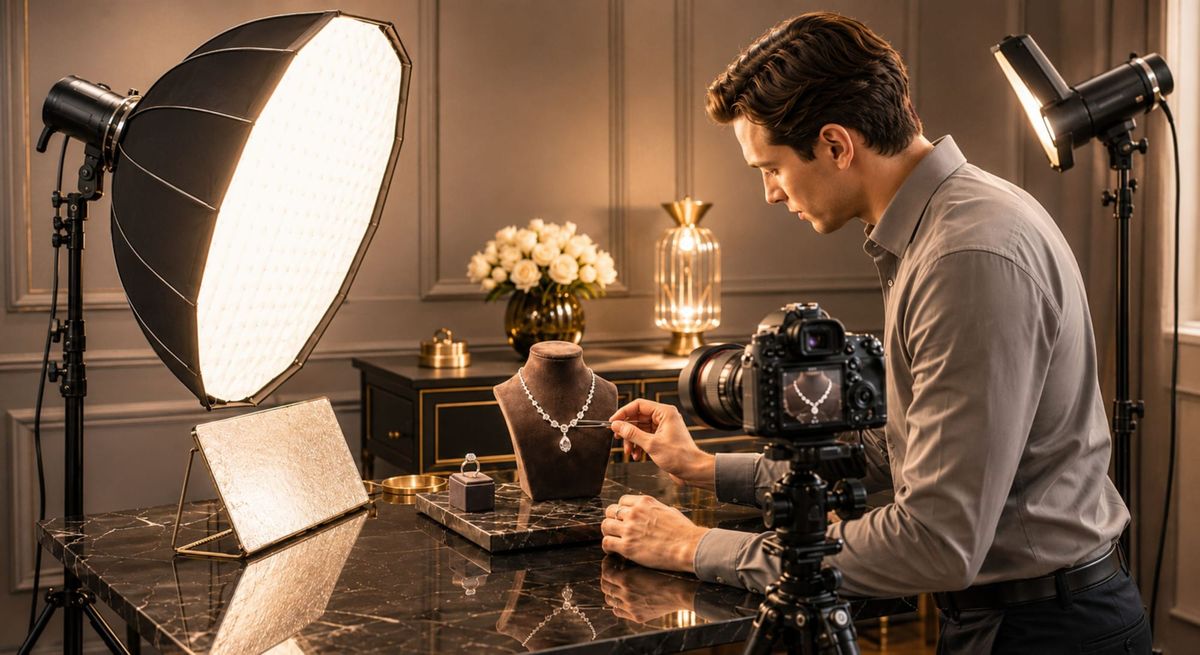
A creative brief is where most marketing money is won or lost before a single photo is taken. This is what writing one with GenAI looks like in practice: how a small, premium jewelry brand turned fuzzy instructions like “make it feel luxurious” into a product-shoot brief a photographer could act on without guessing, and stopped paying for reshoots.
The Context: a Premium Brand Briefed with Adjectives
A premium online jewelry store – branded silver, pearls and crystals – competing on craft and feel, not price. Its shoots and design work were briefed the way most small teams brief: a mood, an adjective, a reference image, and “make it feel premium”. The output came back technically fine and quietly wrong, generic, a little off-brand, hard to tell apart from any mid-market store.
The Challenge: “Make It Feel Premium” Is a Wish, Not a Brief
“Make it feel premium” assumes the photographer shares a definition of premium that lives only in the founder’s head: the exact lighting, the negative space, the styling restraint, the colour temperature that separate a luxury image from a busy one. Handed a wish, a good photographer fills the gap with their own taste and a rushed one fills it with stock conventions; either way the result becomes a negotiation conducted through reshoots. The cost was never bad work; it was rework, and a brand that looked a little less expensive than it actually was.
What a brief is for: A brief’s job is to remove choices, not to inspire them. Every adjective you leave undefined – “premium”, “clean”, “modern”– is a decision you’ve quietly handed to someone who doesn’t share your taste. The skill isn’t describing what you want; it’s specifying it tightly enough that being wrong becomes hard.
The GenAI Workflow: From a Fuzzy Goal to a Precise Creative Brief
The move was to use GenAI as a brief-interrogator before any photographer was booked. Starting from the fuzzy goal – “premium, understated, for a gift-buyer” – GenAI was prompted to convert it into the concrete specifications a shoot actually needs: lighting setup, background and surface, props and styling rules, composition and crop, colour palette and mood references, and an explicit list of clichés to avoid. The founder then edited the draft against the brand – that is where taste still lives – and handed over a brief a photographer could price accurately and shoot once.
You are an art director. I will give you a fuzzy creative goal for a product shoot. Turn it into a precise brief a photographer could execute without coming back with questions.
Goal: [e.g. “premium, understated jewelry shots aimed at gift-buyers”].
Produce specifications, not adjectives, for:
(1) lighting setup
(2) background and surface
(3) props and styling rules
(4) composition and crop
(5) colour palette and mood
(6) a “do NOT” list of clichés to avoid for this category.
Where a choice depends on brand taste I haven’t given you, do not guess — flag it as a DECISION FOR ME and say what you’d need to settle it.
A caveat that decides whether this works: GenAI does not know what your brand’s “premium” looks like; it holds a generic, averaged idea of premium drawn from everything it has seen, and it states it with total confidence. Left unattended, it will hand you a polished brief for someone else’s brand. Its value is as a structured interrogator that forces the fuzzy goal into specifics fast; the taste – the final call on every line – stays with the person who owns the brand.
The Result: A Specification, Not a Wish
The brief stopped being a wish and became a specification. Photographers could quote accurately because nothing was left to interpret, shoots came back on-brand the first time, and the founder’s eye was spent editing a draft rather than re-explaining the same taste on every project. The brand began to look as expensive as it was — not because the photography got better, but because the instruction did. No invented figures here: the change is in the work — fewer reshoots, a consistent look, and a five-person team briefing like a far larger one.
Recommended KPIs to Follow
A creative brief is an operations decision with a commercial tail. These are the metrics to watch – where the industry sits, and the direction tighter briefing should push them. The point is the direction of travel, not a promised number.
First-Time-Right Rate (reshoots avoided)
The share of shoots and design deliverables approved without a redo. A precise brief is the single biggest lever on this: when nothing is left to interpret, far less comes back wrong. This is the metric the brief controls most directly.
Benchmark: No reliable public figure – an internal metric; set your own baseline before the change and track the trend.
Product-Page Conversion Rate
The share of visitors who buy. In a premium category where trust is everything, on-brand imagery that signals quality supports conversion, though it is one of many factors, so read it as a trend, not a single-cause result.
Benchmark: Luxury & jewelry e-commerce converts low by nature – roughly 0.5-1.5%, against a global average of ~2.5-3% (Triple Whale; ConvertCart, 2025–26).
Average Order Value
What each order is worth. Imagery that makes the brand look as premium as it is protects the price positioning, and price positioning is the first thing to slip when a brand photographs like a mid-market store. A supporting metric, not a directly attributable one.
Benchmark: Luxury order values run well above the ~$150–180 global average, often $350+ (Triple Whale, 2025).
Conversion and order value move slowly and for many reasons, the first-time-right rate is the one the brief owns. Track your own trend; the benchmarks are context, not a scoreboard.
Why this Transfers
The quality of your output is capped by the quality of your brief. Whether the work is done by a photographer, a designer or GenAI itself, an undefined adjective is a decision handed to someone else, and the cheapest place to fix expensive work is before it’s made, in the brief.
Recommended articles:
 Diana Socaciu