USE CASE: How to Use GenAI to Build Buyer Personas for a Beauty Salon
A real-world GenAI marketing use case: how a beauty salon turned the booking data it already had into accurate Buyer Personas and real customer segments, and what separates GenAI segmentation that works from the kind that just sounds convincing.
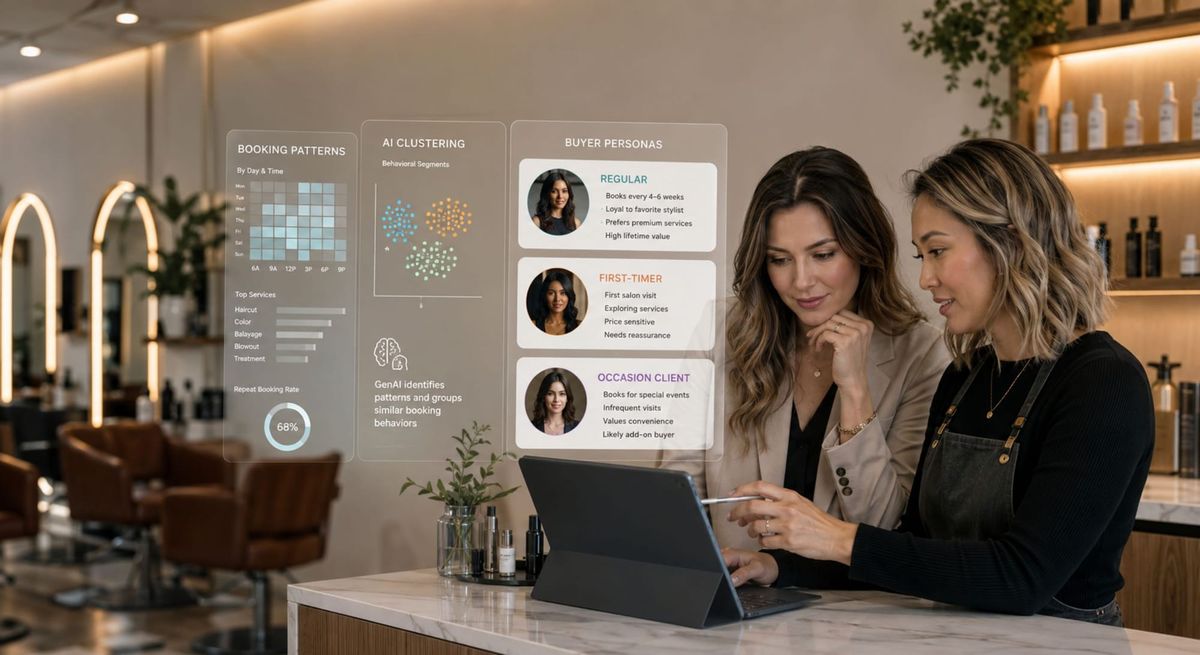
Most writing on customer segmentation stops at the theory. This is what it looks like in practice. A beauty salon used GenAI to turn its booking data into working Buyer Personas, and the part worth your attention is not the prompt, but the judgement calls that decided whether the output was usable or merely plausible.
The Context: a Beauty Salon Marketing to “Everyone”
A beauty salon with ten stylists had a healthy book of business – loyal regulars, a steady flow of first-timers, and the occasional bridal client – but no real customer segments. Every client got the same marketing: the same offers, the same tone, the same posts. A first-timer comparing prices and a regular who returns out of loyalty were sent identical messages, and it moved neither.
The Challenge: Same Message for Different Customers
A first-timer and a five-year regular want opposite things. The first-timer is quietly anxious – will it suit me, is it worth it, will I feel out of place – and needs reassurance before price. The regular wants none of that; she wants to be recognised and rewarded for loyalty. One message can’t carry both: the reassurance patronises the regular, and the loyalty cue is meaningless to someone who has never walked in. The frustrating part was that every distinction the salon needed already existed, captured at every appointment, sitting unread in the booking system.
The part GenAI doesn’t solve: The analysis was never the hard part of segmentation, and GenAI now does it in an afternoon. The hard part is getting a team to accept that these are genuinely different people who deserve different conversations, and then to write differently for each. The personas don’t change anything; the change of habit does.
The GenAI Workflow: Buyer Personas and Empathy Maps from Booking Data
Rather than invent demographics in a workshop, the salon exported anonymised booking patterns (visit frequency, services, average spend, acquisition source and rebooking behaviour), and used GenAI to cluster them into behavioural segments, then draft a Buyer Persona and an Empathy Map for each. The drafts were never the deliverable. They went to the stylists (the people who know these clients by name) who confirmed what was true, killed what was invented, and sharpened the rest.
You are a customer-insight strategist. Below is anonymised booking data from a beauty salon, summarised as behavioural patterns: [paste visit frequency, services booked, average spend, booking lead time, first-visit vs repeat, acquisition source, rebooking rate, typical day/time].
1. Cluster these patterns into 3-4 behavioral segments, not demographic ones.
2. For each, draft a Buyer Persona: the job they are hiring the salon to do, what they value, their single biggest hesitation, and the trigger that brings them in.
3. For each, build an Empathy Map: what they think, feel, say, see and fear about booking a salon.
Flag every inference you are NOT confident about, and tell me which data point would confirm or kill it.
That final instruction matters more than it looks: GenAI is non-deterministic by design, its output varies between runs and it will produce plausible-sounding detail with total confidence. The variable you control is not whether it is right first time; it’s the quality of the data you feed it and the rigour of the validation behind it. Skip that step and you get personas that read beautifully and describe no one.
The Result: 3 Customer Segments, 3 Conversations
3 validated Buyer Personas emerged, ones the whole team recognised:
The Regular – recognition and loyalty; rebooks in the chair; responds to “we saved your slot”, never to an introductory offer.
The First-Timer – anxious and comparing; needs reassurance, proof and a low-risk first visit before price.
The Occasion Client – bridal and events; books far ahead, spends more, refers more; an entirely separate track.
The marketing split to match each segment, and quietly the bigger win, the team gained a shared language. “This post is for the First-Timer” became a sentence anyone could say, and it changed what got written. No invented percentages here: the change worth reporting is in the work, not on a dashboard.
Recommended KPIs to Follow
Segmentation is only worth doing if it moves something. These are the metrics to watc, where the industry sits, and the direction this work should push them. The point is the direction of travel, not a promised number.
New-Client Retention Rate
The share of first-timers who come back for a second visit. Because segmentation gives The First-Timer their own reassurance-led follow-up, this is the metric that should move first, climbing from below the industry average toward the level retention-focused salons reach.
Benchmark: Industry average around 35%, with roughly 50% the realistic target (Meevo / Salon Today, 2025).
Rebooking Rate
How many clients leave with their next appointment already booked. Persona-aware prompts – recognition for The Regular, a low-risk next step for The First-Timer – lift this steadily rather than overnight.
Benchmark: Around 43% for beauty salons and 52% for hair; top performers exceed 80% (Kitomba).
Average Visit Frequency
Visits per client per year – a simple stand-in for lifetime value. As The Regular is nurtured and occasion clients are re-engaged, expect a gradual upward drift, not a sudden jump.
Benchmark: The average salon client visits about 4.9 times a year (Meevo, 2025).
Your own trend, month to month, matters more than any single benchmark; the benchmark is context, not a scoreboard.
Why This Transfers
Every booking system is a segmentation study you’ve already paid for. The job was never to invent personas in a meeting room; it’s to read the behaviour you already capture. GenAI just turns that from a month’s project into an afternoon’s, on one condition: real data in, real human judgement out.
Recommended Articles:
 Diana Socaciu