USE CASE: How to Use GenAI to Build a Hero’s-Journey Funnel from Blog Articles and Nurture Emails in a Welness Studio
A real-world GenAI marketing use case: how a wellness practice with no path from awareness to loyalty built one from two concrete things (blog articles on its website and a nurture email sequence and newsletter to its subscribers) with GenAI mapping each to a stage of the client’s transformation.

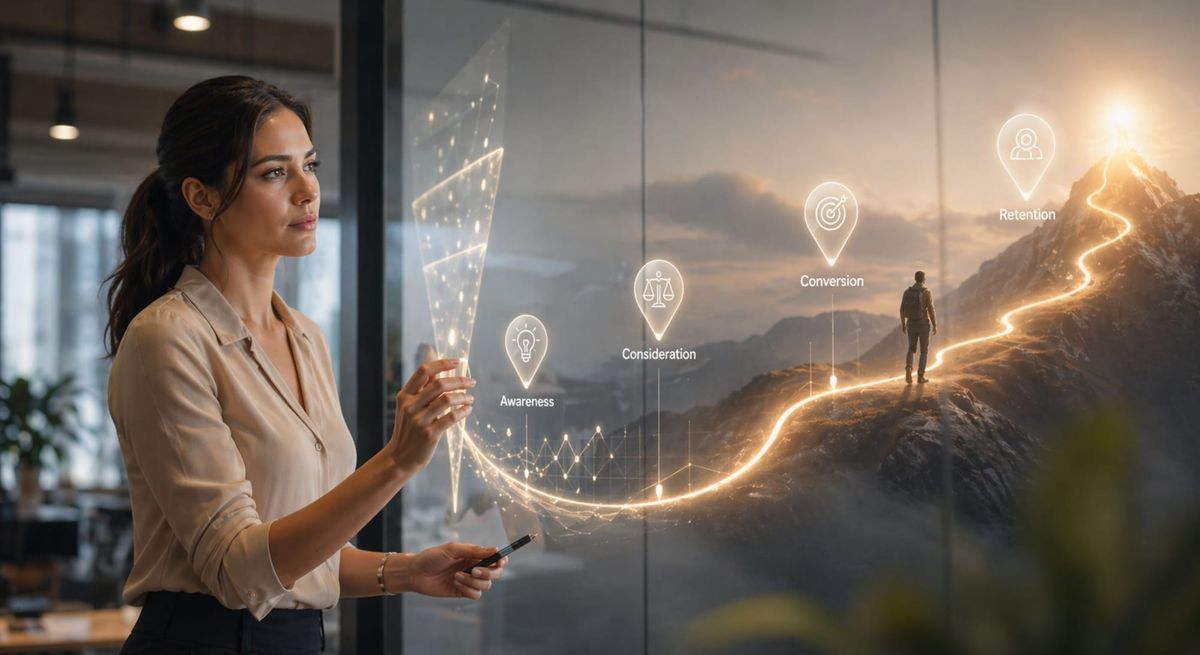
A marketing funnel is really a journey, and a journey needs a road you can actually point to. For this practice that road was built from two things: blog articles that meet a stranger when they’re only beginning to search, and a nurture email sequence and newsletter that walk beside a subscriber the rest of the way. This is how GenAI helped map each to a stage, and lay the road where there wasn’t one.
The Context: a Website that Booked, but Didn’t Carry
A wellness practice (coaching, yoga and mindfulness) with a website that listed classes and took bookings, a handful of blog posts written when someone found the time, and an email list that mostly received the occasional “we have a class spot” message. Plenty of ways to arrive; nothing built to carry someone from first curiosity to belonging.
The Challenge: No Road from Awareness to Loyalty
The booking page served people who had already decided. Everything earlier in the journey was missing. The blog wasn’t answering the questions a stressed, searching person actually types before they’ve heard of you, so the practice was invisible at the awareness stage. And there was no nurture email sequence to catch the people who were curious but not ready; someone might land on the site, feel a flicker of interest, and leave with nothing following them. The deeper issue is what a “funnel” really is for a wellness practice: not a sales mechanism but the client’s own transformation, from stressed-and-searching, to curious, to a first nervous visit, to a regular, to someone who can’t imagine their week without it. No blog article met them at the start of that arc, and no email walked them along it; so the people who felt the first pull simply never found the next step.
A funnel is a journey, not a pipe: A funnel isn’t a pipe people fall through; it’s a journey, and a journey needs a road built piece by piece. Blog articles meet the person who has only just started searching; nurture emails walk beside the one who’s curious but not ready. Skip the road, and everyone who wasn’t ready on day one simply leaves.
The GenAI Workflow: the Journey, Built from Articles and Emails
The practice named the real stages of a client’s transformation (drawn from people they had watched change) and used GenAI to map each stage to a concrete deliverable, then draft it. At awareness, GenAI proposed blog articles built around the questions a searching person genuinely types (“how to quiet a racing mind”, “what a first yoga class is actually like”) – the front door that gets the practice found. At consideration, deeper blog articles built trust – the approach, what to expect – each ending in a quiet invitation to subscribe, turning an anonymous reader into a known subscriber. From there the emails took over: a nurture email sequence that carried a new subscriber from signing up to booking a first session, and an ongoing newsletter that kept regulars close between visits and, in time, invited them to bring someone with them. GenAI drafted the articles and the emails; the practice supplied the emotional truth of each stage – the one thing GenAI couldn’t know.
You are a content strategist for a wellness practice (coaching, yoga, mindfulness). Treat our marketing funnel as the client’s transformation journey (the client is the hero, we are the guide) and build it from two concrete things: blog articles on our website, and a nurture email sequence plus a regular newsletter to our subscribers.
Map the journey in stages, and for EACH stage tell me which deliverable does the work, and draft it:
• Awareness & consideration → blog article topics a searching person would actually look for, then the trust-building reads that follow, and where we invite the reader to subscribe.
• First visit → the nurture email sequence that carries a new subscriber from signing up to booking.
• Regular & loyal → the newsletter that deepens the habit and, gently, invites them to bring others.
Do NOT invent what our clients feel; flag emotional assumptions as VERIFY WITH US. Make no health or outcome promises (no “transform your life”, no cure or result claims). The tone guides, never pressures; these are people who may be struggling. Mark anything you’re assuming as VERIFY WITH US.
The caveat that decides whether this works: Left alone, GenAI writes the wrong version of both deliverables: blog articles stuffed for search engines that answer no real question, and nurture emails that hard-sell a booking. Neither carries anyone. It also doesn’t know what your clients feel at each stage; it will invent plausible feelings and write to those. Two risks matter here especially: this is a vulnerable audience, and GenAI drifts toward outcome promises (“transform your life”) that are both a trust problem and, for anything touching health, a compliance one. The practice is a guide, not a closer; the articles have to genuinely help a searcher, and the emails have to walk beside a subscriber, never push. The controllable variables: the stages and their emotional truth come from real clients; every blog article earns its place by answering a real question; every email guides rather than pressures; no claim outruns what’s honest. GenAI drafts the articles and emails; the truth and the care are yours.
The Result: a Road Built from Articles and Emails
A booking page with nothing leading to it became a connected road. The blog turned into the front door (a stressed searcher could now find a genuinely useful article instead of a dead end) and a simple invitation to subscribe turned a share of those readers into subscribers the practice could stay in touch with. The nurture email sequence then carried new subscribers from “I signed up” to “I booked”, and the newsletter kept regulars close and, over time, turned some of them into people who brought a friend. The practice stopped relying on whoever happened to be ready the day they arrived. No invented figures here: the change is that the journey from awareness to loyalty became something the practice built (out of blog articles and nurture emails) rather than something it hoped for.
Recommended KPIs to Follow
With the road built from two real deliverables, the metrics get concrete: how the blog performs, how the emails perform, and whether the two together actually carry people to a booking. Here’s where the industry sits and the direction this work should push it, direction of travel, not a promised number.
Blog Traffic & Reader-To-Subscriber Conversion
The blog’s job is to be found by people searching, then turn enough readers into subscribers you can keep talking to. Watch organic visits to the articles and the share of readers who sign up – that conversion is the hinge between the website and the email journey.
Benchmark: Consistent blogging is tied to far more inbound interest – a much-cited HubSpot figure puts regular blogging at up to ~13× more leads, and a documented content strategy at roughly 3× more leads per dollar (CMI). Reader-to-subscriber conversion has no clean public figure; set your own baseline (a low single-digit % of readers is common).
Nurture Email & Newsletter Engagement
Once someone subscribes, the emails do the carrying – so watch open and click rates on the welcome sequence and the newsletter. Expect the automated sequence to outperform the broadcast newsletter; that’s normal, and a reason to put the important nudges in the sequence.
Benchmark: Health & fitness email runs roughly a 30-48% open rate and a ~1.5-1.9% click rate (methods vary a lot since privacy changes) — MailerLite; Flowium. Automated nurture flows beat one-off broadcasts — around 3× the click rate of campaigns (Klaviyo, 2026). Worth knowing: wellness lists also see some of the highest unsubscribe rates, so relevance matters.
Subscriber-To-Booking (the road’s real test)
The number that matters: subscribers who become first-time bookers, then regulars. This is where the blog-plus-email road proves it carries people, not just informs them. Slow and multi-causal, so read it as a trend.
Benchmark: Much-cited B2B research on connected paths: organisations that excel at nurturing generate ~50% more sales-ready leads at ~33% lower cost (Forrester) and nurtured contacts make ~47% larger purchases (Annuitas) (Salesgenie); automated email flows also drive far higher order rates than broadcasts (Klaviyo). B2B-origin gives only a direction, not a promise.
Treat the email and nurturing figures as direction, they swing with industry and method, and the nurturing ones come from B2B. The real measure is your own road: blog readers becoming subscribers, subscribers becoming bookers, stage by stage.
Why this Transfers
Any business that wins only the people ready to buy the day they arrive is leaving most of its future on the table. The transferable move is to build the journey out of things you can actually publish and send (blog articles that meet people at the start, nurture emails that walk beside them after), so that being “not ready yet” becomes a stage you serve, not a customer you lose.
Recommended Articles:
 Diana Socaciu