Thought Leadership as Demand Driver: The B2B Content Framework That Builds Pipeline
Most B2B teams file thought leadership under brand and measure it in likes. which never earns a pipeline budget. When buyers decide who makes the shortlist before they ever speak to you, thought leadership is not the awareness layer on top of demand generation. It is the demand generation.

Picture the quarterly pipeline review. Demand generation presents the paid programme: cost per lead, MQL volume, conversion to opportunity. Then someone asks about the thought-leadership work: the point-of-view articles, the practice lead's LinkedIn series, the conference talk. The answer is a slide of impressions and a handful of comments. It sits under "brand". Nobody asks what it did for pipeline, because nobody expected it to do anything for pipeline.
Now look at the next slide and ask sales how the three largest deals started. More often than the dashboard admits, you hear some version of this: "Their operations director had been following our head of practice for a year. When the project got budget, we were already on the list". The CRM credits the deal to the demo request. The reason there was a demo request at all sits in the brand column, next to the likes.
That is the assumption this article overturns. In B2B, thought leadership is not a brand exercise that runs alongside demand generation. In considered purchases, where buyers do most of their research before they contact a vendor and build the shortlist from firms they already trust, it is the main mechanism by which demand gets created. File it under brand and you under-fund it, measure it with the wrong numbers, and hand it to the wrong people.
In Demand Gen vs Lead Gen we separated creating demand from capturing it. The B2B Hero's Journey and the Buying-Committee Persona showed that you are writing for six people, not one, and The Long Game mapped content across a long sales cycle. This article gives thought leadership its proper place in that system, as the demand engine, and introduces The Expertise-to-Pipeline Framework: four stages that turn what your experts know into conversations your sales team can close.
Why Thought Leadership Gets Filed Under Brand
The filing error is understandable. Thought leadership looks like brand work. It is published content, there is no form in front of it, and its first visible effect is recognition. Its commercial effect arrives months later, through a sales conversation the CRM credits to the last touch. So the people who own the budget see a cost with no line to revenue, and the people who own the content defend it with reach.
The same programme can be run in two very different ways, and the difference shows up in every decision about it:
| Run as a brand exercise | Run as a demand driver | |
|---|---|---|
| Purpose | ✕ Be visible in the category | ✓ Change how target buyers define their problem, so your approach becomes the obvious answer |
| Author | ✕ The company page, or a ghostwritten executive voice | ✓ The experts who do the work, with their real judgement on the page |
| Topic source | ✕ The trend of the month | ✓ The questions buyers ask in real sales conversations |
| Audience | ✕ "The market" | ✓ Named roles inside target accounts |
| Measured by | ✕ Impressions, likes, followers | ✓ Influence on opportunities: who engaged, which deals, how fast |
| Budget line | ✕ Brand, first to be cut | ✓ Demand generation, defended with pipeline evidence |
The Shortlist Principle: In B2B, you do not win the deal in the sales cycle. You win the right to be in it, and that right is earned long before the buyer fills in a form.
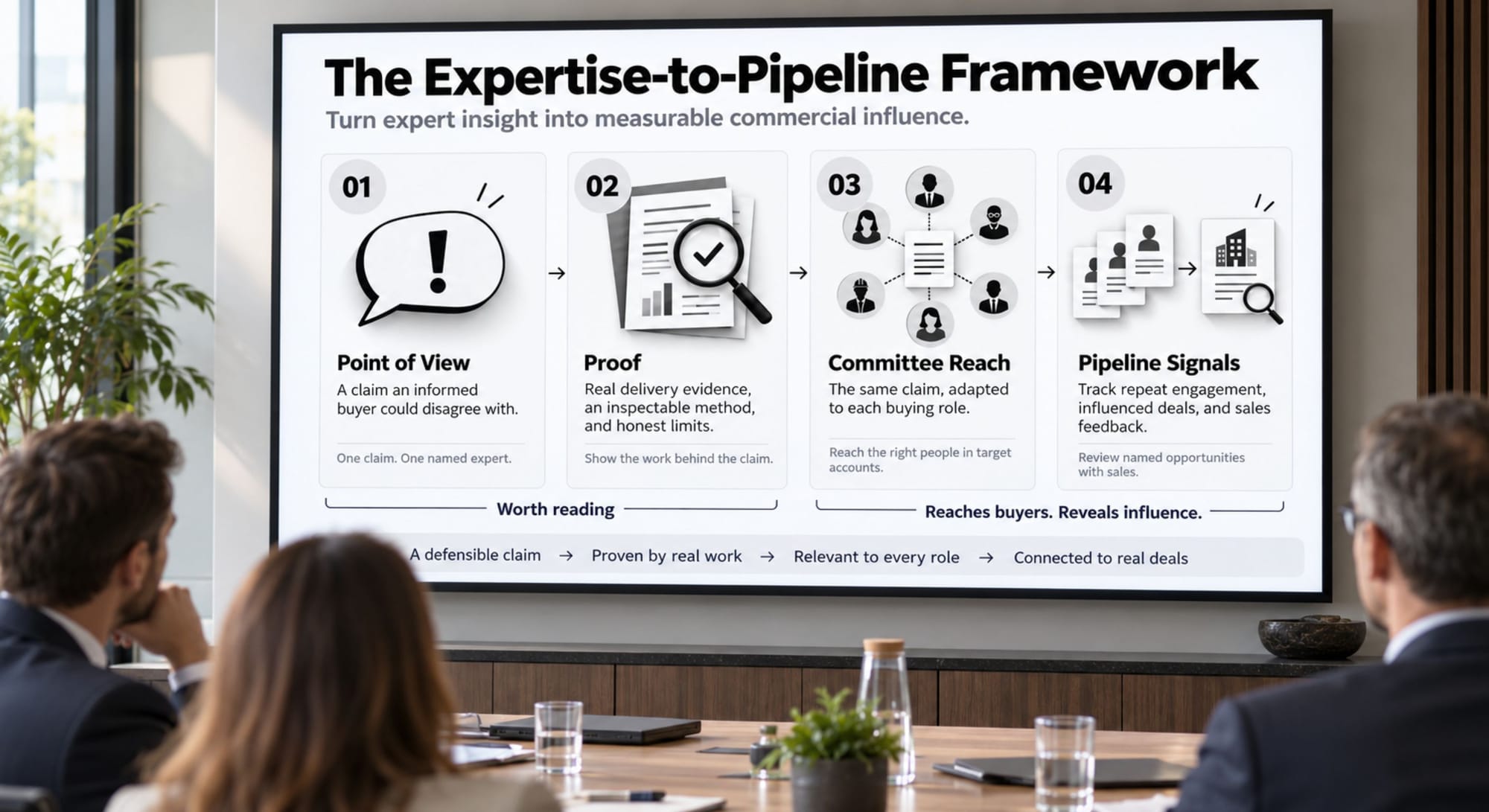
The Expertise-to-Pipeline Framework
If thought leadership is a demand mechanism, build it like one: a sequence with an input, a conversion logic and a measurement point. The framework has four stages. The first two decide whether the content is worth reading. The last two decide whether it reaches the people who buy, and whether you can see it working.
1. Point of View
The claim someone could disagree with
Thought leadership starts with a position, not a topic. "Five trends in supply chain" is a topic. "Most visibility projects fail because they start with the dashboard instead of the decision" is a point of view. The test is simple: could an informed buyer reasonably disagree? If not, it is commentary, and commentary does not move anyone's shortlist. The strongest points of view come from patterns your experts see across dozens of engagements, which no competitor and no generic research report can see.
In practice: one core claim per quarter, owned by a named expert, written as a single sentence before any content is produced.
2. Proof
Why anyone should believe it
A point of view without proof is an opinion, and B2B buyers are paid to be sceptical of opinions. Proof is evidence from real delivery: the anonymised pattern across client work, the before and after of a method, the failure mode your team has fixed more than once. This is where most corporate thought leadership collapses, because the proof lives in the heads of the people who did the work, not in the marketing team.
Contains: a real example, a method the reader can inspect, and an honest limit ("this does not apply when…").
3. Committee Reach
Who needs to hear it
One point of view, argued differently for each role in the buying committee. The operations lead needs to see the risk it removes, the finance lead the cost of the status quo, the technical evaluator the method, the executive sponsor the strategic consequence. The claim stays the same; the proof and the language change. This is the committee logic from the B2B Hero Committee applied to thought leadership. You are not trying to reach more people. You are trying to reach the right six people inside the accounts that matter.
The format: one flagship piece, then role-specific derivatives distributed where each role actually reads.
4. Pipeline Signals
How you know it is working
Stop measuring what the audience did to the content and start measuring what the content did to the pipeline. Which target accounts engaged more than once? Which opportunities include contacts who read the flagship piece? Which prospects quote your point of view back to your sales team? How does deal velocity compare for accounts that engaged against those that did not? None of these is perfect attribution. Together they give an honest read of influence, which is what this article argued attribution should be.
In practice: a monthly review with sales that lists the named deals where the content played a role, not a dashboard of reach.
The framework in one idea: a defensible claim, proven by real work, argued for every role in the committee, and measured by its influence on named deals. Drop any one stage and thought leadership slides back into brand.

Where the Real Constraint Sits
Most teams that try this discover the bottleneck is neither distribution nor budget. It is supply. The points of view and the proof sit with senior practitioners: the specialist who has fixed the same failure mode fifteen times, the consultant who can tell in week two which projects will overrun, the account lead who knows what buyers are actually afraid of. These people have the authority. They rarely have the time, or the appetite, to write.
So marketing does what it can and writes around them. The result is fluent, on-brand and empty, because the thing that made the expert worth listening to, their specific judgement, never reached the page. The answer is not to turn experts into writers. It is to change the job. The expert supplies the thinking in the form that costs them least, usually a conversation, and marketing turns it into content. That is an extraction problem, and it is where GenAI genuinely earns its place in this framework.
Three Mistakes That Keep Thought Leadership in the Brand Column
Mistake #1: Measuring It With Reach
Impressions and likes are the easiest numbers to report and the least connected to revenue. A post that delights fellow practitioners can be invisible to the three executives who approve budget in your target accounts. When reach is the metric, content drifts toward whatever the platform rewards, which is rarely what a buying committee needs. The over-correction does as much damage: gating every piece behind a form to prove its worth. That turns the demand engine back into a lead-capture tool and shrinks the audience to the few people ready to hand over an email address.
Mistake #2: Commentary Instead of a Claim
The trend round-up, the conference recap, the "five things we learned" post. Each is easy to produce and easy to agree with, which is exactly the problem. Nobody changes a shortlist because a vendor agreed with the consensus. If your content could carry a competitor's logo without anyone noticing, it is not thought leadership. It is category noise with your name on it.
Mistake #3: Writing Around the Expert
The ghostwritten executive post that sounds like every other executive post. The white paper assembled from secondary research because the practice lead never had a free hour. Buyers notice. Senior buyers meet senior practitioners during the sale, and when the voice in the content does not match the judgement in the room, trust drops. Borrowed authority reads as borrowed.
How to Use GenAI to Turn Expert Conversations Into a Point of View
Here GenAI helps with the supply constraint, not with the thinking. Record a thirty-minute conversation with one of your experts about a problem they solve again and again, and transcribe it. Then use GenAI as a structuring partner: to find the claim buried in the conversation, separate proof from opinion, and map one point of view to the roles in your buying committee. The expert still owns the thinking. GenAI shortens the distance between what they said and a draft they will put their name to.
Use this GenAI Prompt:
INPUTS
[Transcript: paste the full transcript of a conversation with one internal expert]
[Buying committee: list the roles in your typical buying committee and what each one cares about]
[Target accounts: describe the type of organisation you want to reach]
TASKS
1. Point of View: Identify up to three claims in the transcript that an informed buyer could disagree with. Write each as one sentence and quote the passage it comes from.
2. Proof: For each claim, list the evidence the expert gave: examples, patterns, methods, limits. Mark any claim without evidence in the transcript as "needs proof".
3. Committee Reach: For the strongest claim, write one opening angle per committee role: what this role should take from it, in their own language.
4. Pipeline Signals: Suggest three signals our sales team could watch for that would show this point of view is influencing target accounts.
RULES
- Use only what is in the transcript. Where something is missing, say so and write the follow-up question to ask the expert.
- One claim per piece. Never merge several claims into a list.
- Keep the expert's own phrasing wherever it is sharper than yours.
- No trend language and no generic industry statistics.
OUTPUT
A one-page brief: the chosen claim, its proof, the role-by-role angles, the signals, and the follow-up questions for the expert.
Validate the audit against what you know about your buyers and your market. GenAI is good at finding structure in a rambling conversation and at producing role-specific variations quickly. What it does not know is whether the claim holds across your client base, whether it is sharp enough to separate you from competitors, or whether the proof would survive a sceptical buyer's questions. Take the brief back to the expert before anything is written in full. Their judgement on what they actually believe, and yours on what your buyers need to hear, is what makes the result thought leadership rather than content.
Final Thought
Thought leadership has been sitting in the wrong column. As long as it is filed under brand, it will be measured by applause, written by people who were not in the room, and cut first when budgets tighten. In B2B, where the shortlist forms long before the first sales call, it belongs where demand is created: a claim worth arguing, proof from real work, a message for every person who signs off, and a monthly look at the deals it touched.
Pick one expert this month. Record one conversation. Find the one claim in it that a buyer could disagree with, and build from there.
Is your thought leadership built to be admired by the market or to put you on the shortlist of the accounts you actually want?
Recommended Use Cases:
 Diana Socaciu