The Nurture Architecture: How to Build Email Sequences That Move B2B Buyers Forward Without Burning Trust
B2B buyers do not stop reading your nurture because the emails are bad. They stop because every unearned email spends trust that does not refill. Here is the four-component architecture that moves an account forward across a long cycle, and knows when to go quiet.

Open your automation platform and find the sequence your largest open account is sitting in. Not the campaign report: the actual path. It is probably named after the asset someone there downloaded fifteen months ago. It has sent eleven emails, four of which asked for a meeting. The finance director joined a webinar in March, and the sequence does not know. The original contact stopped opening in June, and the sequence sent three more. Somewhere along that path the account decided your company is loud, and it made the decision quietly.
The assumption underneath most B2B nurture is that staying in touch is free, and that a buyer who has not unsubscribed is a buyer who is still listening. Neither holds. Every email you send either earns the right to send the next one or spends it. In a six-to-eighteen-month cycle, trust is the only asset that carries from the first touch to the signed contract, and nurture is the function that spends it fastest, because it runs on a schedule while the buyer runs on a problem.
In Lead Nurturing that Works, I set out four principles for a single sequence that does not feel like a machine. This article is the system around that sequence. The Growth System Architecture named a Demand Layer and a Qualification Layer; nurture is the mechanism that carries an account between them over months, through the stages of the Demand Generation Content Map, to a committee rather than a person. What follows is The Nurture Architecture: four components, one ledger, and a standard for when to stop.
Why a Drip Is Not an Architecture
The drip sequence was designed for a different buyer. A linear run of emails on a timer, built around what a contact downloaded, ending in an ask: for a three-week consumer decision made by one person, that is a reasonable design. For a B2B purchase it has three structural faults, and no copywriting repairs any of them.
It is linear where the buying process loops: committees revisit the problem, lose a sponsor, restart the evaluation. It is addressed to a person when the decision belongs actually to a group, so it can perform well with one champion while the economic buyer has never heard of you. And it is timed by the sender where the pace is set by the buyer's budget cycle and competing priorities. A drip measures itself in opens and clicks, which is why it looks healthy right up to the quarter the account goes silent.
The Trust Ledger principle: every nurture email is a transaction. It either earns the right to the next message, by arriving with something the buyer needed at the moment they needed it, or it spends that right. A sequence that spends faster than it earns ends in silence, however good its open rates look along the way. Design the ledger before you design the emails.
| Decision | Drip thinking ✕ | Architecture thinking ✓ |
|---|---|---|
| The unit being nurtured | A contact, identified by the form they filled in | An account, with the committee roles inside it mapped |
| What organises the sequence | The lead source: the webinar sequence, the guide sequence | The buying stage: where the account is on the Content Map |
| What advances the buyer | Time: day 3, day 7, day 14 | Behaviour: a signal that the committee's question has changed |
| How it ends | With the ask, then a loop back to the start | With a designed exit: to sales, to dormancy, or to stop |
| How success is measured | Opens, clicks, meetings booked | Accounts moved one stage forward with trust intact |
Every row on the right is a structural decision rather than a creative one. That is the reframe: nurture is not a sequence of emails. It is a system of permissions, and the emails are only what the system sends when a permission has been earned.
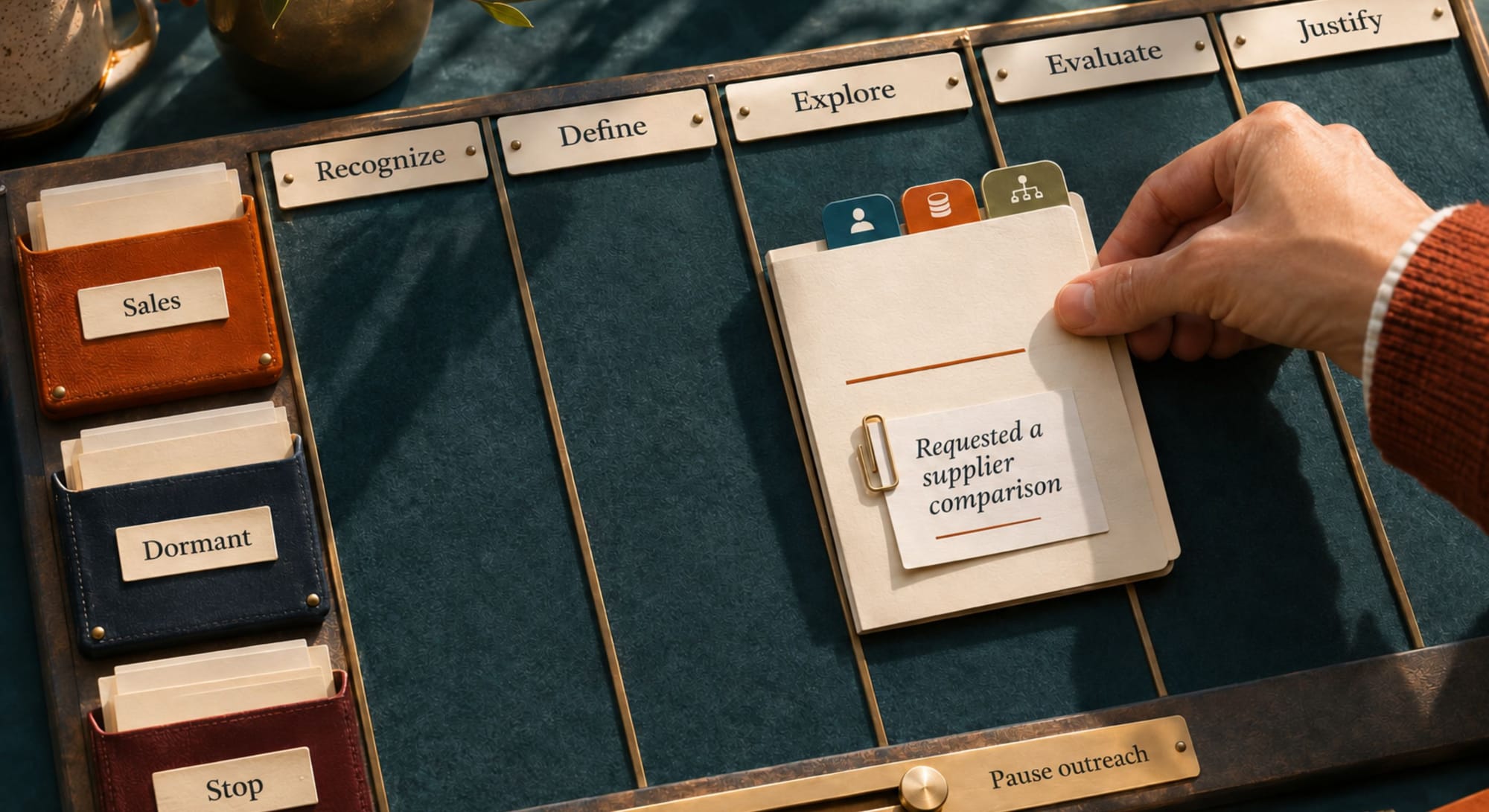
The Nurture Architecture: Four Components
Four components. Two describe the structure an account moves through; two govern how the system behaves while it moves. Build them in this order, because each depends on the one before.
1 – The Stage Tracks: Where the account is
One track for each stage of the buying cycle, not one sequence for each lead source. The Content Map gave you five stages, each defined by the question the committee is asking: is this really a problem, how should we define it, what kinds of solution exist, which supplier, and can we defend this choice internally. A Stage Track exists to answer that stage's question and no other. An account is enrolled by where it is, not by what it downloaded, which means two accounts from the same webinar can legitimately enter two different tracks.
Output: Five tracks, each with a stated question it answers and a short library of content that answers it.
Unit: Accounts in a stage, not contacts in a campaign.
2 – The Movement Rules: What moves the account
A written rule, per track, naming the behaviour that moves an account to the next one. Not an open, not a click on anything, but a signal that the question has changed: an account in Problem Definition that starts reading comparison content has moved; an account in Supplier Evaluation whose procurement lead appears for the first time has moved. The rules run in three directions. Forward, when the signal arrives. Backward, when a sponsor leaves or the evaluation is paused. Sideways, when a new committee role surfaces and needs the earlier stages the champion already passed.
Output: A movement rule for every track boundary, written in plain language sales can read.
Unit: Stage movements per quarter, the only engagement metric that means anything here.
3 – The Trust Rules: How the system behaves
The governance that keeps the ledger in credit. Three rules do most of the work. A give-to-ask ratio, set per track: the early stages ask for nothing at all, and no track asks before it has given something the account engaged with. A cadence ceiling per account, not per contact, because a committee of five receiving separate sequences experiences one company sending five times as much. And the right to silence: when an account's signals stop, the system sends less, not more, and never treats quiet as a problem to be solved with volume.
Output: A one-page set of rules the platform enforces: ratio, ceiling, and what happens at silence.
Unit: Unsubscribes and complaints per account in a track, read as ledger debits.
4 – The Exit Rules: When nurture ends
A nurture system without designed exits has only one: unsubscribe, which is the exit the buyer designs for you. The architecture has three, each with a stated trigger. To sales, when the account meets the qualification definition both teams signed, carrying its full history. To dormancy, when the signals stop for a reason that is not rejection: a budget year, a reorganisation, a parked project. To stop, when the account has told you in behaviour that it is not buying, and the respectful thing is to say so and leave the door open.
Output: Three exits with written triggers, and a return path from dormancy back into a Stage Track.
Unit: Accounts exited by design versus accounts exited by unsubscribe.
The architecture in one idea: the Stage Tracks and Movement Rules make nurture follow the buyer instead of the calendar; the Trust Rules and Exit Rules make it stop before the buyer has to make it stop. A system that does only the first half still burns trust, just more precisely.
The Stage Tracks as a Working Reference
The architecture's spine, laid flat: one row per track, with the question it answers, what it sends, and the signal that moves an account on. Rewrite it in your market's language, with your head of sales in the room.
| Track | The committee's question | What the track sends | What moves the account on |
|---|---|---|---|
| Status Quo | Is this really a problem for us? | Point of view, pattern pieces, no mention of you. Asks nothing. | Repeat engagement with the problem framing; a second role from the account appears |
| Problem Definition | How should we define and size it? | Diagnostic frameworks, cost-of-inaction models, peer language. Asks nothing. | Engagement with sizing or diagnostic content; a question submitted |
| Solution Exploration | What kinds of answer exist? | Category education, approaches compared, honest trade-offs. First light ask: a longer asset. | Reading of comparison content; visits to solution pages; a technical role appears |
| Supplier Evaluation | Which supplier, and why you? | Proof, references, implementation reality, pricing logic. Direct ask: a conversation. | Procurement or finance role appears; pricing or security content engaged |
| Consensus | Can we defend this choice internally? | Business-case material, risk answers, content built for forwarding to the committee. Supports the champion. | Qualification definition met: exit to sales with the account's history |

Nurture the Account, Not the Contact
Here B2B nurture parts company with everything the automation platform assumes. The platform enrols a contact. The deal is made by a committee. The architecture reconciles the two with one rule: the track belongs to the account; the message belongs to the role. An account sits in Supplier Evaluation once; its finance director receives the pricing logic, its technical lead the implementation reality, its champion the material built to be forwarded.
The consequence most teams miss: one engaged champion cannot move an account forward alone. The Movement Rule into Supplier Evaluation requires a second role to appear, because a committee that has not formed is not evaluating suppliers, whatever one enthusiastic reader is doing. Part of nurture's job in the earlier tracks is helping the champion assemble that committee, which is why content built for forwarding is a design requirement, not a nice-to-have.
Three Mistakes That Turn Nurture Into Noise
Mistake #1: Organising sequences by what people downloaded
The webinar sequence, the guide sequence, the event follow-up: each is built around the source, so every account from that source walks the same path regardless of where it stands. An account already in Supplier Evaluation receives three emails explaining that the problem exists, decides you are not paying attention, and the ledger goes into debit. The source tells you how an account found you. Only its behaviour tells you which track it belongs in.
Mistake #2: Reading engagement with the email as movement of the account
Opens and clicks measure the email. Stage movement measures the buyer. A sequence can report strong engagement for two quarters while not one account has changed the question it is asking, and a dashboard built on email metrics will call that success. Report Movement Rules fired, by track, by quarter. If the number is small, you have learned something true that open rates would have hidden for a year.
Mistake #3: Having no exit except unsubscribe
In a long cycle, accounts go quiet for legitimate reasons: the budget year closed, the sponsor changed roles, the project was parked. A system with no dormancy track reads that silence as failure and responds with the one thing that turns a parked buyer into a lost one: more email. Design the quiet. A dormancy track that sends rarely, asks nothing and watches for the return signal keeps the ledger intact for the quarter the project comes back. Unsubscribe is the buyer designing that exit for you.
How to Use GenAI to Map Your Existing Sequences onto the Architecture
Nobody builds this from a blank page; you build it by reorganising sequences that already exist and that nobody has read end to end since they went live. That is where GenAI earns its place. Given every email in your current sequences, with its trigger and timing, it can classify each by the stage question it actually answers, count the gives against the asks, and show where a source-built sequence sends Status Quo content to an account already evaluating suppliers. It does the tedious reading so you can do the design.
Use the prompt below with your real material.
INPUTS
[Every active nurture sequence: the name, its enrolment trigger, and the full text of each email with its send timing]
[The five buying stages your content map uses, with the committee question each stage answers]
[The committee roles for a typical account, and which roles your sequences currently address]
[Your current exit conditions, if any: when an account is passed to sales, paused, or removed]
[A sample of 10-20 accounts: which sequences they entered, what they engaged with, and what happened to them]
TASK
1. Classify every email by the stage question it answers. Flag each email that is enrolled by source rather than by stage, and each sequence that mixes stages.
2. For every sequence, count the gives (content given with nothing requested) against the asks (meetings, demos, forms). Report the ratio per sequence and the position of the first ask.
3. Identify what currently moves an account between sequences. Separate time-based progression from behaviour-based progression. State which sequences have no movement rule at all.
4. Examine the account sample. For each account, state whether it received content for a stage it had already passed, and whether more than one role was addressed.
5. List every way an account currently leaves nurture. State which exits are designed and which are the buyer's own: unsubscribe, silence, complaint.
6. Propose the redesign onto five Stage Tracks: which existing emails move to which track, which are retired, and the three gaps where a track has no content for its question. Recommend the single Trust Rule to enforce first.
RULES
- Classify from the email text provided; do not assume a stage from the sequence name.
- Where inputs are silent, say so and name what is missing rather than inferring intent.
- Never recommend additional emails, higher frequency or a new tool as a first fix.
- Separate what the sequences say they do from what the account sample shows they did.
OUTPUT: a stage-classified inventory of every email, the give-to-ask ratio per sequence, the movement and exit audit, the account-sample findings, and the five-track redesign with the one Trust Rule to enforce first.
Validate the result. GenAI can read forty emails and tell you which stage question each answers, where the first ask falls, and which accounts received content for a stage they had passed, patiently and without loyalty to the sequence somebody on your team is proud of. It does not know that the parked account went quiet because its sponsor was promoted, or which committee role is decisive in your market. The inventory and the proposed tracks are a draft. Which Trust Rule to enforce first, and what you are prepared to stop sending, are decisions for you and your head of sales.
Final Thought
A B2B buyer does not move forward because you emailed them. They move forward when their committee's question changes, and the email that arrives at that moment, answering that question, earns the right to the next. Every other email is spending. The drip never knew the difference, because it measured itself in opens and ran on a calendar. The architecture knows, because it is built on the buyer's stages, moved by the buyer's behaviour, governed by rules that keep the ledger in credit, and ended on purpose.
So stop building sequences and start building tracks. Write the movement rules with sales. Set the cadence ceiling for the account, not the contact. Design the quiet, and design the three exits, so that unsubscribe stops being the only door. The emails will be fewer, and each one will arrive owed rather than imposed.
Is your nurture earning the right to the next email or spending trust you have not yet built?
Recommended Use Cases:
 Diana Socaciu