Lead Nurturing That Works: Building Journeys That Don't Feel Like Automation
Most nurture sequences feel like automation because they are built around the seller's timeline, not the buyer's behaviour. A nurture that works continues the relationship the buyer is already in; responding to what they do, not broadcasting on a schedule. Here is how to build one.

Everyone can recognise a nurture sequence from the inside. You download one resource from a company, and the next morning a suspiciously eager email arrives. Then another two days later. Then another, each a little pushier than the last, all clearly pre-written, all clearly indifferent to anything you have actually done since the download. By email four you know exactly what is happening: you have been dropped into a machine, and the machine will keep firing until you buy or unsubscribe. So you unsubscribe; not because the emails were badly written, but because they made it unmistakable that no one was paying attention.
This is the paradox of most lead nurturing: it is designed to build a relationship and achieves the opposite, because it feels exactly like what it is: automation. Not in the neutral, mechanical sense, but in the sense the recipient feels: impersonal, scheduled, indifferent. The sequence broadcasts on the seller's timeline regardless of what the buyer does, and that indifference is precisely what the buyer detects. The problem is not that nurture is automated since everything at scale is automated. The problem is that most nurture feels automated, and feeling automated is a choice, not a consequence.
This article is about building nurture that does not feel that way. It follows directly from the previous two: the narrative-to-pipeline mechanism that showed story is the demand engine, and the attention-to-revenue arc that mapped the full journey. Nurture is what sustains the relationship across the long middle of that arc: the deepening phase where trust is built over weeks. Done well, it does not feel like a machine. It feels like a brand that is paying attention.

Why Nurture Feels Like Automation
Nurture feels like automation for one root reason: it is built around the seller's timeline instead of the buyer's behaviour. The typical sequence is a fixed series of emails on a fixed schedule (day one, day three, day seven) pushing toward a fixed goal, the demo booking, regardless of what the recipient does in between. Everyone entering the sequence gets the same emails in the same order at the same intervals. The sequence is indifferent to the person by design, because it was built as a broadcast on a timer rather than a response to a human.
The buyer feels this indifference immediately, because human relationships do not work on timers. When you have a real conversation, the other person responds to what you say. When a nurture sequence sends its scheduled email regardless of whether you opened the last three, visited the pricing page twice, or replied with a question, it announces that no one is responding to you: a script is running at you. The recipient does not consciously analyse it, but they feel it: this is not a relationship, it is a conveyor belt, and I am the thing on the belt.
The core principle: Nurture feels like automation when it broadcasts on the seller's schedule and like a relationship when it responds to the buyer's behaviour. The technology is identical; the orientation is opposite. A sequence built around what the buyer does, and paced to how they are actually moving, feels human even though it is automated. A sequence built around the seller's timeline feels mechanical even when the emails are beautifully written. Responsiveness, not prose quality, is what separates the two.
The Four Principles of Human-Feeling Nurture
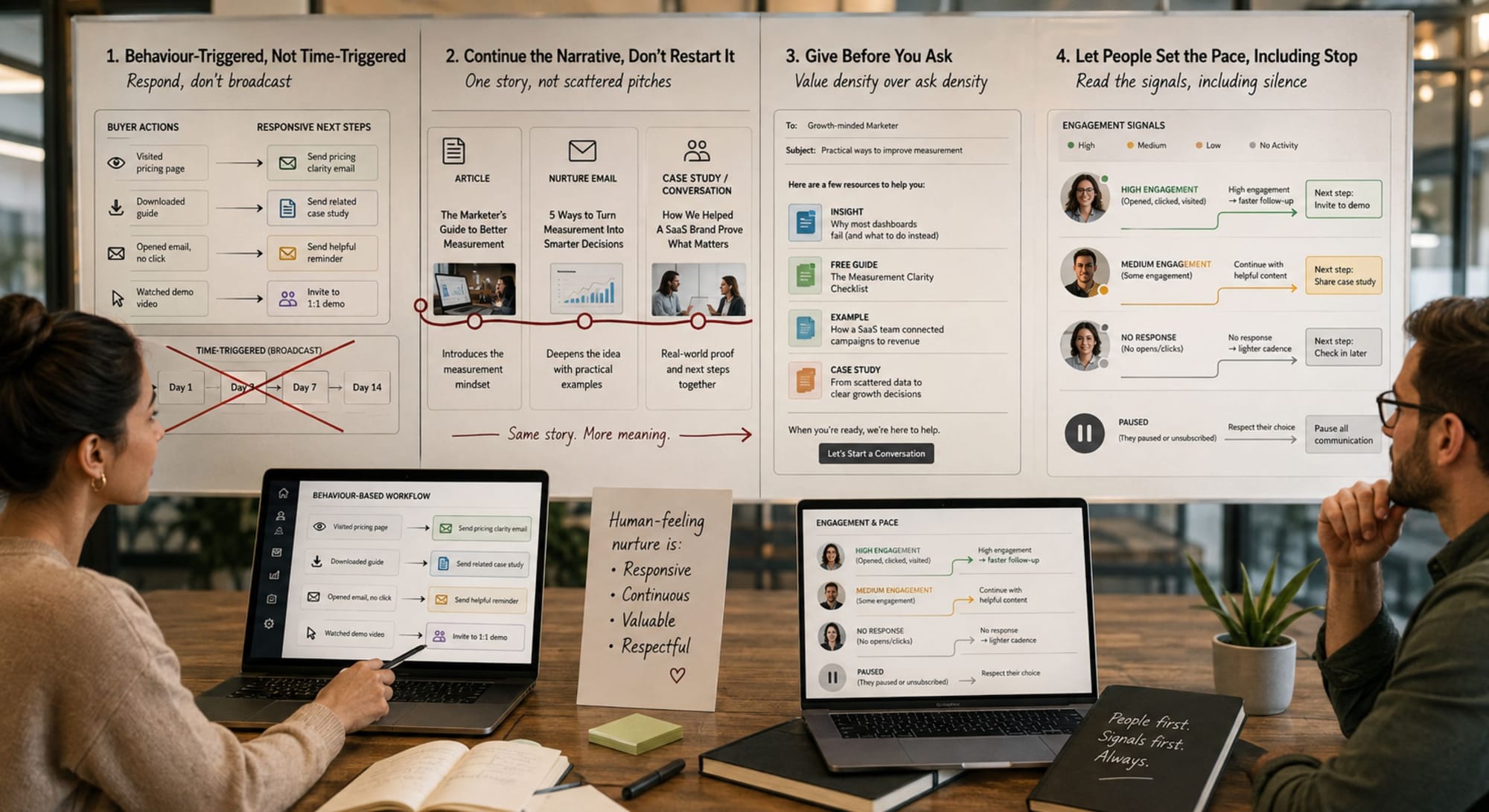
A nurture sequence that feels human is not a matter of warmer copy or a friendlier sign-off. It is a matter of structure, four principles that reorient the sequence away from the seller's timeline and toward the buyer's actual behaviour. Get these right and the copy almost writes itself; get them wrong and no amount of polish will hide the machine.
1. Behaviour-Triggered, Not Time-Triggered
Respond, don't broadcast
The single most important shift is from a time-based sequence to a behaviour-based one. Instead of "send email two on day three", the logic becomes "send this when they do that" when they open the first email and click, when they return to the site, when they view a specific page, when they go quiet.
A behaviour-triggered sequence responds to the person; a time-triggered one ignores them. This one change does more to make nurture feel human than every copy improvement combined, because it is the difference between a brand that reacts to what you did and a script that fires regardless.
In practice: Build the sequence as a set of triggered responses to real actions (visited pricing, opened but did not click, downloaded a second resource) rather than a fixed calendar of sends.
2. Continue the Narrative, Don't Restart It
One story, not scattered pitches
A lead entered your world through a specific narrative, a particular framing of their problem that made them pay attention. Human-feeling nurture continues that story rather than switching to a generic sales pitch. If they came in through a piece on measurement, the nurture deepens the measurement conversation; it does not abruptly pivot to a feature list.
The nurture is the next chapter of the relationship the content already started, not a new and unrelated sales sequence bolted on afterward. Continuity is what makes a sequence feel like one coherent relationship rather than a company talking to itself.
In practice: Map each entry point to a nurture track that extends its narrative. The problem they engaged with is the thread every subsequent email pulls on.
3. Give Before You Ask
Value density over ask density
Most nurture asks too early and too often; every email angling for the demo, the call, the conversion. Human-feeling nurture inverts the ratio: it gives genuine value repeatedly before it asks for anything, so that by the time the ask arrives, it has been earned.
Each email should be worth opening whether or not the reader ever buys: a useful idea, a relevant example, a genuinely helpful resource. The ask, when it comes, lands as a natural next step from someone who has been consistently useful, rather than as the demand it always was underneath the pleasantries.
In practice: Aim for several value-only emails before any ask. If an email contains nothing the reader would value without buying, it is not a nurture email, but rather a sales email wearing one's clothes.
4. Let People Set the Pace, Including Stop
Read the signals, including silence
A human relationship reads the other person's engagement and adjusts; leaning in when there is interest, backing off when there is not. Human-feeling nurture does the same: it accelerates for the engaged and slows, or pauses, for the unresponsive.
Silence is a signal, and a sequence that keeps firing into silence is the clearest possible proof that no one is listening. The willingness to slow down, step back, and let a quiet lead stay quiet is counterintuitive to a team measured on sends, but it is exactly what separates a brand that respects the buyer from a machine that cannot take a hint.
In practice: Build de-escalation paths, not just escalation. A lead who stops engaging should move to a slower, lighter cadence, not receive the same push harder.
The four principles in one line: Respond to behaviour, continue the narrative, give before you ask, and let people set the pace. Notice that none of them is about copywriting. They are all about orientation: building the sequence around the buyer's real behaviour rather than the seller's timeline. That reorientation is what makes automated nurture feel human, because it makes the automation actually pay attention.
Time-Triggered Versus Behaviour-Triggered: The Core Shift
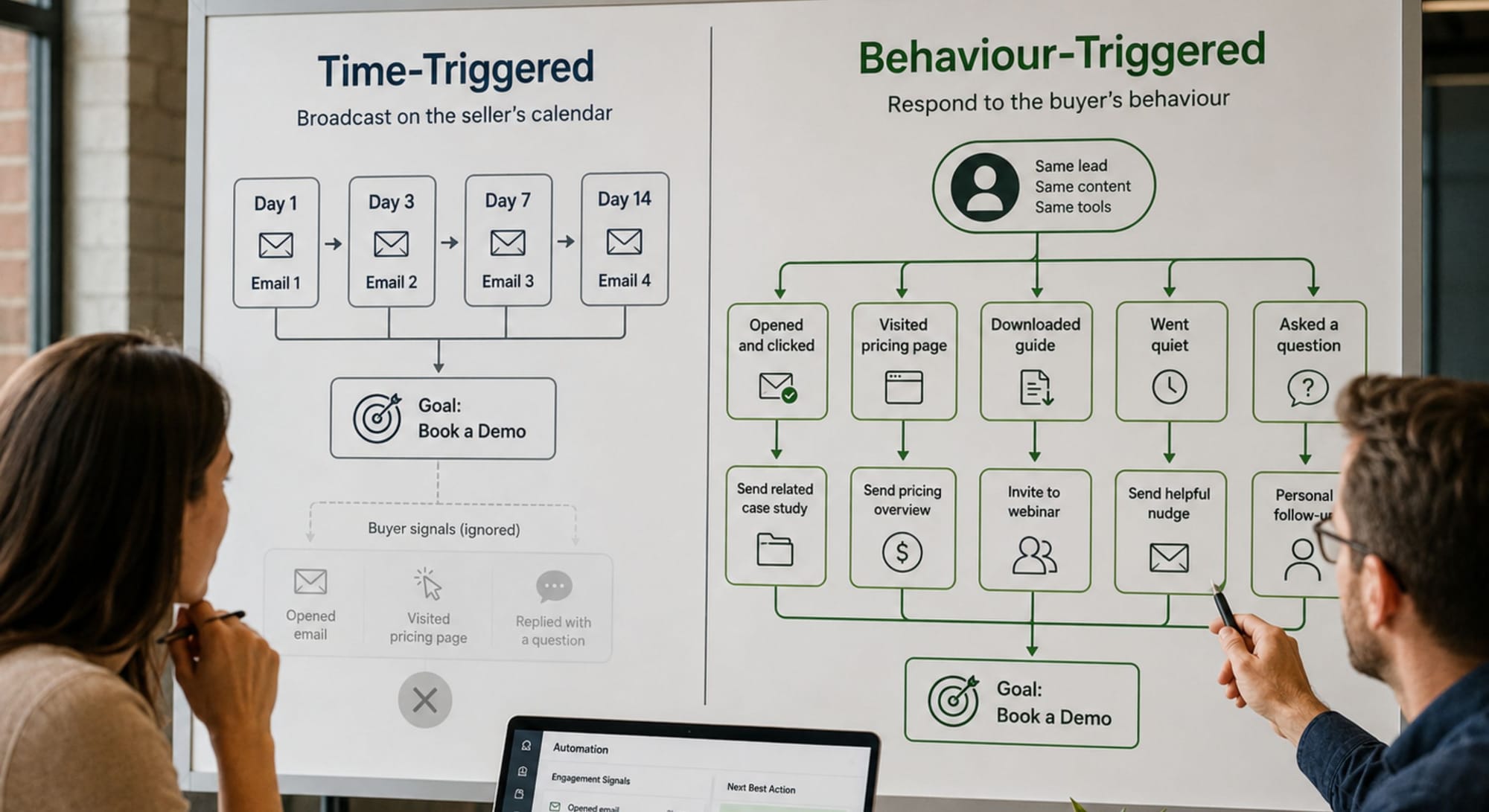
The distinction at the heart of this whole article is worth making concrete, because it is where most nurture goes wrong and where the biggest improvement lives. The same lead, the same content, the same tool d two completely different experiences depending on which logic the sequence runs on.
The right-hand column is not more sophisticated technology: the same automation platform runs both. It is a different design philosophy: build the sequence as a set of responses to the buyer's behaviour, not a broadcast on the seller's calendar. That is the whole shift, and it is available to any team already running email automation. Most simply have not reoriented the logic from time to behaviour.
Three Mistakes That Make Nurture Feel Robotic
Mistake #1: Sending on a schedule regardless of engagement
The defining mistake – the one that produces the conveyor-belt feeling – is sending the next email because the calendar says so, not because the lead did anything to warrant it. A lead who has ignored four emails receives the fifth on schedule; a lead who replied with a specific question receives the same generic day-seven email as everyone else. Both experiences prove the same thing to the recipient: nothing they do changes what they receive. The fix is the first principle (trigger on behaviour, not time) so that what the lead does actually shapes what happens next. If a lead's actions never alter the sequence, it is not nurture. It is a scheduled broadcast.
Mistake #2: Asking for the demo in every email
When every email drives toward the same conversion ask, the sequence reveals that it was never about being useful, it was about extracting a meeting, and the helpful framing was decoration. Buyers feel the relentless ask and read it correctly as impatience. It also wastes the long middle of the buying cycle, where the buyer is not ready to talk to sales but is very willing to keep learning. A sequence that only knows how to ask has nothing to offer the many weeks a B2B buyer spends deciding. Give consistently, ask occasionally, and the occasional ask converts far better than the relentless one ever did.
Mistake #3: Treating silence as a reason to push harder
When a lead goes quiet, the instinct of a team measured on activity is to escalate: more emails, stronger subject lines, a sharper push. This is exactly backward. Silence usually means the timing is wrong, not that the message was too soft, and pushing harder into it confirms to the lead that the brand is interested in its own targets rather than in them. The human response to disengagement is to ease off, not lean in. A lead who stops responding should be moved to a lighter, slower track that stays available without demanding attention, because the buyer who is not ready now may be ready in three months, and the brand that pushed them to unsubscribe will not be there when they are.
How to Use GenAI to Build Behaviour-Based Nurture
Designing a behaviour-triggered nurture (mapping the branches, matching content to entry narratives, writing value-first emails for each path) is more involved than a linear drip, and GenAI is genuinely useful for building it. Not to generate generic sequences, but to help design the branching logic and draft the narrative-continuing emails each path needs.
Use this GenAI prompt:
Help me design a nurture sequence for the following situation.
THE ENTRY POINT:
- How this lead entered (the content / narrative they engaged with): [Describe]
- The problem framing they responded to: [Describe]
- Where they are in the buying cycle (early research / active evaluation / near decision): [Describe]
THE CONTEXT:
- Typical B2B buying cycle length for this offer: [e.g. 3-6 months]
- The genuine value I can offer (resources, insights, examples) beyond a demo: [List]
- The eventual conversion goal: [e.g. book a strategy call]
DESIGN THE SEQUENCE:
1. BEHAVIOUR TRIGGERS, NOT TIME: Map the sequence as responses to actions, not a calendar. For each likely behaviour (clicked, returned to site, viewed pricing, went silent, downloaded a second resource), specify what should happen next. Include the SILENCE path explicitly.
2. NARRATIVE CONTINUITY: Every email must continue the narrative they entered through, not pivot to a generic pitch. State the thread each email pulls on.
3. GIVE-BEFORE-ASK RATIO: Structure the sequence so genuine value comes repeatedly before any ask. Tell me where the first ask belongs and why it is earned by then.
4. THE DE-ESCALATION PATH: Design what happens when a lead disengages; the slower, lighter track, not a harder push.
5. DRAFT THE EMAILS: For the main engaged path, draft each email: value-first, continuing the narrative, human in tone. Short. No false urgency.
Rules:
- Never design a purely time-based drip. If I have given you no behavioural triggers, tell me what to track instead of defaulting to a calendar.
- Every email must be worth opening whether or not the reader ever buys.
- Treat silence as a signal to slow down, never to escalate.
Validate the drafts against your own knowledge of the buyer and your brand voice. GenAI can design the branching logic and draft value-first emails that continue the narrative, but it does not know the specific rhythms of your market, the real reasons your buyers go quiet, or the voice that makes your brand recognisable. Use it to build the behaviour-based structure and the first drafts. The judgment about pacing, tone, and when to let a quiet lead stay quiet are the human calls that make nurture feel human and they remain yours.
Final Thought
Nurture does not feel like automation because it is automated. It feels like automation because it is indifferent, because it broadcasts on the seller's schedule and ignores everything the buyer actually does. The fix is not warmer words or a cleverer subject line. It is a reorientation: build the sequence around the buyer's behaviour, continue the story they entered through, give before you ask, and read the signals, including the silence. Do that, and the same automation that felt like a conveyor belt starts to feel like a brand that is paying attention.
The long middle of the buying cycle – the weeks and months when a B2B buyer is learning but not yet ready to tal – is where nurture either builds the relationship or burns it. A sequence that keeps giving, keeps responding, and knows when to ease off is still there, trusted, when the buyer is finally ready, while the one that pushed them onto a conveyor belt is not. The technology is the same, but the feeling is different.
If a lead did nothing at all, would your nurture sequence notice or would it just keep sending?
Recommended Use Cases:
 Diana Socaciu