The Demand Generation Content Map: What to Publish at Every Stage of the B2B Buying Cycle
Most B2B content plans assign formats to funnel stages. Your buyer does not move through formats. They move through questions. Here is the stage-by-stage map of what to publish, built on the question each stage is trying to answer.

A sales colleague messages you on a Thursday afternoon. An account they have worked for four months has gone quiet. The operations director is convinced, the finance director is not, and the decision is stuck between them. Do you have something they can send?
You open the content library. There are a hundred and forty assets in it, each neatly tagged top, middle or bottom of funnel. Thirty articles on industry trends. A dozen product sheets. Six case studies and two whitepapers. And nothing that helps one director explain to another why this purchase is worth making this year. The library is full, and it is empty exactly where the deal is stuck.
Rather than being a volume problem, this seems a mapping problem. The library was organised by format and funnel stage, which describes your pipeline. The buyer was never moving through your pipeline. They were moving through a sequence of questions, and the content that wins is the content that answers the one they are asking this month. Formats do not move buyers. Answered questions do.
This article builds the map. It takes the distinction between demand generation and lead generation, the Committee of Heroes and the long-cycle content arc from earlier in the series and turns them into one working tool: five stages of the B2B buying cycle and, for each, the question the buyer is asking, the job your content has to do, and what to publish.
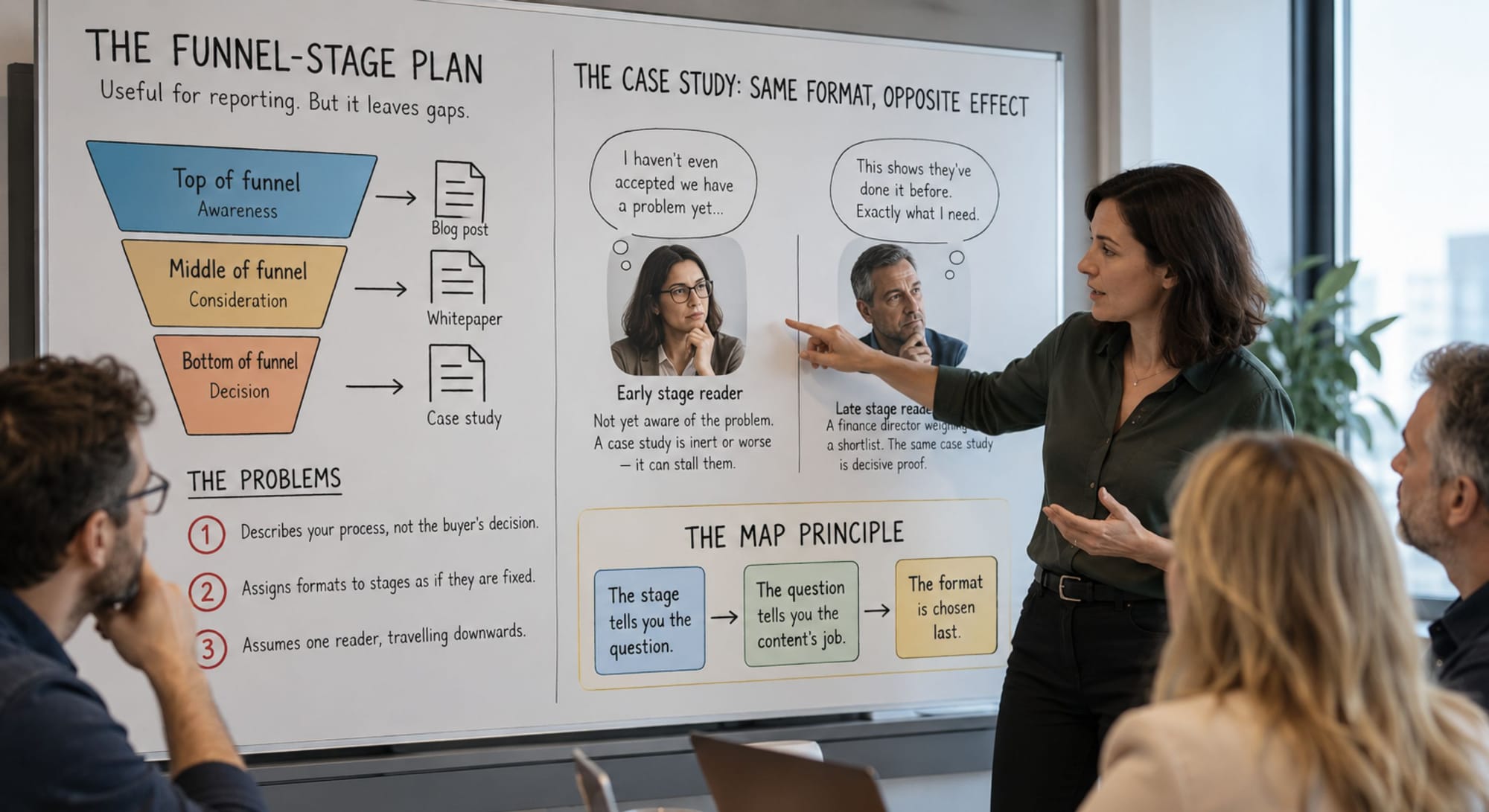
Why the Funnel-Stage Plan Leaves Gaps
The top, middle and bottom of funnel model is not wrong. It answers a real question: where is this lead in our system? For reporting, that is useful. As a publishing guide, it has three weaknesses:
- It describes your process, not the buyer's decision.
- It assigns formats to stages as if a whitepaper were a middle-of-funnel object by nature.
- And it assumes one reader travelling downwards, when a B2B purchase is made by a committee whose members arrive at different moments with different concerns.
Take the case study. Read late, by a finance director weighing a shortlist, it is decisive proof the supplier has done this before. Read early, by someone who has not yet accepted they have a problem, the same case study is inert or worse, it stalls them, answering a question they have not asked. Same format, opposite effect. The format tells you nothing about which job you need done, or whether the buyer is ready for it.
| The Format Map | The Question Map | |
|---|---|---|
| Organised by | Your pipeline stages | The buyer's decision stages |
| Unit of planning | The format: blog, whitepaper, case study | The question the buyer needs answered |
| Reader assumed | One lead moving down a funnel | A committee, with different roles active at each stage |
| Success measure | Leads per asset | Whether the buyer moves on to the next question |
| What a gap sounds like | "We need more content" | "We have nothing for stage five" |
The map principle: The stage tells you the question. The question tells you the content's job. The format is chosen last.

The Demand Generation Content Map
Every model of the B2B buying cycle names its stages a little differently. The names matter less than the questions underneath them. The Demand Generation Content Map uses five stages, each defined by the question the buying committee has to answer before it can move on.
| Stage | The buyer's question | Your content's job | Most active roles |
|---|---|---|---|
| 1. Status Quo | Is this a problem worth my attention? | Make the cost of standing still visible | Future Champion, End User |
| 2. Problem Definition | What exactly is our problem, and how big is it? | Help them name it and size it | Champion |
| 3. Solution Exploration | What are the ways to solve this? | Teach the options honestly | Champion, Technical Evaluator |
| 4. Supplier Evaluation | What should we require, and who meets it? | Shape the requirements and prove fit | Technical Evaluator, End User, Economic Buyer |
| 5. Consensus and Decision | Can we defend this choice to everyone who must agree? | Arm the Champion for a room you will never enter | Economic Buyer, Risk Guardian, Sceptic |
To keep it concrete, follow one example through all five stages: a fleet-leasing provider selling to mid-sized logistics firms.
Stage 1: Status Quo
"Is this a problem worth my attention?"
The buyer is not shopping. They are living with a situation they have stopped noticing. Your content's job is to make the cost of standing still visible, without mentioning what you sell. The fleet-leasing provider does not publish about leasing here. It publishes about what an ageing vehicle costs a logistics firm in missed deliveries.
Publish: Point-of-view articles, cost-of-inaction pieces, benchmark data, short diagnostic posts. Ungated, and distributed where the buyer already spends time.
Moved on when: They start using the problem's name: searching for it, subscribing, coming back.
Stage 2: Problem Definition
"What exactly is our problem, and how big is it?"
The buyer now accepts there is a problem and needs to measure it inside their own organisation. This is where a Champion is born, because whoever sizes the problem usually ends up owning it. Give them the instruments. The fleet-leasing provider offers a way to calculate the true cost per vehicle, maintenance and downtime included.
Publish: Self-assessments, calculators, diagnostic frameworks, "how to tell if" checklists, problem explainers.
Moved on when: The content gets shared internally and a second person from the same account appears.
Stage 3: Solution Exploration
"What are the ways to solve this?"
The buyer is comparing approaches, not suppliers. Owning, leasing and outsourcing the fleet altogether are all on the table. Your job is to teach the options honestly, including the ones you do not sell. The supplier who explains the category fairly is the one trusted to define it.
Publish: Approach comparisons, category guides, expert webinars, "what to expect" explainers, trade-off analyses.
Move on when: Their questions shift from "why" to "how", and they start reading about requirements.
Stage 4: Supplier Evaluation
"What should we require, and who meets it?"
Now the committee builds its shortlist and its criteria. Content here does two jobs: it helps the buyer write good requirements, and it proves you meet them. The Technical Evaluator and the End User read closely at this stage, and they want specifics, not claims.
Publish: Buyer's guides, requirement checklists, questions to ask every supplier, detailed case studies, technical and integration documentation, a plain explanation of how pricing works.
Moved on when: They make direct contact: a demo request, a pricing question, a conversation with sales.
Stage 5: Consensus and Decision
"Can we defend this choice to everyone who must agree?"
This is the stage from the opening scene. The Champion is convinced and now has to carry the case into rooms you will never enter: finance, legal, procurement, the board. Content here is not written for you to send. It is written for the Champion to forward, and for an Economic Buyer, a Risk Guardian and a Sceptic to read without you present.
Publish: A business case template, a return model with its assumptions shown, a one-page executive summary, risk and compliance summaries, an implementation plan, reference customers.
Moved on when: Internal documents are requested and procurement or legal joins the conversation.
Where Demand Is Created and Where It Is Captured
The map has a line running through it. In stages one and two, the buyer is not looking for a supplier. This is demand creation: you are building the belief that the problem deserves solving. In stages three to five, the buyer is actively looking. This is demand capture: you are making sure that when they look, they find you and can verify you.
The two sides run on different rules. Creation content stays open, travels through channels the buyer already uses, and is judged by whether the right accounts read it and return. Capture content can sit behind a form or a conversation, because by now the buyer wants the exchange. Put a form in front of a stage-one article and you are asking for an email address from someone who does not yet believe they have a problem.
Most budget arguments about content are really arguments about this line. The map lets you have them stage by stage, with the right measure for each.

How to Audit Your Library Against the Map
The map earns its place when you lay your existing content over it. Three steps.
- Tag by question, not format. For each asset, ask which of the five questions it answers. If the answer is none, it may still serve the brand or search visibility, but it is not doing demand generation work. Leave it off the map.
- Count by stage and by role. In my experience the pattern is often the same: a crowded stage one of trend articles, a crowded stage four of product sheets and case studies, and thin shelves at two, three and five. Then check the roles. Stage five with nothing for the Economic Buyer is a stuck deal waiting to happen.
- Build into the emptiest stage nearest to revenue. A gap at stage five is costing you deals already in the pipeline. A gap at stage two costs you pipeline next year. Fix the one closest to money first, then work backwards.
The map, in use: Five questions, one row each. Every asset sits against the question it answers. Every empty cell is a place where a buyer is asking and you are silent.
Three Mistakes in Content Mapping
Mistake #1: Publishing the right content at the wrong stage
The most damaging error this map exposes is not a missing asset. It is well-made content delivered to a buyer who is not ready for it. A polished case study sent to someone who has not yet accepted they have a problem does not impress them; it confuses them, because it answers a question they never asked, and it signals you are selling rather than helping. The reverse is just as costly: a broad point-of-view piece handed to a convinced buyer who wants proof reads as evasion. Wrong-stage content does not merely underperform, it actively stalls the buyer, and a stalled buyer rarely tells you why they went quiet. Before you publish, name the question the piece answers and check the buyer is actually asking it. The map's whole purpose is to stop you mapping formats instead of questions; this is the error it exists to catch.
Mistake #2: Measuring every stage with the last stage's metric
If every asset is judged on leads or pipeline, stage-one and stage-two content will always look like it is failing, and it will be the first thing cut. Six months later the later stages run dry, because nobody created the demand they were meant to capture. Give each stage its own signal: the "moved on when" line in the map is the measure.
Mistake #3: Treating the map as a sequence you control
Buyers do not enter at stage one and proceed in order. They arrive at stage three from a colleague's recommendation, loop back to stage two when a new committee member joins, and skip ahead when a budget deadline appears. You cannot march them through it. What you can do is make every piece stand on its own and point clearly to the next question, so that wherever they land, there is a way forward.
How to Use GenAI to Audit Your Content Against the Map
Sorting a hundred and forty assets against five questions and six committee roles is patient classification work, and it is the part of this exercise where GenAI saves you real time. Give it the map's definitions and your inventory, and ask it to show you the gaps.
Use this GenAI prompt:
Audit my content library against a five-stage map.
MY SITUATION:
- What I sell and to whom: [Describe]
- Typical buying committee roles: [e.g. Champion, Economic Buyer, Technical Evaluator, End User, Risk Guardian, Sceptic]
- My content inventory (title, format, one-line description for each asset): [Paste]
THE MAP:
1. STATUS QUO: "Is this a problem worth my attention?"
2. PROBLEM DEFINITION: "What exactly is our problem, and how big is it?"
3. SOLUTION EXPLORATION: "What are the ways to solve this?"
4. SUPPLIER EVALUATION: "What should we require, and who meets it?"
5. CONSENSUS AND DECISION: "Can we defend this choice to everyone who must agree?"
DO THIS:
1. CLASSIFY: Assign each asset to the ONE stage whose question it best answers, and name the committee role it serves. If an asset answers none of the five questions, list it separately as "off the map".
2. COUNT: Show the number of assets per stage and per role in a simple table.
3. GAPS: Name the emptiest stages and the roles with nothing written for them. Prioritise the gap closest to the decision.
4. FILL: For the top three gaps, propose one content piece each: the question it answers, the role it serves, and the format that fits.
5. DOUBTS: Flag every classification you are not confident about and say what you would need to know to settle it.
Rules:
- Classify by the question answered, never by format.
- Do not force an asset onto the map to make the counts look even.
- Work only from the inventory I gave you. Do not assume content I have not listed.
Validate the map against your real pipeline and your sales team's experience. GenAI classifies quickly, its output can vary from one run to the next, and it sees only the titles and descriptions you give it, not how each piece performed or where your last deal stalled. The variables you control are the quality of the inventory you feed it and the stage definitions you hold it to. Use it for the sorting and the first view of the gaps. The decision about which gap to fill first, and what your buyers are really asking at that stage, stays with you and your sales colleagues.
Final Thought
A content library is not a map. However well it is tagged, it stays a pile until every piece in it is attached to a question a buyer is asking. Funnel labels tell you where a lead sits in your system. They do not tell you what that buyer needs to read next, and they never told you why the finance director went quiet.
Build the map from the buyer's side. Name the five questions, lay your content against them, and publish into the empty cells, starting with the one closest to the decision. Choose the format last. A buyer will forgive you an unfashionable format. They will not wait for an answer you never wrote.
If a buyer in your pipeline went quiet tomorrow, would you know which question they are stuck on, or only which funnel stage your system has filed them under?
Recommended Use Cases:
 Diana Socaciu