USE CASE: How to Turn a Seasonal Collection Launch into a Real Campaign with a GenAI Blueprint for a Lingerie Brand
A real-world GenAI marketing use case: how a lingerie brand stopped simply dropping its Spring/Summer and Autumn/Winter collections and started running real campaigns, using a reusable, end-to-end blueprint from brief to measurement that a lean team could refill each season.

A campaign blueprint is what stands between a seasonal launch and a single hopeful post; a reusable structure that carries a launch from brief to measurement. This is what one looks like in practice: how a lingerie brand selling online and in-store turned its two collection launches a year into real campaigns, with a goal at the front and a verdict at the back.
The Context: Two Collections a Year, the Same Launch Every Time
A lingerie and underwear brand selling online and through its stores, with the clean seasonal rhythm the category runs on: a new collection twice a year: Spring/Summer and Autumn/Winter. The collections themselves got real care: the design, the fit, the photography. The launch around them did not; each season’s collection went out the same way, as a drop, and then the next season came round and it happened again.
The Challenge: a Drop Where a Campaign Should Be
Each season a new collection would appear (product shots on the site, a launch post, perhaps an email) and that was the whole “campaign”. What was missing were the two bookends every real campaign has: a brief at the front (what is this launch for — grow online revenue this season? sell through last season’s stock? make a hero piece the season’s signature?) and measurement at the back (did it work?). The brand jumped straight to the drop in the middle, with no goal set and no result read. And because nothing was measured, nothing was learned, so the next season repeated the same un-briefed, unmeasured drop. The launches came round twice a year, every year, each starting from scratch and ending in silence. The problem wasn’t effort, and it certainly wasn’t the collection; it was that a drop was being mistaken for a campaign.
An announcement isn’t a campaign: A collection dropped with a launch post is an announcement. A campaign has two things the announcement skips: a brief that says what it’s for, and measurement that says whether it worked. Skip the bookends and you don’t have a campaign; you have a notification, repeated every season, learning nothing.
The GenAI Workflow: Build the Blueprint Once, Refill it Every Season
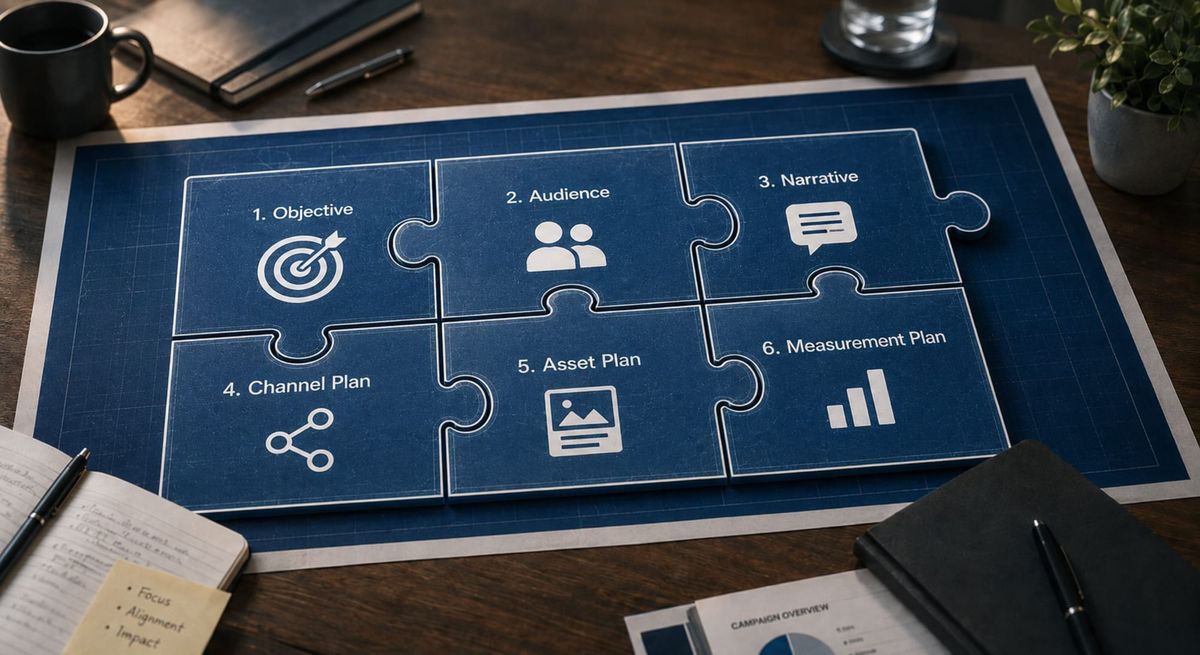
The fix took advantage of the one thing that makes seasonal launches ideal for a blueprint: they recur. Rather than build a campaign from scratch each season, the team built the structure once (a reusable blueprint with the two missing bookends designed in), and refilled it twice a year. At the front, a brief: the team set the goal (grow online revenue, clear through last season, make a hero piece land), and GenAI turned that goal into a structured brief. In the middle, a coordinated plan across both sides of the business, online and in-store, rather than a single drop: channels, timing, the assets each needed. At the back, measurement: what to track for that goal, and an honest read on what could and couldn’t be attributed. GenAI drafted the brief, generated the plan and set up the measurement; the team supplied the one thing that had to be theirs: the goal. Each season refilled the same blueprint, and because the measurement fed the next brief, each launch started smarter than the last.
You are the marketing strategist building a complete, reusable campaign blueprint for a seasonal collection launch at a lingerie brand that sells online and in-store.
Here is this season’s collection and the goal I’ve set: [collection + season (SS/AW) + goal — e.g. grow online revenue / sell through last season’s stock / make a hero piece the season’s signature]. Fill in every part of the blueprint below for THIS season.
BRIEF – the front bookend
• Objective: restate the goal I gave you (do NOT invent a different one) and define what success looks like in one measurable sentence.
• Audience: who this collection is for — split between online and in-store where they differ.
• Core message: the single compelling hook of this collection — its story or theme, why this, why now.
PLAN – the middle
• Channels & roles: which channels carry online vs in-store, and the job each one does.
• Timeline: the arc across the season — tease → launch → sustain → end-of-season / sale — with rough timing for each phase.
• Assets: what to produce for each channel (lookbook & product photography, captions, on-site and email creative, in-store visual merchandising), so nothing is missed.
MEASUREMENT – the back bookend
• Metrics: the two or three numbers tied directly to the objective above — no vanity metrics.
• Honest attribution: say plainly what you can and can’t cleanly attribute (online sales are trackable; in-store sales, the awareness halo, and cross-channel “saw online, bought in-store” are not); don’t manufacture a tidy result.
• Learning capture: the one or two questions to answer once the season is over, written so the answers can feed next season’s brief.
Keep everything specific to this season, not a generic template stamped out. Flag anything you’re assuming, or any field I haven’t given you, as CONFIRM WITH ME.
The caveat that decides whether this works: A blueprint is only as good as the brief at the front of it, and the brief is only as good as the goal you put in; which is the one part GenAI must not supply. Ask it to invent the objective and it will cheerfully optimise a whole campaign toward “raise awareness”, a goal nobody chose and no one can check; the goal has to be yours. The measurement at the back needs the same honesty in the other direction: a brand selling online and in-store cannot cleanly attribute much of what matters (the customer who sees the campaign online and buys in a store, the awareness that lifts the whole season), so the measurement layer must own what it can and can’t know, and resist the urge to manufacture a tidy cross-channel number.
Two smaller cautions. The blueprint is a structure to refill, not a cutter that stamps every season identical; the process repeats, the collection and its story shouldn’t. And measurement only earns its place if it closes the loop: the point of knowing whether this season worked is to brief the next one better. GenAI builds and runs the blueprint; the goal, the honesty about results, and the learning stay human.
The Result: Campaigns that Compound
Seasonal launches stopped being drops and became campaigns. Each one now opened with a brief – a goal the team had actually set – and closed with measurement honest about what it could and couldn’t attribute, instead of opening with a launch post and closing with silence. Because the blueprint was reusable, a lean team could run a real campaign every season without rebuilding it each time; and because measurement fed the next brief, the launches compounded: each Spring/Summer starting from what the last Spring/Summer taught, each Autumn/Winter from the last, rather than from zero. The collection work didn’t change; what changed is that it now sat inside a structure with a goal at the front and a verdict at the back. No invented figures here: the change is that the brand stopped mistaking a drop for a campaign, and started learning from one season to the next.
Recommended KPIs to Follow
A blueprint is judged on whether launches become real campaigns, whether they hit the goal they set, and whether they get better over time. Here’s where the evidence sits and the direction this should push things. The point is the direction of travel, not a promised number.
Launches Run with a Brief and Measurement
The share of seasonal launches that have both bookends (a written goal at the front, a result at the back), rather than going out as a bare drop. It’s the simplest read on whether a launch is now a campaign at all.
Benchmark: Direction, not a promise: self-reported surveys consistently find that marketers who set goals are far more likely to report success, and teams that document a plan outperform ad-hoc ones (CoSchedule). Correlational, but the pattern is strong.
Performance Against the Brief’s Objective
Did the launch move the specific thing the brief set out to move (online revenue, sell-through of the range, the hero piece landing), read honestly against what you can actually attribute? This is the campaign’s own scorecard, not a vanity metric.
Benchmark: Direction, not a promise: organisations that consistently track campaign metrics are reported to be ~2.3× more likely to exceed their revenue goals than those that don’t (aidigital). Measurement is what makes “did it work?” answerable.
Season-Over-Season Improvement
The payoff of the loop: does each launch beat the like-for-like one a year ago (this Spring/Summer against last Spring/Summer), because the previous season’s measurement actually fed this season’s brief? If the line doesn’t bend upward, the loop isn’t closing.
Benchmark: No public figure, an internal metric; compare each launch against the same season last year, and watch whether the learning is compounding.
The first metric says you’re running campaigns; the second says they work; the third says they’re getting better. The external figures are self-reported and correlational; treat them as direction, not proof. Your own season-over-season trend is what matters.
Why this Transfers
Any business with a recurring moment (a seasonal collection, a sale, an annual event) tends to announce it rather than run a campaign around it, because building one from scratch each time is more than a lean team can sustain. The transferable move is to build the campaign once as a blueprint with a brief at the front and measurement at the back, then refill it each cycle, so the thing that recurs gets better instead of just repeating.
Recommended Articles:
 Diana Socaciu